Every year, when the festive season arrives, India begins to glow with devotion, music and celebration. Homes are decorated, temples become vibrant, and in Gujarat, the nights come alive with Garba and Dandiya Raas.
But have you ever wondered why Navratri is celebrated for nine days and nine nights?
The answer begins with the name itself.
Navratri = Nav + Ratri
In Sanskrit, “Nav” means nine and “Ratri” means night. Together, Navratri literally means “nine nights.”
But these nine nights represent much more than a number. In Hindu traditions, Navratri is associated with the worship of Shakti, the Divine Feminine, and different manifestations of Goddess Durga.
The festival traditionally culminates on the tenth day, known as Vijayadashami or Dussehra, which is associated with victory and the triumph of dharma over adharma.
So why nine nights? What is the connection between Goddess Durga and these days? And why does Gujarat celebrate Navratri with such extraordinary energy?
Let’s explore the meaning, traditions and spiritual ideas behind Navratri.
What Does the Word Navratri Actually Mean?
The word Navratri comes from two Sanskrit words:
- Nav – Nine
- Ratri – Night
Together, they form Navratri, meaning nine nights.
The festival is traditionally observed through worship, prayer, fasting, meditation, music and celebration dedicated to Shakti.
Although Navratri is commonly described as a nine-day festival, its name specifically refers to nine nights. Nighttime worship and celebrations have special significance in many traditions associated with Shakti.
The tenth day is not included in the nine nights. Instead, it represents the culmination of the festival and is celebrated as Vijayadashami.
The sequence can therefore be understood simply as:
Nine nights of devotion → Tenth day of victory
Why Are There Nine Nights in Navratri?
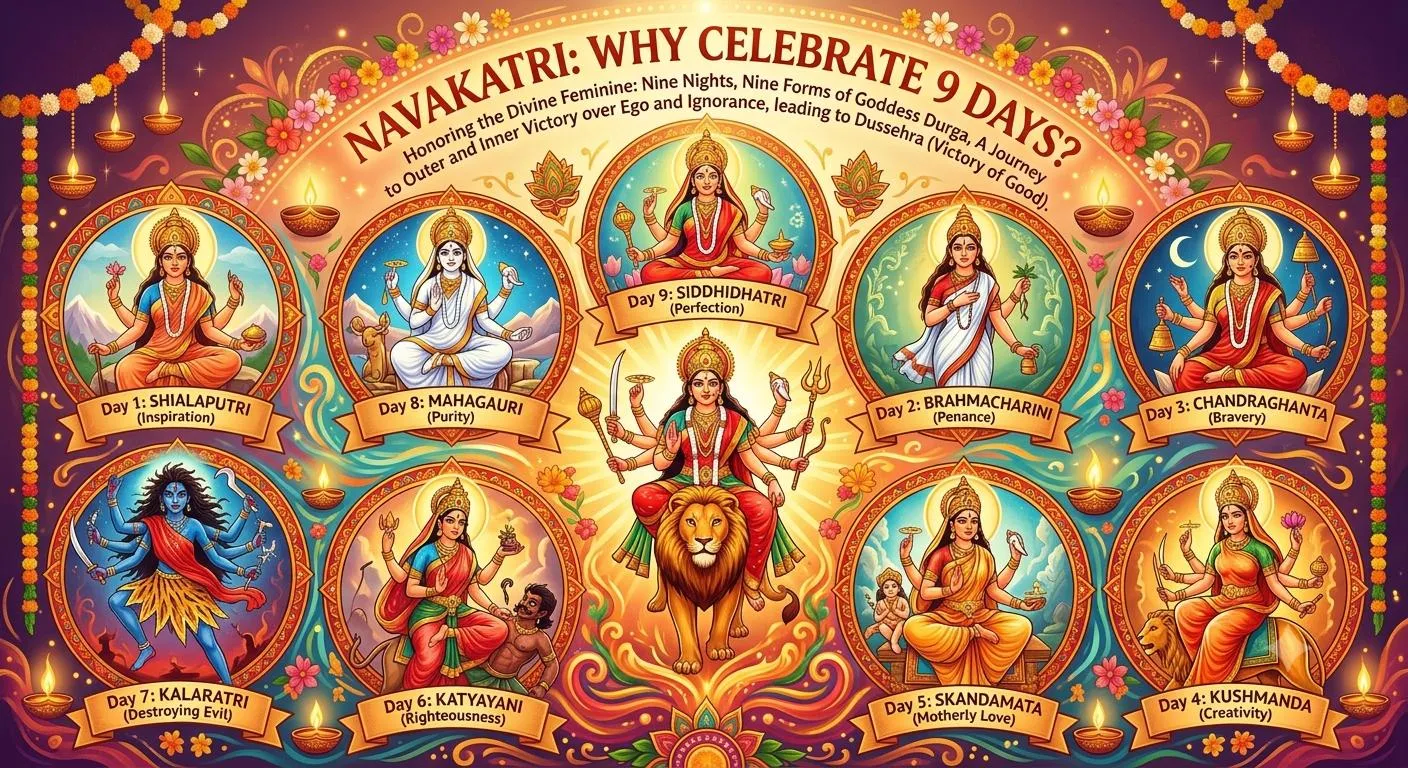
One important tradition connects the nine nights with the worship of Navadurga, the nine forms of Goddess Durga.
Each night or day of Navratri is traditionally associated with a different manifestation of the Goddess.
The nine forms are:
1. Shailaputri
Shailaputri is traditionally associated with strength, nature and purity.
2. Brahmacharini
Brahmacharini represents devotion, discipline, determination and spiritual practice.
3. Chandraghanta
Chandraghanta is associated with courage, protection and strength.
4. Kushmanda
Kushmanda is traditionally connected with creative energy and the sustaining power of life.
5. Skandamata
Skandamata represents motherhood, compassion and nurturing energy.
6. Katyayani
Katyayani is associated with courage, power and the strength to confront challenges.
7. Kalaratri
Kalaratri represents the destruction of darkness and negative forces.
8. Mahagauri
Mahagauri is associated with purity, peace and spiritual clarity.
9. Siddhidatri
Siddhidatri is traditionally associated with spiritual accomplishment, wisdom and divine grace.
These nine forms provide a symbolic structure for the nine nights.
For many devotees, the sequence can also be understood as an inner journey through qualities such as discipline, courage, compassion, strength, purity and spiritual awareness.
The Story of Goddess Durga and Mahishasura
Another major tradition associated with Navratri is the story of Goddess Durga and Mahishasura.
According to Hindu mythology, Mahishasura became extremely powerful and caused suffering among the gods and other beings.
The gods combined their divine energies, leading to the manifestation of Goddess Durga as a powerful form of Shakti.
Durga confronted Mahishasura in a battle that is traditionally associated with the nine days and nights of Navratri.
The Goddess eventually defeated Mahishasura, and her victory became a powerful symbol of the triumph of dharma over adharma and good over evil.
Different Hindu traditions and regional texts may present the story with variations in detail and emphasis. However, the central message of overcoming destructive forces remains an important part of the festival’s symbolism.
Navratri can therefore be understood not only as a celebration of an ancient story but also as an opportunity for personal reflection.
The forces represented by Mahishasura can be interpreted symbolically as qualities such as anger, ego, greed, fear and ignorance that people try to overcome within themselves.
Why Does Navratri End on the Tenth Day?
If Navratri means nine nights, an obvious question follows:
What happens on the tenth day?
The tenth day is celebrated as Vijayadashami, also widely known as Dussehra.
The Sanskrit word Vijaya refers to victory, while Dashami refers to the tenth lunar day.
In traditions centered on Goddess Durga, Vijayadashami marks the victory of the Goddess over Mahishasura.
In other parts of India, Dussehra is strongly associated with Lord Rama’s victory over Ravana.
Although the stories and regional customs differ, the tenth day broadly represents the triumph of good, righteousness or dharma over opposing forces.
The festival can therefore be viewed symbolically as:
Nine nights of devotion and preparation → Tenth day of victory
Nine Nights as a Spiritual Journey
There is another meaningful way to look at Navratri.
The nine nights can represent a person’s inner transformation.
The journey can begin with recognizing negative habits and then developing greater discipline, courage, compassion, purity and awareness.
From this perspective, Navratri is not only about worshipping the Goddess externally. It can also be a time to reflect on the Shakti or inner strength within ourselves.
During these nine days, people may choose to:
- Spend more time in prayer
- Practise patience
- Reduce harmful habits
- Control anger
- Help others
- Reflect on personal actions
- Strengthen spiritual discipline
- Develop greater awareness
This interpretation helps explain why Navratri continues to hold meaning for many people even in modern life.
Why Is Navratri So Special in Gujarat?
Gujarat has given Navratri a distinctive cultural identity through its famous Garba and Dandiya Raas celebrations.
During Navratri, people gather in decorated venues, community spaces and temple grounds. Traditional and modern music fills the night as people dance in circles.
The Garba circle has a deep connection with traditions of Shakti and the Divine Feminine. In many celebrations, dancers move around a symbolic lamp or representation associated with the Goddess.
The circular movement can also be understood as a symbol of continuity, life and the cycles of existence.
Over time, Garba has grown into a major cultural celebration that attracts people of different ages and backgrounds.
Yet its devotional roots continue to remain an important part of the tradition.
For Gujarat, Navratri is therefore much more than a festival on the calendar.
It is a cultural and emotional experience.
Why Is It Nine Nights Instead of Nine Days?
This is one of the most interesting aspects of the festival’s name.
The word Ratri, meaning night, is specifically included in Navratri because night holds an important place in many Shakti traditions.
Night can also be understood symbolically as a time when the outside world becomes quieter and people have an opportunity for introspection and spiritual reflection.
That gives the word Navratri a deeper meaning.
It is not simply about counting nine days.
It represents nine nights of devotion, worship, reflection and spiritual awakening.
Is Navratri Celebrated the Same Way Everywhere in India?
No. Navratri is celebrated through a wide variety of regional traditions across India.
Two widely observed Navratri periods are:
- Chaitra Navratri, generally occurring around March–April
- Sharadiya Navratri, generally occurring around September–October
The exact dates change each year according to the Hindu lunar calendar.
Different communities follow different rituals, fasting practices, forms of worship and cultural traditions.
Gujarat
Gujarat is particularly known for Garba and Dandiya Raas during Sharadiya Navratri.
West Bengal
The period is closely associated with the grand celebration of Durga Puja, with elaborate idols, artistic pandals and community worship.
Other Regions
Other parts of India have their own customs, rituals and interpretations of Navratri.
This regional diversity is one of the reasons the festival has such a rich cultural identity across the country.
The central connection with Shakti remains, while the way people celebrate can vary significantly.
The Deeper Meaning of Navratri
Perhaps one of the most meaningful aspects of Navratri is that the festival can inspire people to look inward.
Rather than viewing the celebration only as a time to ask the Goddess for blessings, devotees may also see it as an opportunity to develop their own inner qualities.
The nine nights can inspire people to move away from:
- Anger
- Ego
- Greed
- Fear
- Jealousy
- Ignorance
and work toward:
- Courage
- Discipline
- Compassion
- Wisdom
- Purity
- Faith
In this sense, Goddess Durga becomes a symbol of the strength needed to face challenges and overcome negativity.
That message can remain relevant regardless of how someone personally observes the festival.
Navratri and the Power of Shakti
At the heart of Navratri is the idea of Shakti, often understood as divine feminine energy or power.
The Goddess is not portrayed only as a gentle or nurturing presence. The different forms of Durga also represent courage, protection, determination and the ability to confront destructive forces.
This combination of strength and compassion is one reason the festival has remained deeply meaningful within Hindu traditions.
The nine nights provide an opportunity to celebrate different expressions of the Divine Feminine while also reflecting on qualities that people may wish to cultivate in their own lives.
Why Navratri Remains Relevant Today
Navratri has ancient religious and cultural roots, but its themes can still connect with modern life.
People today face their own forms of stress, uncertainty, fear and distraction.
The festival provides an opportunity to pause, reconnect with family and community, practise devotion and reflect on personal values.
For some people, that may mean fasting and prayer.
For others, it may mean attending Garba, visiting a temple, spending time with family or simply using the festival as a period of reflection.
The way people participate may differ, but the underlying themes of strength, devotion and renewal continue to resonate.
Conclusion: Nine Nights, One Powerful Message
So, why is Navratri celebrated for nine days and why is it called Navratri?
The answer begins with the Sanskrit words Nav, meaning nine, and Ratri, meaning night.
The nine nights are traditionally associated with the worship of Shakti and the Navadurga, the nine forms of Goddess Durga.
Navratri is also connected with the story of Goddess Durga’s victory over Mahishasura, while the tenth day, Vijayadashami, represents victory.
But beyond mythology and ritual, Navratri carries a timeless message.
Darkness does not last forever. Strength can overcome fear. Wisdom can overcome ignorance. And good can rise above evil.
For nine nights, devotees celebrate the Divine Feminine.
For nine nights, Gujarat comes alive with Garba and Dandiya.
For nine nights, homes, temples and communities glow with devotion.
And on the tenth day comes the celebration of victory.
That is the beauty of Navratri: nine sacred nights of Shakti, devotion, celebration and inner transformation.
Frequently Asked Questions About Navratri
Why is Navratri celebrated for 9 days?
Navratri is traditionally observed for nine nights and is associated with the worship of Shakti and the nine forms of Goddess Durga known as Navadurga. The festival culminates on the tenth day with Vijayadashami.
What does Navratri mean?
Navratri comes from the Sanskrit words Nav, meaning nine, and Ratri, meaning night. Therefore, Navratri literally means nine nights.
What are the nine forms of Goddess Durga?
The nine forms of Navadurga are Shailaputri, Brahmacharini, Chandraghanta, Kushmanda, Skandamata, Katyayani, Kalaratri, Mahagauri and Siddhidatri.
What is the story of Durga and Mahishasura?
According to Hindu tradition, Goddess Durga manifested as a powerful form of Shakti and fought Mahishasura, eventually defeating him. The story is traditionally understood as a symbol of the victory of dharma over adharma and good over evil.
Why is the tenth day of Navratri important?
The tenth day is celebrated as Vijayadashami or Dussehra. In Durga traditions, it is associated with the Goddess’s victory over Mahishasura. In other traditions, it is associated with Lord Rama’s victory over Ravana.
Why is Navratri important in Gujarat?
Gujarat is especially known for its Garba and Dandiya Raas celebrations during Navratri. The festival combines devotion, music, dance and community celebration.
Is Navratri celebrated only once a year?
There are several Navratri observances during the Hindu calendar year. Chaitra Navratri and Sharadiya Navratri are among the most widely observed.
What is the spiritual meaning of Navratri?
Navratri can be understood as a period of devotion, reflection and inner transformation. The nine nights can symbolically represent the development of qualities such as discipline, courage, compassion, purity and spiritual awareness.
Stay updated with the latest news and articles. Subscribe Now for more articles.
