
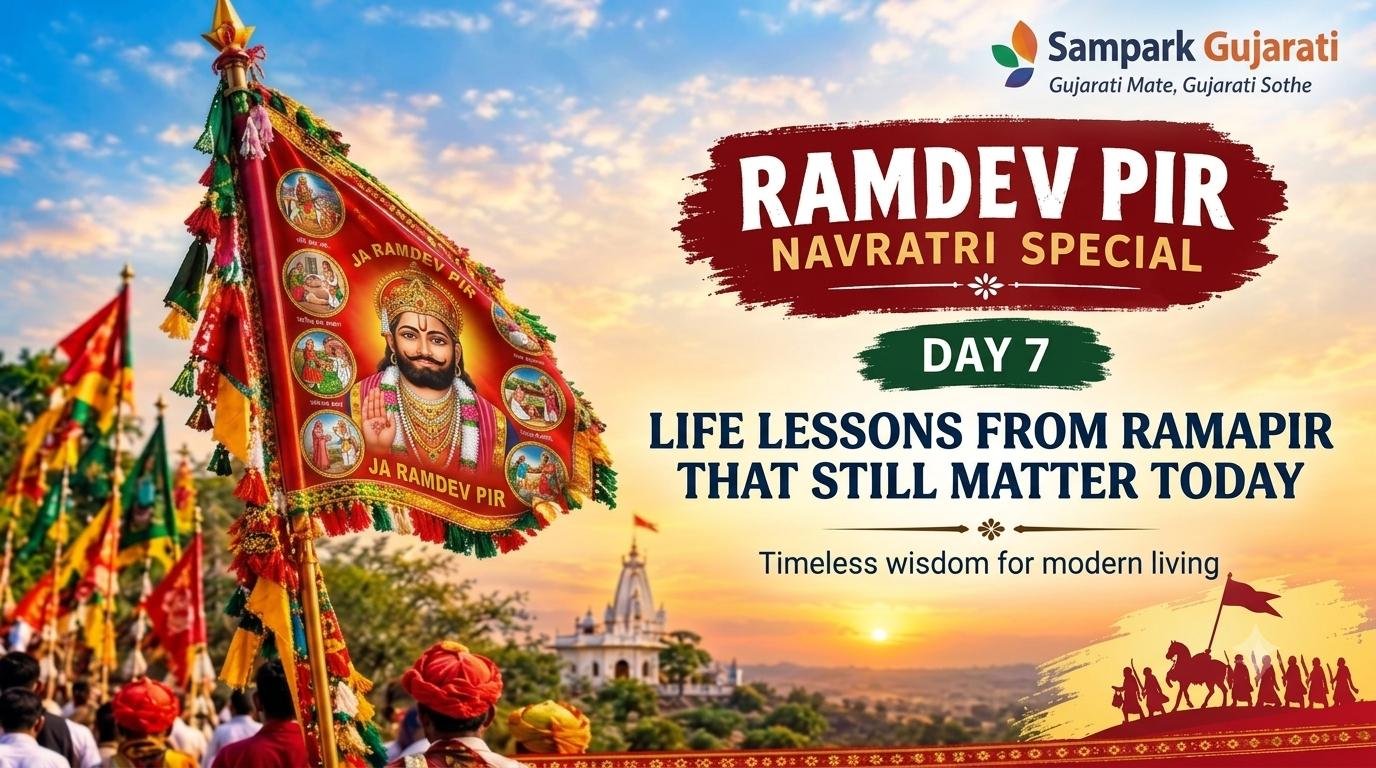
Ramdev Pir Navratri Special | Day 7
What can a centuries-old folk tradition teach us about living a better life in today’s fast-moving world?
We live in an age of instant communication, constant competition and endless digital noise.
People can connect with thousands of others online but sometimes struggle to connect with the person standing next to them.
That is why the values associated with Ramdev Pir, Ramapir and Baba Ramdevji continue to attract cultural and devotional interest.
Ramdev Pir is remembered in Rajasthan and Gujarat as a revered folk deity, while traditions surrounding him emphasize ideas such as equality, service, compassion, social harmony and devotion.
A Rajasthan government document on Ramdevra describes Baba Ramdevji as a saint and folk deity who worked for the welfare of his people, sought the upliftment of poor and disadvantaged communities, and preached equality.
Whether these traditions are approached through faith, folklore or cultural history, they offer several values that remain relevant today.
Here are 7 life lessons traditionally associated with Ramapir’s legacy.
1. Treat People With Equality
One of the strongest themes associated with Ramdev Pir is equality.
The Rajasthan Devasthan Department’s Ramdevra document describes him as someone who worked for the upliftment of disadvantaged people and treated people of different religions equally.
This idea has a simple modern meaning:
Don’t measure a person’s worth by their social position.
A person’s profession, income, appearance, community or background should not decide how respectfully we treat them.
In everyday life, equality can mean:
– Respecting every worker
– Listening to different perspectives
– Avoiding discrimination
– Giving people fair opportunities
– Treating service workers with dignity
– Not judging someone by their financial status
Equality is not just a large social concept.
It begins with ordinary interactions.
2. Turn Faith Into Seva
Day 5 of our Ramdev Pir series explored seva, or service.
The same idea appears again here because service is one of the most practical ways to turn values into action.
Prayer may be personal.
Seva becomes visible through what we do for others.
Helping an elderly person, supporting someone in difficulty, donating useful resources or volunteering time can all become forms of service.
The important part is the attitude.
Help without making another person feel small.
That distinction matters.
A good deed should preserve the dignity of the person receiving help.
3. Stay Humble Despite Success
Ramdev Pir’s traditional image combines spirituality, leadership and service.
The stories surrounding him often present a figure who had authority but remained connected with ordinary people.
For today’s generation, this offers an important reminder:
Success should increase responsibility, not arrogance.
Whether someone becomes successful in:
– Business
– Entertainment
– Technology
– Education
– Government
– Sports
– Social media
their success becomes more meaningful when they use their position responsibly.
Having influence does not make someone more valuable than another person.
It simply creates an opportunity to make a larger positive contribution.
4. Have Courage to Stand for What You Believe
Devotional traditions surrounding Ramapir contain numerous stories of challenges, tests and difficult situations.
Some of these are folk and devotional narratives rather than independently verified historical events, so they should be understood in that context.
But the cultural message behind such stories is clear:
Courage is needed when values are tested.
In modern life, courage can mean something very ordinary.
It can mean:
– Saying no to unfair treatment
– Speaking up when someone is being bullied
– Refusing dishonest shortcuts
– Protecting someone who is being treated unfairly
– Admitting a mistake
– Starting again after failure
Courage isn’t always dramatic.
Sometimes it is simply doing the right thing when doing the wrong thing would be easier.
5. Build Harmony Instead of Division
Ramdevra is particularly significant because Rajasthan Tourism describes Baba Ramdevji as a folk deity worshipped by people of different faiths and identifies the tradition with Hindu-Muslim unity.
The Ramdevra Temple is also described by Rajasthan Tourism as a place visited by people of all faiths.
This gives the tradition an important cultural lesson:
Differences don’t have to prevent people from sharing a common space.
Modern society contains many differences:
Religion.
Language.
Region.
Food.
Lifestyle.
Political opinions.
Professional backgrounds.
Personal beliefs.
Harmony doesn’t require everyone to become identical.
It requires people to learn how to coexist with mutual respect.
6. Remember Where You Came From
Traditions survive because people remember.
A bhajan remembered from childhood.
A story told by grandparents.
A pilgrimage repeated every year.
A Neja carried by a family.
A temple visited across generations.
These practices create a connection between the present and the past.
The Ramdevra tradition demonstrates how cultural memory can continue across generations. Rajasthan Tourism records the annual Ramdevra Fair, where large numbers of devotees gather and participate in devotional activities.
For young people, preserving tradition does not necessarily mean rejecting modern life.
You can use:
Technology to preserve tradition.
Social media to tell old stories.
Digital platforms to promote folk music.
Photography to document festivals.
Video to record oral histories.
Tradition and technology can coexist.
7. Keep Humanity at the Centre
This may be the most important lesson of all.
Religious traditions can contain rituals, symbols, stories and sacred places.
But behind them are often human values.
Compassion.
Respect.
Service.
Kindness.
Equality.
Community.
The Rajasthan government document describing Ramdevji’s legacy specifically connects him with welfare and upliftment of poor and disadvantaged people.
That gives today’s generation a useful way to look at devotion:
What does your faith inspire you to do for another human being?
If it inspires kindness, that kindness matters.
If it inspires service, that service matters.
If it inspires respect, that respect matters.
Ramapir’s Seven Lessons in One Look
Life Lesson| Modern Meaning
Equality| Treat people with dignity
Seva| Help without expecting recognition
Humility| Stay grounded after success
Courage| Stand up for what is right
Harmony| Respect differences
Tradition| Preserve meaningful cultural memories
Humanity| Put compassion into action
These aren’t rules that belong only to a particular religious community.
They are values that can be understood more broadly as principles of responsible living.
Why These Lessons Matter in the Digital Age
Today’s generation faces challenges that previous generations could not have imagined.
Social media creates constant comparison.
Success is often measured through followers and views.
People can become famous overnight.
Arguments can spread within minutes.
Misinformation can travel faster than facts.
Online conversations can become unnecessarily hostile.
In such an environment, values such as humility, equality, patience and compassion become especially meaningful.
The challenge is not simply to know these values.
The challenge is to practice them.
You can post a quote about kindness.
Or you can actually help someone.
You can share a message about equality.
Or you can treat someone fairly.
You can talk about seva.
Or you can volunteer.
The second option is where values become real.
Ramapir and the Meaning of Responsible Influence
There is another interesting lesson for today’s social media generation.
Ramdev Pir’s cultural legacy has travelled through songs, stories, pilgrimage, symbols and community traditions.
Today, information travels through Reels, YouTube videos, podcasts and digital articles.
The medium has changed.
The responsibility has not.
If you create content about religious traditions, it is important to distinguish between:
Historical evidence
and
Devotional belief.
A folk legend can be beautiful without being presented as a proven historical event.
A devotional story can inspire people without requiring a claim that historians have independently verified every detail.
That distinction helps preserve both faith and credibility.
A 7-Day Ramapir-Inspired Personal Challenge
Want to turn these lessons into action?
Try this simple seven-day challenge:
Day 1 — Equality
Treat everyone you interact with with the same basic respect.
Day 2 — Seva
Help someone without expecting recognition.
Day 3 — Humility
Give credit to someone who helped you succeed.
Day 4 — Courage
Address one problem you have been avoiding.
Day 5 — Harmony
Have a respectful conversation with someone who thinks differently from you.
Day 6 — Tradition
Ask an elder in your family about a story or tradition from their childhood.
Day 7 — Humanity
Do one kind act anonymously.
The objective isn’t perfection.
It is awareness.
The Real Legacy of a Tradition
A tradition survives when each generation finds a reason to continue it.
Ramdev Pir’s name continues to be remembered through Ramdevra, bhajans, Neja, pilgrimage, folk stories and community celebrations.
Rajasthan Tourism identifies Ramdevra as the sacred place associated with Baba Ramdevji and notes that devotees from different faiths visit the site.
But traditions survive for more than one reason.
People don’t preserve only places.
They preserve meaning.
And perhaps that is the most valuable lesson from Ramapir’s cultural legacy:
A tradition becomes truly powerful when its values continue to influence how people live.
Day 7 Takeaway
You don’t need to live centuries ago to understand the values associated with Ramapir.
You can practice them today.
Respect someone.
Help someone.
Stand up for someone.
Preserve your culture.
Stay humble.
Build harmony.
Choose humanity.
The world may change rapidly, but these values remain understandable across generations.
The best way to keep a meaningful legacy alive is not only to remember its stories — but to live its values.
🔔 Tomorrow: Ramdev Pir Navratri Special Day 8
The series now moves from what Ramapir represents to how devotees traditionally express their devotion.
What does a simple Ramdev Pir worship practice look like? What are some traditional ways devotees pray, offer devotion and participate in Ramapir-related religious traditions?
Day 8: How to Worship Ramdev Pir: Traditional Prayer, Devotion & Simple Puja Practices
Frequently Asked Questions
What are the main life lessons associated with Ramdev Pir?
The values commonly associated with Ramapir’s cultural and devotional legacy include equality, service, compassion, social harmony, humility and concern for disadvantaged people.
Is Ramdev Pir associated with equality?
Yes. A Rajasthan government document on Ramdevra describes Baba Ramdevji as preaching equality and working for the upliftment of poor and disadvantaged people.
Why is Ramdev Pir associated with social harmony?
Rajasthan Tourism describes Ramdevji as a folk deity worshipped by people of different faiths and identifies Ramdevra as a place associated with Hindu-Muslim unity.
Where is Ramdevra Temple?
Ramdevra Temple is located about 12 kilometres from Pokhran on the Jodhpur–Jaisalmer route in Rajasthan. Rajasthan Tourism identifies it as the temple dedicated to Baba Ramdevji.
Are all stories about Ramdev Pir historically proven?
No. Ramdev Pir’s tradition contains a mixture of documented cultural history, oral traditions, devotional narratives and legends. Individual miraculous stories should be understood according to their source and should not automatically be presented as independently verified historical facts.
Stay updated with the latest news and articles. Subscribe Now
