Ramdev Pir Navratri Special | Day 6
What if a song could carry a centuries-old tradition from one generation to the next?
You may hear the name Ramdev Pir in a temple, during a pilgrimage, at a village gathering, through a devotional bhajan or while watching devotees walk toward Ramdevra carrying colourful flags.
But there is something fascinating about this tradition:
Ramapir’s story has not survived only through written history. It has also travelled through voices.
Through bhajans, folk songs, kirtans, devotional gatherings, oral storytelling and the Neja tradition, generations of devotees have continued expressing their faith in their own cultural language.
That is why the story of Ramdev Pir is not simply something people read.
For many communities, it is something they sing, carry, celebrate and pass on.
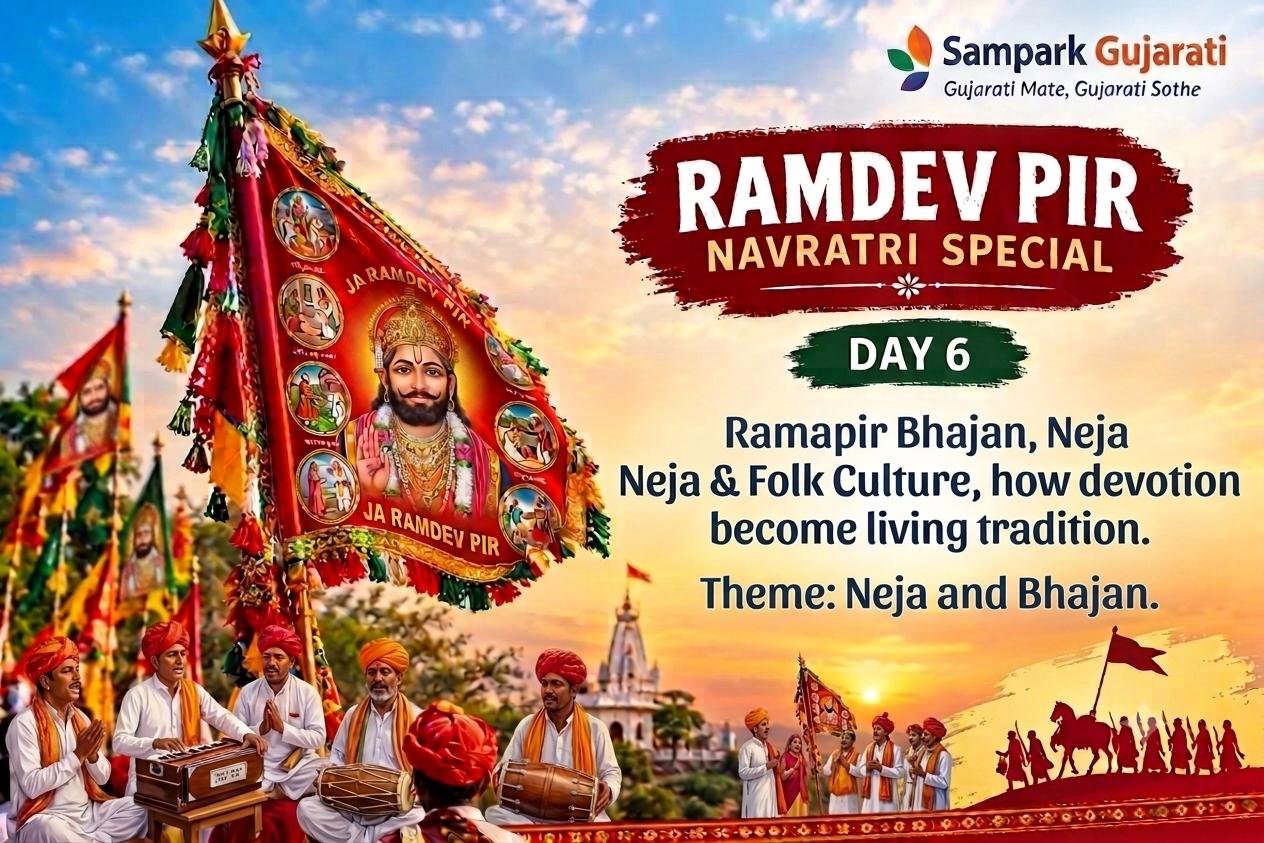
As the Sampark Gujarati Ramdev Pir Navratri Special reaches Day 6, we explore the connection between Ramapir, devotional music, Neja and Rajasthan-Gujarat folk culture.
Why Are Bhajans So Important in the Ramapir Tradition?
A devotional song can do something that a written article cannot always achieve.
It can be remembered easily.
It can be sung by a group.
It can travel from one village to another.
And most importantly, it can be passed from parents and grandparents to children.
This is one reason devotional music has played such an important role in India’s folk traditions.
In the case of Ramdev Pir, the cultural tradition includes bhajans and devotional songs praising Baba Ramdevji, particularly around Ramdevra and its annual fair.
The Rajasthan Tourism Department notes that large numbers of devotees gather at Ramdevra between August and September and sing devotional songs through the night.
A Rajasthan government development plan for Ramdevra similarly records that bhajans, kirtans and devotional songs are sung through the night during the fair, with devotees gathering from different communities.
This tells us something important:
Music is not merely entertainment in this tradition. It is part of the devotional experience.
What Do Ramdev Pir Bhajans Talk About?
Ramdev Pir bhajans can vary significantly depending on region, singer, community and tradition.
Some focus on:
– Baba Ramdevji’s devotion
– His compassion
– Stories associated with his life
– Miracles remembered in folk tradition
– Ramdevra pilgrimage
– Ramapir’s relationship with devotees
– Equality and social harmony
– Faith and surrender
– The symbolic Neja
– The journey toward the sacred place
Many such stories belong to oral and devotional tradition, meaning they should be understood within their cultural and religious context rather than automatically treated as independently verified historical events.
That distinction actually makes the tradition more interesting.
Because folk culture tells us not only what people believe happened, but also what values communities chose to remember.
Ramdevra: Where Devotion Becomes Music
Ramdevra in Rajasthan is one of the most important centres associated with Baba Ramdevji.
Rajasthan Tourism identifies the Ramdevra Temple as dedicated to Baba Ramdevji and describes it as his eternal resting place. The site attracts people of different faiths, particularly during the annual fair.
During the fair, devotional singing becomes part of the atmosphere.
Imagine the scene:
A long pilgrimage.
Devotees arriving from different places.
Colourful flags moving through the crowd.
Temple bells.
Folk instruments.
People singing together.
Families participating in traditions they may have seen their elders follow.
For a devotee, this can be a deeply spiritual experience.
For a cultural observer, it is also an example of living folk heritage.
What Is the Ramapir Neja?
The Neja is one of the most recognizable symbols associated with Ramdev Pir devotion.
In simple terms, it is a religious flag or banner carried by devotees.
The exact colour, design, decoration and style can differ according to local tradition.
A Rajasthan government publication describing Ramdevji’s pilgrimage tradition notes that devotees carry white or multicoloured flags, with representations of Baba Ramdev’s footprints, while travelling toward Ramdevra. It also records pilgrims arriving from Rajasthan as well as neighbouring states including Gujarat, Punjab and Haryana.
This makes the Neja more than a decorative object.
For devotees, it can represent:
Faith.
Identity.
Pilgrimage.
Community.
A visible connection with Ramapir.
Why Do Devotees Carry the Neja?
There isn’t one universal explanation that applies identically to every community.
Different families and regions may attach their own devotional meanings to the Neja.
But culturally, carrying a flag during a pilgrimage creates a powerful visual symbol.
You can see the group from a distance.
You know that a pilgrimage is taking place.
The flag becomes an identity marker.
And when hundreds or thousands of people carry similar devotional symbols, an individual journey becomes a collective cultural experience.
This is one reason traditional symbols survive.
They are simple enough to understand, powerful enough to remember and visible enough to become part of community identity.
The Journey Is Also Part of the Tradition
One of the most beautiful aspects of Ramdev Pir’s folk culture is the importance of the journey itself.
For many devotees, travelling toward Ramdevra is not simply transportation from one place to another.
It becomes a pilgrimage.
The Rajasthan government’s cultural material describes groups of devotees walking toward Ramdevra carrying flags and chanting devotional slogans. It also notes participation across age groups and communities.
This creates an important cultural idea:
Sometimes the spiritual experience is not only about reaching the destination. It is about what happens during the journey.
People walk together.
They sing together.
They rest together.
They help one another.
They share food.
They experience the same physical journey.
And eventually, they arrive at the sacred destination together.
Folk Music Keeps Memory Alive
Before smartphones, YouTube and social media, how did communities preserve stories?
One major answer was:
Memory through music.
A song could preserve a story.
A repeated verse could preserve a name.
A melody could preserve an emotion.
A gathering could preserve a tradition.
A grandmother could teach a devotional song to her grandchildren.
The grandchildren could later teach it to another generation.
This is how oral traditions can survive for remarkably long periods.
Ramdev Pir’s devotional culture provides an excellent example of how religion, music and community memory can overlap.
From Village Gatherings to Digital Platforms
The way people consume devotional content has changed dramatically.
Earlier, people primarily encountered Ramapir bhajans through:
– Village gatherings
– Temple events
– Pilgrimages
– Religious fairs
– Family gatherings
– Folk singers
– Community celebrations
Today, the same tradition can reach audiences through:
– YouTube
– Instagram Reels
– Music streaming platforms
– Podcasts
– Digital devotional channels
– Short-form video
This creates both an opportunity and a responsibility.
Digital creators can introduce younger audiences to traditional songs and stories.
But they should also avoid presenting every folk legend as proven history.
Preserving culture does not require changing tradition into “fact.”
Instead, we can say:
“According to devotional tradition…”
“A popular folk story says…”
“Devotees traditionally believe…”
That approach respects both faith and historical accuracy.
Why Young People Should Know About Ramapir Folk Culture
For younger generations, traditional devotional culture can sometimes feel distant.
But folk traditions become easier to understand when we look beyond rituals.
Ramdev Pir’s cultural heritage connects several things:
Music + storytelling + pilgrimage + community + identity + tradition.
These are not outdated concepts.
In fact, modern social media works in a surprisingly similar way.
A short Reel can tell a story.
A song can become viral.
A visual symbol can create identity.
A community can gather around shared interests.
The difference is the medium.
The human desire to share stories and belong to a community remains remarkably similar.
Ramdev Pir Bhajans and Gujarati Culture
Ramdev Pir’s influence is not limited to Rajasthan.
The Ramdevra pilgrimage tradition has strong connections with devotees from neighbouring Gujarat as well. Rajasthan government material records pilgrims travelling from Gujarat and other states toward Ramdevra.
This is particularly significant for Gujarati audiences.
Across Gujarat, devotional traditions often blend music, pilgrimage, storytelling and community participation.
The result is a cultural bridge between Rajasthan and Gujarat.
Ramapir therefore becomes more than a regional religious figure.
He becomes part of a wider western Indian folk-devotional landscape.
The Cultural Power of a Simple Bhajan
Why can a simple devotional song become so powerful?
Because it can contain multiple layers.
For one person, it may be prayer.
For another, it may be childhood memory.
For another, it may be cultural identity.
For a singer, it may be artistic expression.
For a pilgrim, it may provide energy during a long journey.
For a family, it may be a tradition passed down through generations.
The same song can therefore mean different things to different people.
And that is the power of folk culture.
What the Neja Represents Today
The Neja can be understood as a visual expression of devotion.
But culturally, it also represents something bigger:
A community carrying its identity forward.
Every generation changes.
Music changes.
Technology changes.
Cities change.
But symbols such as the Neja can provide continuity.
A young devotee carrying a traditional flag today may be participating in a practice that their grandparents or great-grandparents also recognized.
That creates a connection between past, present and future.
Ramdev Pir’s Folk Culture: More Than Religion
One of the most important lessons from Ramapir’s tradition is that folk culture cannot always be placed into a single category.
It can simultaneously be:
Religious.
Musical.
Social.
Historical.
Cultural.
Community-based.
The annual Ramdevra gathering demonstrates this combination particularly well.
People arrive to worship.
They sing.
They travel.
They meet others.
They participate in a fair.
They carry traditional symbols.
They preserve memories.
That is how a tradition becomes a living culture rather than simply a story from the past.
Day 6 Takeaway
A temple can preserve a sacred place.
A book can preserve information.
But a song can preserve emotion.
That may be one reason Ramdev Pir bhajans continue to hold a special place in devotional culture.
The Neja gives devotion a visible identity.
The bhajan give
The bhajan gives devotion a voice.
The pilgrimage gives devotion a journey.
And the community gives the tradition a future.
When people sing a tradition together, they don’t just remember the past — they keep it alive.
🔔 Tomorrow: Ramdev Pir Navratri Special Day 7
Day 7 will explore seven powerful life lessons associated with Ramapir’s spiritual and cultural legacy.
From equality and courage to compassion, service, humility and faith, what can today’s generation learn from the values traditionally associated with Ramdev Pir?
Day 7: 7 Life Lessons From Ramapir That Are Still Relevant Today
Frequently Asked Questions
What is a Ramdev Pir bhajan?
A Ramdev Pir bhajan is a devotional song dedicated to Baba Ramdevji/Ramapir. Different regions and communities have their own musical styles, lyrics and traditions.
Why are bhajans important during Ramdevra celebrations?
Rajasthan Tourism and Rajasthan government material document devotees singing devotional songs, bhajans and kirtans, particularly during the annual Ramdevra Fair.
What is Ramapir Neja?
The Neja is a devotional flag or banner carried by devotees. Its design and meaning can vary between communities and regions.
Do all Neja flags look the same?
No. Colours, decorations and designs can vary according to regional and family traditions.
Is Ramdev Pir’s folk music historically documented?
Ramdev Pir‘s devotional songs and folk narratives form part of an oral and cultural tradition. Individual stories or miraculous events should be understood as devotional or folk traditions unless independently supported by historical evidence.
Where is Ramdevra?
Ramdevra is in Jaisalmer district, Rajasthan. Rajasthan Tourism places the temple about 12 km from Pokhran on the Jodhpur–Jaisalmer route.
Stay updated with the latest news and articles. Subscribe Now
