
What makes customers choose one business over another when several companies offer similar products at comparable prices? Often, the deciding factor is the experience they receive.
Customers remember more than the product they purchase. They remember how easily they found information, how clearly a business communicated, how their questions were answered, and how problems were handled.
In 2026, customer experience (CX) has become an important consideration for businesses seeking sustainable growth. Customers expect convenient digital services, transparent communication, dependable support, and experiences that respect their time.
For entrepreneurs, startups, small businesses, and established companies, creating a positive customer experience can help strengthen relationships, encourage repeat purchases, and generate valuable recommendations.
What Is Customer Experience?
Customer experience refers to the overall impression customers develop through their interactions with a business.
These interactions can happen before, during, and after a purchase.
Examples include:
– Discovering a brand online
– Visiting a website
– Contacting customer support
– Comparing products and prices
– Making a purchase
– Receiving a product or service
– Requesting assistance
– Returning for another purchase
Customer experience includes every relevant touchpoint, not just the customer service department.
A business may have an excellent product but still disappoint customers through confusing pricing, delayed communication, or a complicated purchasing process.
Why Customer Experience Matters in 2026
A strong customer experience strategy can help businesses:
– Improve customer satisfaction
– Encourage repeat purchases
– Strengthen brand reputation
– Reduce avoidable customer complaints
– Create opportunities for referrals
– Differentiate the business from competitors
– Improve customer retention
– Identify opportunities for service improvement
However, good customer experience does not guarantee loyalty. Customers also consider price, product suitability, availability, and competing alternatives.
The goal is to make every reasonable effort to deliver an experience that matches the promises made by the business.
1. Understand Customer Expectations
The first step is understanding what customers actually need.
Do not rely entirely on assumptions or internal opinions.
Collect insights through:
– Customer surveys
– Reviews
– Support conversations
– Interviews
– Purchase patterns
– Website feedback
– Complaint analysis
– Sales team observations
Look for recurring problems.
For example, customers may not be dissatisfied with a product itself. Their frustration might come from unclear delivery information or difficulty obtaining support.
Identifying the real problem allows businesses to make improvements that matter.
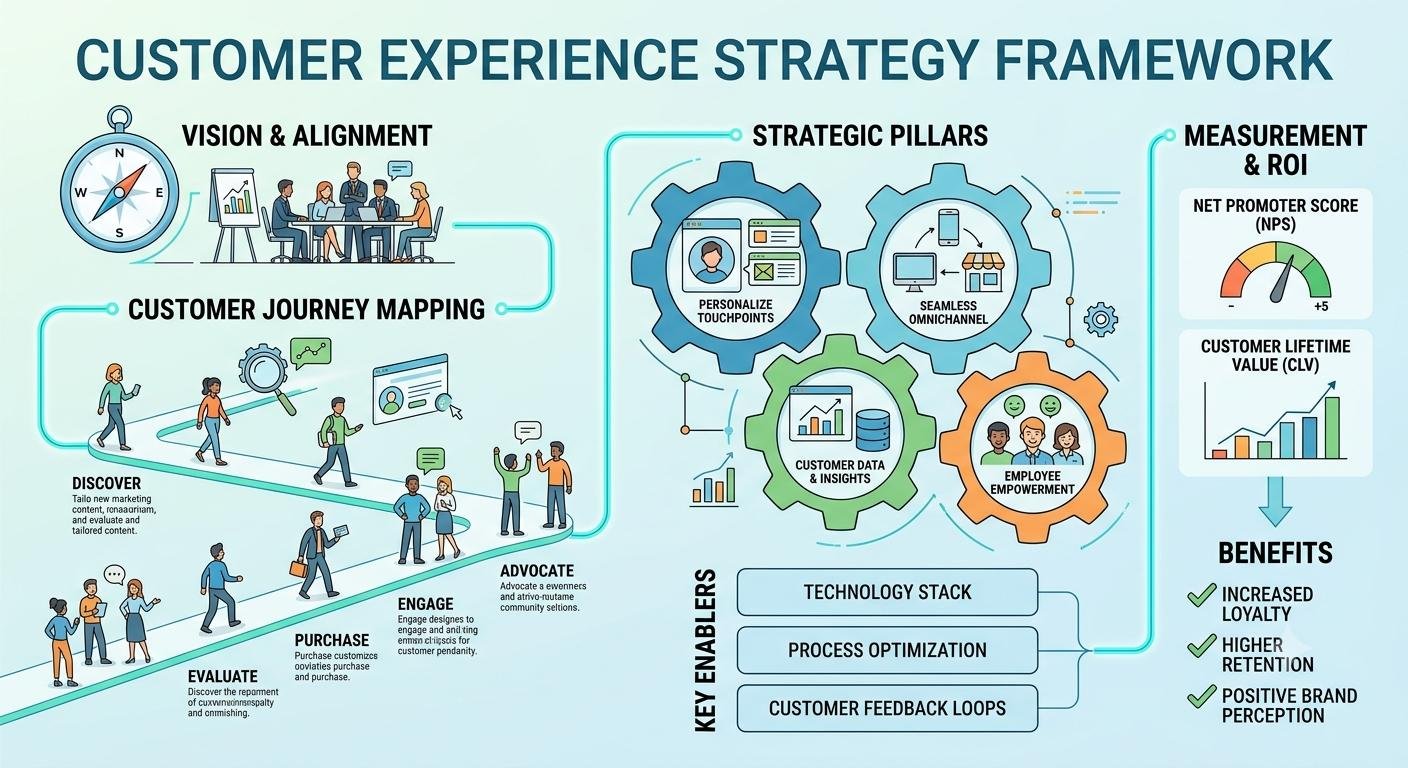
2. Map the Complete Customer Journey
A customer journey map shows the different stages customers experience when interacting with a business.
A typical journey includes:
**Discovery → Research → Purchase → Onboarding → Support → Repeat Purchase**
For each stage, identify what customers are trying to accomplish, where they encounter difficulties, and what information or assistance they need.
For an online store, the journey might include finding a product, checking delivery costs, completing payment, receiving an order confirmation, tracking delivery, and requesting support if necessary.
Mapping these steps helps businesses identify unnecessary friction.
3. Simplify the Buying Process
Customers appreciate processes that are clear and convenient.
Businesses can improve the purchasing experience by:
– Providing transparent pricing
– Simplifying enquiry forms
– Offering clear product descriptions
– Making contact information easy to find
– Optimizing mobile experiences
– Explaining payment options
– Setting realistic delivery expectations
– Clarifying return and cancellation policies
Avoid adding unnecessary steps to the buying journey.
For service businesses, make it easy to request a quotation, schedule a consultation, or understand what happens after an enquiry.
4. Deliver Consistent Quality
Customer experience begins with the actual product or service.
Businesses should establish quality standards and monitor whether they are being met.
For products, this may include reliability, packaging, accurate descriptions, and dependable delivery.
For services, it may include professional conduct, punctuality, clear communication, and consistent results.
When expectations cannot be met, communicate honestly and provide realistic alternatives.
Consistency is important because customers need confidence that they can expect a dependable experience each time they interact with the business.
5. Personalize the Customer Experience
Personalization means making interactions more relevant to individual customer needs.
Examples include:
– Relevant product recommendations
– Customer-specific onboarding
– Appropriate service reminders
– Useful follow-up messages
– Recommendations based on stated preferences
– Support that considers previous interactions
Personalization should be helpful rather than intrusive.
Businesses must handle customer information responsibly, respect communication preferences, and follow applicable privacy requirements.
The objective is to reduce customer effort and improve relevance—not to collect unnecessary personal information.
6. Train Employees to Deliver Better Experiences
Employees often have the greatest influence on how customers perceive a business.
Customer-facing teams should receive training in:
– Communication
– Product knowledge
– Active listening
– Problem-solving
– Complaint handling
– Professional behavior
– Escalation procedures
Employees should also understand the limits of their authority and when they can resolve a problem without unnecessary delays.
A customer who must repeat the same issue to multiple employees may lose confidence in the company.
Give employees the guidance and appropriate authority needed to resolve common problems efficiently.
7. Build an Effective Customer Support System
A strong support system helps customers receive assistance when they need it.
Depending on the business, support channels may include:
– Telephone
– Website contact forms
– Live chat
– Messaging platforms
– Self-service help centers
– Frequently asked questions
Choose channels your customers actually use and can reasonably support.
Set clear expectations for response times. If a problem requires investigation, acknowledge it and explain the next steps.
The goal is not simply to close support tickets quickly. It is to resolve customer problems accurately and fairly.
8. Use Technology to Improve Customer Experience
Technology can help businesses reduce friction and deliver more consistent service.
Useful tools may include:
**CRM systems:** Organize customer information and interaction history.
**Help-desk platforms:** Track support requests and monitor resolution progress.
**Chatbots:** Answer suitable routine questions and direct customers to relevant resources.
**Automation:** Send confirmations, reminders, and service updates.
**Analytics tools:** Identify website difficulties, recurring complaints, and customer behavior patterns.
Technology should simplify the experience rather than make it more complicated.
Always provide an appropriate route to human assistance when automated support cannot resolve a customer’s issue.
9. Collect Feedback and Take Action
Customer feedback is valuable when it leads to meaningful improvements.
Ask focused questions about specific interactions, such as:
– Was the purchasing process easy?
– Did the product meet expectations?
– Was support helpful?
– Was the information clear?
– What could have been improved?
Avoid asking customers to complete lengthy surveys after every interaction.
Review feedback regularly and identify recurring themes.
When appropriate, communicate improvements to customers. This demonstrates that their opinions are being considered.
10. Handle Complaints Professionally
Customer complaints can reveal weaknesses in products, processes, or communication.
A practical complaint-handling process includes:
1. Listen carefully.
2. Acknowledge the customer’s concern.
3. Clarify the facts.
4. Explain available solutions.
5. Take appropriate action.
6. Follow up when necessary.
7. Investigate recurring causes.
Employees should avoid arguing with customers or making promises the business cannot keep.
Not every complaint can be resolved exactly as requested, but every legitimate concern deserves fair consideration.
11. Create a Consistent Omnichannel Experience
Customers may interact with the same business through multiple channels.
They might discover it on social media, research its website, ask questions by telephone, and complete a purchase in person.
An omnichannel approach aims to make these interactions feel connected.
Businesses can improve consistency by maintaining accurate information, aligning pricing and policies, and helping employees access relevant customer history where appropriate.
Customers should not encounter contradictory information simply because they switched channels.
12. Measure Customer Experience Performance
Businesses need meaningful metrics to understand how well their strategy is working.
| Metric | What it measures |
|—|—|
| Customer Satisfaction Score (CSAT) | Satisfaction with a specific experience |
| Net Promoter Score (NPS) | Likelihood of recommending the business |
| Customer Effort Score (CES) | How easy customers find an interaction |
| First Contact Resolution | Issues resolved during the first contact |
| Response Time | How quickly a business responds |
| Customer Retention Rate | The proportion of customers retained over a period |
| Complaint Resolution Time | Time required to resolve complaints |
Use these metrics alongside customer comments and operational data. No single measurement can fully explain the customer experience.
Common Customer Experience Mistakes
Businesses should avoid:
– Ignoring customer feedback
– Making unrealistic promises
– Providing inconsistent information
– Complicating the buying process
– Relying entirely on automated support
– Failing to train employees
– Making customers repeat information unnecessarily
– Collecting excessive customer data
– Measuring speed without measuring resolution quality
– Treating customer experience as the responsibility of one department
A better experience requires coordination across marketing, sales, operations, technology, and customer support.
Customer Experience Trends to Watch in 2026
**AI-assisted support:** AI tools can help answer routine questions and support service teams, pro
provided customers can access human help when needed.
Proactive communication: Relevant order updates, appointment reminders, and service notifications can reduce uncertainty.
Self-service options: Clear help centers and account-management tools can help customers solve straightforward problems independently.
Personalization with privacy: Businesses can use relevant information to improve experiences while respecting customer consent and preferences.
Frictionless digital journeys: Mobile-friendly websites, clear forms, accessible information, and straightforward checkout processes remain valuable areas for improvement.
Businesses should evaluate these approaches based on customer needs, operational capabilities, and measurable results.
A Simple 30-Day Customer Experience Improvement Plan
Week 1: Understand. Review customer feedback, complaints, and frequently asked questions.
Week 2: Identify. Choose the three most important customer difficulties to address.
Week 3: Improve. Simplify a process, update unclear information, or strengthen support procedures.
Week 4: Measure. Compare feedback and relevant performance indicators, then identify the next improvements.
This approach allows businesses to make manageable changes instead of attempting a complete transformation at once.
Conclusion
Customer experience is shaped by every interaction between a business and its customers.
Understanding customer expectations, simplifying processes, maintaining quality, training employees, using technology responsibly, and responding to feedback can help businesses create more dependable relationships.
In a competitive marketplace, businesses should not focus exclusively on attracting new customers. They should also make it easier for existing customers to receive value, solve problems, and choose the company again.
Customers may discover your business because of marketing, but the experience you deliver gives them a reason to return.
Stay Updated With the Latest Articles
Stay updated with the latest news, insights, and articles.
Subscribe Now for more articles and updates.
