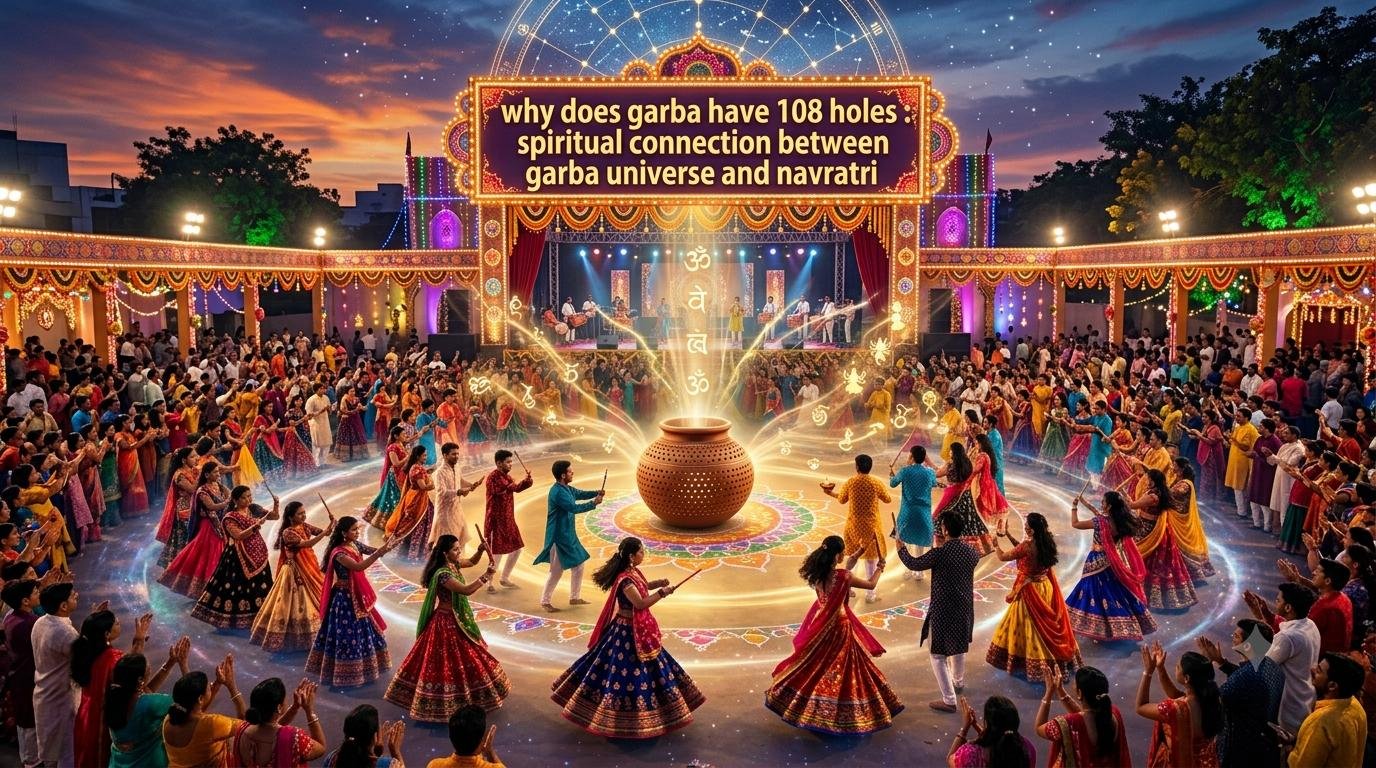
During Navratri, Gujarat transforms into a spectacular celebration of music, devotion, colorful traditional clothing and Garba. Thousands of people gather in circles, dancing around a beautifully decorated Garbo with a lamp glowing at its center.
For many people, the Garba pot is simply a traditional symbol of Navratri. But behind this beautiful tradition lies a deeper spiritual symbolism.
In some traditional Garba designs, the earthen pot is made with 108 small openings or perforations. Through these openings, the light of the lamp inside shines outward.
This creates a powerful image:
One flame. Many openings. One source. Countless expressions.
But what does 108 actually represent? And how can the Garba pot be connected symbolically with the universe?
Let’s explore the fascinating story behind this Navratri tradition.
What Is the Garbo?
The traditional Garbo or Garbi is an earthen vessel associated with Gujarati Navratri celebrations.
A lamp is placed inside the vessel, while decorative openings allow the light to shine through.
The word Garba is commonly connected with garbha, meaning womb.
This gives the Garba an important symbolic meaning.
The pot can represent the womb of creation, while the lamp inside represents life, consciousness or divine energy.
When people dance around it, they are symbolically moving around the source of creation.
This is one reason the Garba becomes much more than a decorative object during Navratri.
Why Is the Number 108 So Important?
The number 108 has a special place in Hindu, Buddhist and yogic traditions.
For example, many prayer malas traditionally contain 108 beads, and devotional traditions include practices involving 108 names or repetitions.
However, there is not one universally accepted explanation for why 108 is sacred. Different spiritual traditions provide different interpretations.
Therefore, it is better to understand 108 as a sacred symbolic number, rather than claiming that one particular scientific calculation proves its meaning.
When 108 is associated with Garba, it can represent a sense of wholeness, completeness and cosmic connection.
How Can 108 Holes Represent the Universe?
Imagine the Garba pot placed in the center of a circle.
Inside the pot is one flame.
Around it are many openings.
The flame is one, but its light emerges through many different openings.
Spiritually, this can be interpreted as:
One divine source → countless forms of life.
The universe may contain billions of people, animals, stars and worlds, yet Indian spiritual philosophy often reflects on the idea of an underlying unity behind this diversity.
The Garba therefore becomes a visual metaphor:
The pot represents the universe.
The lamp represents the divine source.
The openings represent countless expressions of creation.
The dancers represent living beings.
The circle represents the continuing cycle of existence.
This is a spiritual interpretation, not a scientific description of how the physical universe works.
💫 Why Does the Light Shine Through the Holes?
This is perhaps the most beautiful part of the symbolism.
If the lamp were hidden completely inside the pot, people outside would not see its light.
But the openings allow the light to travel outward.
Spiritually, this can represent the idea that divine energy is not confined to one place.
The central flame remains one, but its light reaches many directions.
It can therefore be interpreted as a reminder:
“The source may be one, but its expressions are many.”
This idea also fits beautifully with the diversity of Indian spiritual traditions.
Why Do People Dance Around the Garba?
The circular formation of Garba is another important part of its symbolism.
Dancers move around the central lamp in a circle.
There is no obvious beginning or ending point in a circle.
This can represent the cyclical nature of life:
Birth → Growth → Change → Experience → Transformation → Renewal
Indian philosophical traditions frequently use cycles as important spiritual concepts.
From an astrology-inspired perspective, celestial movements, lunar cycles and the changing seasons also provide examples of recurring patterns.
However, Garba should not be described as an astronomical model. The connection is primarily symbolic and spiritual.
🪐 Garba and Astrology: Is There a Connection?
Garba is not an astrological remedy in the scientific sense.
However, its symbolism can be interpreted through traditional astrology.
Vedic astrology gives importance to the Navgrah, while Navratri celebrates the divine feminine power through the Navadurga, the nine forms of Maa Durga.
This creates an interesting symbolic connection around the number nine.
The Navgrah are traditionally associated with different qualities:
– Sun: confidence and vitality
– Moon: emotions and mind
– Mars: courage and action
– Mercury: intelligence and communication
– Jupiter: wisdom and knowledge
– Venus: beauty and relationships
– Saturn: discipline and responsibility
– Rahu: ambition and worldly desire
– Ketu: detachment and spirituality
The nine forms of Maa Durga similarly provide different spiritual lessons throughout the nine nights of Navratri.
Garba becomes the celebration through which devotees express this connection with Shakti, devotion and cosmic symbolism.
Navratri, Shakti and the Garba Flame
Navratri is fundamentally a celebration of Shakti—the divine feminine power.
The lamp inside the Garba can therefore be understood symbolically as a representation of divine energy.
The darkness surrounding the lamp makes its light even more visible.
This creates another spiritual message:
Light represents awareness.
Darkness represents ignorance.
The flame represents hope and consciousness.
As the Garba moves around the central light, devotees are reminded to keep their lives connected to an inner source of strength.
The Garba Pot Can Also Represent the Human Body
There is another fascinating spiritual interpretation.
The Garba pot can be compared symbolically with the human body.
The body is like the vessel.
The consciousness or life force is represented by the flame.
The openings can represent the many ways through which we experience the world.
Under this interpretation, Garba becomes a reminder that the outer world is constantly moving, but there is an inner center that deserves attention.
This interpretation is philosophical and spiritual rather than a literal description of human anatomy.
Why Does Garba Feel So Powerful During Navratri?
There is a reason the atmosphere of Garba can feel extraordinary.
Think about what happens at a major Navratri celebration:
Music + Rhythm + Movement + Lights + Devotion + Community + Tradition
Thousands of people move together while devotional songs and Garba music fill the surroundings.
From a cultural perspective, this creates a powerful sense of community.
From a spiritual perspective, devotees may experience it as collective Shakti and devotion.
From a personal perspective, it can provide joy, exercise, social connection and emotional expression.
All three perspectives can exist together.
Is 108 Holes a Rule for Every Garba?
Not necessarily.
It is important not to say that every traditional Garba pot must have exactly 108 holes.
Garbo designs, decorations and the number of openings can vary according to regional traditions, artisans and individual designs.
The association with 108 is best presented as a sacred symbolic tradition found in some interpretations and designs, rather than a universal construction rule.
This distinction makes the story more accurate while preserving its spiritual beauty.
The Real Message Behind the 108-Hole Garba
Perhaps the most beautiful lesson is not the number itself.
It is the relationship between the one flame and the many openings.
One light can illuminate many directions.
One source can have countless expressions.
One tradition can bring thousands of people together.
And one small Garba pot can carry a powerful message about life, unity and spirituality.
When we look at the Garba during Navratri, we may see only a lamp inside an earthen vessel.
But symbolically, we can also see:
The universe as a vessel.
Life as a journey.
The divine as the central light.
Humanity as the moving circle.
And 108 as a reminder of sacred completeness.
Final Thoughts
Garba is not simply a dance performed during Navratri.
For Gujarat, it is a cultural identity. For devotees, it is an expression of Shakti. And through its traditional symbolism, it can also become a beautiful reflection on the relationship between light, life, creation and the universe.
The Garba pot with its openings reminds us that one flame can shine in many directions.
The circular dance reminds us that life keeps moving.
The nine nights remind us of the many forms of Shakti.
And the sacred symbolism of 108 invites us to think beyond the visible celebration.
So, the next time you stand in a Garba circle and see the light shining through the traditional pot, remember:
“One light, many paths. One source, countless forms.”
That may be the most beautiful spiritual meaning hidden inside Gujarat’s beloved Garba tradition.
Jai Mata Di! 🌺
Garba Ramva Aavo! 💃🪔
Stay Updated With the Latest Articles
Stay updated with the latest news, insights, and articles.
Subscribe Now for more articles and updates.
