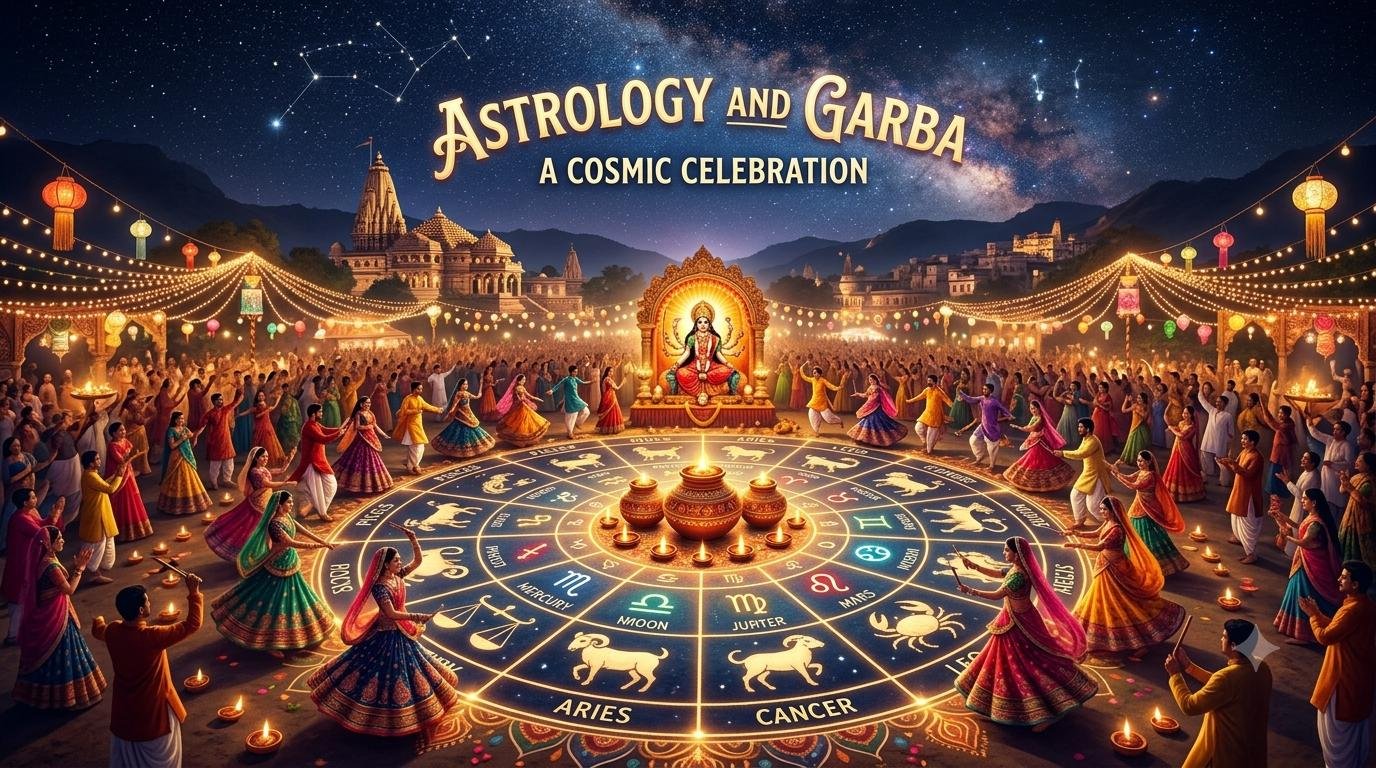
When the beats of the dhol, the sound of clapping hands and the colorful circles of dancers fill Gujarat during Navratri, Garba becomes much more than a traditional dance.
For millions of devotees, Garba is a celebration of Maa Shakti, community, devotion and positive energy.
But have you ever wondered whether Garba also has a connection with astrology?
The circular movement, nine nights of Navratri, traditional colors, rhythmic clapping and worship of the Divine Mother can all be interpreted through a spiritual and astrological lens.
According to Hindu traditions, Navratri is dedicated to the worship of Goddess Durga and her different forms. Garba, particularly associated with Gujarat, has deep cultural and devotional significance during these celebrations.
From an astrology-inspired perspective, Garba can be viewed as a symbolic journey involving energy, rhythm, balance, planetary qualities and the human connection with the cosmic cycle.
What Does Garba Symbolize?
The word Garba is traditionally connected with the Sanskrit word Garbha, meaning womb.
A traditional Garba setup may feature a lamp or sacred object at the center, around which people dance in circles.
This central light can symbolically represent divine consciousness or Shakti, while the circular movement represents the continuous cycle of life.
The dancers move around the center, but the center remains constant.
This creates a beautiful spiritual message:
Life keeps changing, but the inner source of strength can remain steady.
From an astrology perspective, this idea can be compared symbolically with the movement of celestial bodies around a cosmic order.
This is a spiritual interpretation rather than a scientific claim about Garba physically influencing planets.
Why Is Garba Played for Nine Nights?
Navratri means nine nights, and each night is traditionally associated with a form of Goddess Durga.
The nine forms are commonly known as Navadurga:
1. Maa Shailputri
2. Maa Brahmacharini
3. Maa Chandraghanta
4. Maa Kushmanda
5. Maa Skandamata
6. Maa Katyayani
7. Maa Kalaratri
8. Maa Mahagauri
9. Maa Siddhidatri
Each form carries different spiritual symbolism.
Garba performed throughout these nine nights can therefore be viewed as a celebration of the many dimensions of Shakti—strength, discipline, courage, compassion, transformation and wisdom.
Garba and the Navgrah: A Symbolic Connection
The Navgrah occupy an important place in traditional Vedic astrology.
Although Garba itself is not an astrological remedy for the Navgrah, devotees may interpret the nine-night festival through the symbolic qualities traditionally associated with the planets.
Surya – Sun
The Sun represents confidence, vitality, leadership and self-expression.
Garba encourages people to participate confidently while remaining connected to the community.
Garba lesson: Shine without overpowering others.
Chandra – Moon
The Moon is traditionally associated with emotions, mind and sensitivity.
Music and rhythmic movement can provide a meaningful opportunity for emotional expression.
Garba lesson: Find emotional balance through positive expression.
Mangal – Mars
Mars represents courage, energy, action and determination.
The physical movement of Garba can symbolically remind us to channel energy constructively.
Garba lesson: Turn energy into disciplined action.
Budh – Mercury
Mercury represents communication, learning and adaptability.
Garba involves coordination with music, rhythm and other dancers.
Garba lesson: Communicate, listen and adapt.
Guru – Jupiter
Jupiter represents wisdom, knowledge, dharma and guidance.
Navratri gives devotees an opportunity to learn from tradition and spiritual teachings.
Garba lesson: Let celebration also become a learning experience.
Shukra – Venus
Venus is associated traditionally with beauty, art, harmony and relationships.
Garba’s costumes, music, decoration and social atmosphere naturally create a strong cultural connection with artistic expression.
Garba lesson: Appreciate beauty while maintaining respect and harmony.
Shani – Saturn
Saturn represents discipline, responsibility, patience and karma.
Dancing regularly for several nights requires stamina and discipline.
Garba lesson: Consistency matters more than instant results.
Rahu
Rahu is traditionally associated with ambition, fascination and strong worldly desires.
Large modern Garba events can create excitement, popularity and social attention.
Garba lesson: Enjoy celebration without allowing comparison or ego to control you.
Ketu
Ketu is associated traditionally with detachment and spiritual introspection.
Despite the energetic celebration, the central devotional focus can remind people that the festival is ultimately connected with spirituality.
Garba lesson: Celebrate externally while remaining connected internally.
Why Is Garba Performed in a Circle?
The circle is perhaps the most interesting symbolic feature of Garba.
There is no permanent beginning or ending point.
One round naturally leads into another.
Spiritually, this can represent:
Birth → Growth → Change → Experience → Transformation → Renewal
Astrology also deals symbolically with cycles—planetary movements, lunar cycles, seasons and recurring patterns.
Therefore, the Garba circle can be interpreted as a cultural representation of the idea that life is constantly moving and changing.
The important point is that this is a symbolic spiritual interpretation, not evidence that Garba follows astronomical planetary mechanics.
Garba and Zodiac Signs
Every zodiac sign can take a different personal lesson from Garba.
Aries
Use your natural energy positively and avoid unnecessary impatience.
Taurus
Enjoy music, beauty and tradition while remaining grounded.
Gemini
Connect with people and express yourself through communication and rhythm.
Cancer
Enjoy the emotional and family-oriented side of Navratri.
Leo
Express confidence while giving space and respect to others.
Virgo
Focus on rhythm, discipline and coordination rather than perfection.
Libra
Embrace harmony, relationships and balanced participation.
Scorpio
Use the festival as an opportunity for emotional transformation.
Sagittarius
Explore the cultural and spiritual meaning behind the celebration.
Capricorn
Enjoy the celebration while maintaining discipline and responsibility.
Aquarius
Appreciate innovation while respecting traditional culture.
Pisces
Connect with the devotional and emotional side of Garba.
These are general astrology-inspired reflections, not individual horoscope predictions.
Do Navratri Colors Have an Astrological Meaning?
Navratri celebrations often feature different colors associated with particular days.
Color symbolism varies between regional and devotional traditions, so there is no single universal astrological color system for Navratri.
However, astrology traditionally associates colors with planetary symbolism.
For example:
– Sun: red, orange and golden shades
– Moon: white and silver
– Mars: red
– Mercury: green
– Jupiter: yellow
– Venus: white and pastel shades
– Saturn: dark or blue shades
These associations can be used as cultural or spiritual symbolism rather than guaranteed remedies.
Wearing a particular color should not be considered a scientifically proven way to change planetary influences.
Can Garba Be Considered an Astrological Remedy?
This is an interesting question.
Traditional devotees may feel that participating in devotional Garba creates positive energy and strengthens their connection with Maa Durga.
However, Garba should not be presented as a guaranteed astrological remedy.
Its potential benefits can be understood more practically:
– Physical movement supports an active lifestyle.
– Music can encourage emotional expression.
– Group participation strengthens social connection.
– Devotional practices can provide meaning and routine.
– Cultural celebrations can strengthen community identity.
The spiritual value comes from devotion, intention and participation, not from a promise of guaranteed planetary results.
Garba, Shakti and the Divine Feminine
At the heart of Navratri is Shakti—the divine feminine power.
Garba can therefore be viewed as a celebration of energy itself.
The dancers continuously move around the central light.
Symbolically:
The center represents divine consciousness.
The circle represents life.
The movement represents energy.
The music represents rhythm.
The community represents togetherness.
This makes Garba more than entertainment for many participants.
It becomes a cultural expression of devotion.
Why Garba Can Feel Emotionally Powerful
There is another side to Garba that astrology alone cannot fully explain.
Thousands of people dancing together create a powerful sense of collective participation.
The music, repetitive rhythm, traditional clothing, lights, devotion and social environment can make people feel connected to something larger than themselves.
From a spiritual perspective, devotees may experience this as Shakti or divine energy.
From a social and cultural perspective, it can be understood as collective celebration and community bonding.
Both perspectives can coexist.
Garba and the Energy of the Night
Navratri Garba traditionally takes place after sunset and continues into the night.
Nighttime has a special place in many Indian spiritual traditions, particularly because it provides an atmosphere for prayer, meditation and introspection.
The combination of:
Night + Music + Mantra + Movement + Devotion + Community
creates a distinctive Navratri experience.
For devotees, the night becomes a time to celebrate while remembering Maa Durga.
How to Make Your Garba More Meaningful
Instead of focusing only on clothing, competition, popularity or social media content, devotees can add a small spiritual intention to each night.
Before starting Garba, take a moment to think:
“What quality do I want to strengthen today?”
It could be:
– Courage
– Patience
– Discipline
– Compassion
– Confidence
– Forgiveness
– Wisdom
– Gratitude
– Inner peace
Then enjoy the celebration.
This approach transforms Garba from simply a dance event into a personal reflection during Navratri.
The Deeper Astrology Connection
The strongest connection between astrology and Garba is not that dancing will automatically change your horoscope.
Rather, both traditions can encourage people to think about cycles, balance, energy and personal qualities.
Astrology provides a symbolic framework for understanding planetary qualities.
Garba provides a cultural and devotional expression of movement, rhythm and Shakti.
Together, they can inspire one powerful message:
Keep moving, but do not lose your center.
Life will change.
Circums
Circumstances will change.
Relationships will change.
Success and challenges will come and go.
Like the Garba circle, the journey continues.
What matters is staying connected to your values while moving through every new phase.
Final Thoughts
Garba is one of Gujarat’s most recognizable cultural traditions, and during Navratri it becomes deeply connected with devotion to Maa Durga.
From an astrology-inspired perspective, the nine nights, Navadurga, planetary symbolism, colors, rhythm and circular movement can all become opportunities for reflection.
But the most important lesson is not about predicting the future.
It is about developing the qualities that help us navigate the present:
Courage to act.
Wisdom to decide.
Discipline to continue.
Compassion to connect.
And faith to keep moving.
So, when the dhol begins and the Garba circle starts moving this Navratri, remember that the celebration can be both joyful and meaningful.
Dance with happiness.
Celebrate with devotion.
Respect the tradition.
And stay connected to your inner center.
Jai Mata Di! 🌺
Garba Ramva Aavo! 💃🪔
Stay updated with the latest news and articles. Subscribe Now for more articles.
