What if farmers could know when a crop needs water, identify early signs of plant stress, monitor soil conditions from a smartphone and make better decisions before a small problem becomes serious?
That is the idea behind digital agriculture, also known as smart farming or precision agriculture.
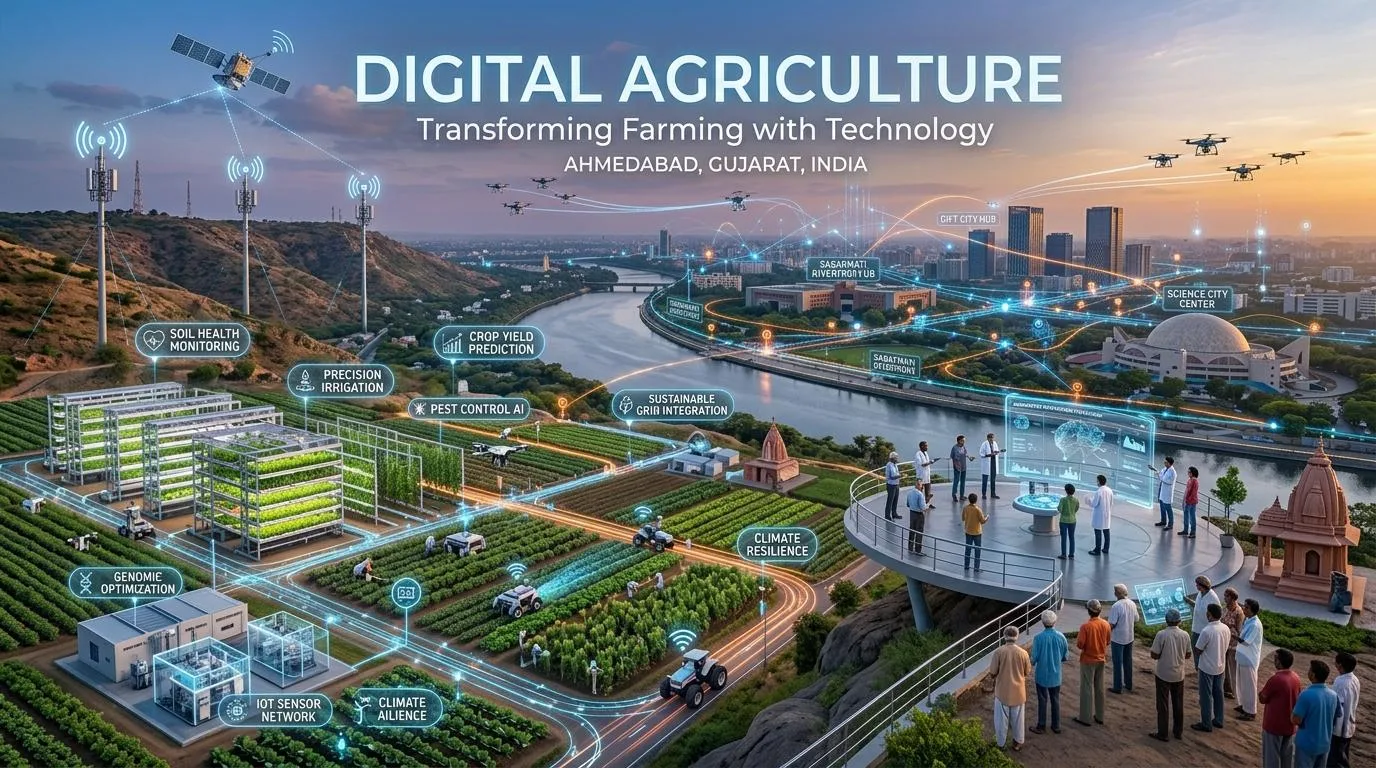
Agriculture is becoming increasingly connected through technologies such as Artificial Intelligence (AI), Internet of Things (IoT) devices, drones, satellite imagery, GPS, robotics and data analytics.
The goal is not simply to put more technology on farms. It is to give farmers useful information that can support better decisions about crops, soil, water, equipment and other resources.
What Is Digital Agriculture?
Digital agriculture is the use of digital technologies, connected devices and data to improve farming activities.
Traditional farming has always depended on experience, observation and local knowledge. Those skills remain extremely important. Digital tools add another layer of information by helping farmers monitor conditions and identify patterns over time.
A digital farming system can collect information about:
- Soil moisture
- Temperature
- Weather conditions
- Crop growth
- Irrigation
- Pest activity
- Farm equipment
- Field conditions
- Production data
Farmers can then use this information to understand what is happening in different parts of a farm instead of relying only on fixed schedules or occasional manual inspections.
How Does Smart Farming Work?
Smart farming brings several technologies together to create a connected agricultural system.
1. IoT Sensors
IoT sensors can be installed in fields to monitor conditions such as soil moisture, temperature and humidity.
For a large farm, checking every area manually can take significant time. Connected sensors can provide information remotely, allowing farmers to pay closer attention to areas that may require action.
2. Satellite Technology
Satellite imagery can provide information about large agricultural areas without requiring farmers to physically inspect every part of a field.
Remote sensing technologies can help identify changes in vegetation and field conditions. When combined with other sources of information, satellite data can become a useful part of crop and land monitoring.
3. Agricultural Drones
Drones can capture aerial images of fields and provide a different view of crop conditions.
Depending on the equipment being used, drones can support activities such as crop monitoring, mapping and targeted agricultural operations.
They can be particularly useful when farmers need to investigate specific areas of a large field.
4. Artificial Intelligence
Artificial Intelligence can process large amounts of agricultural data and identify patterns that may be difficult to detect manually.
AI can support applications such as crop monitoring, disease detection, yield estimation, forecasting and farm management.
However, AI should be viewed as a decision-support tool. The quality of its recommendations depends heavily on the quality, accuracy and relevance of the data available.
5. GPS and Digital Mapping
GPS technology can help farmers map fields, track equipment and perform certain agricultural operations with greater precision.
Digital maps can also help farmers understand differences between field areas and support more targeted use of resources.
When these technologies work together, they create a more connected farming ecosystem.
Smart Irrigation: Using Water More Efficiently
Water management is one of the most important areas where digital technology can support agriculture.
Traditional irrigation systems may operate according to fixed schedules. However, crop water requirements can change depending on soil conditions, weather, crop type and other factors.
Smart irrigation systems can use information such as soil moisture, weather conditions and crop requirements to help determine when irrigation may be needed.
For example, if sensors show that one part of a field already has sufficient moisture, the farmer may be able to avoid unnecessary watering in that area.
This approach is often referred to as precision irrigation.
The actual benefits and water savings depend on factors such as the crop, soil, climate, irrigation infrastructure and how the technology is implemented.
What Is Precision Agriculture?
A large field is rarely identical from one end to another.
Different areas can have different soil characteristics, moisture levels, crop growth and nutrient requirements.
Precision agriculture aims to understand these variations and manage them instead of treating the entire field as one uniform area.
For example, digital tools can help identify areas that may require different levels of irrigation or agricultural inputs.
This can support more targeted farming practices and potentially reduce unnecessary use of water, fertilizer and other resources.
How Drones Can Help Monitor Crops
Agricultural drones give farmers an aerial view that can be difficult to obtain from ground level.
Regular aerial imagery may help identify:
- Differences in crop growth
- Possible water stress
- Damaged areas
- Certain signs associated with disease or pest problems
- Irrigation issues
- Field boundaries
This type of monitoring can help farmers identify areas that deserve closer investigation.
However, drone imagery should not replace field inspection or agricultural expertise. Images provide information, but farmers still need to interpret that information within the context of the crop, soil, weather and local conditions.
Agricultural Robots and Automation
Robotics is another emerging area within digital agriculture.
Agricultural robots are being developed and used for tasks such as:
- Weeding
- Crop monitoring
- Harvesting
- Transportation
- Automated field operations
Robots can potentially perform repetitive tasks with a high level of consistency.
As the technology develops, specialized agricultural machines could become increasingly useful for different crops and farming environments.
The adoption of agricultural robotics will depend on factors such as cost, farm size, crop type, available infrastructure and the complexity of the task being automated.
Weather and Climate Technology in Agriculture
Weather has always been a major factor in farming.
Rainfall, temperature, humidity and wind can influence planting, irrigation, spraying and harvesting decisions.
Digital agriculture can combine weather information with farm data to help farmers plan their activities.
Farmers may use digital systems to monitor:
- Rain forecasts
- Temperature
- Humidity
- Wind conditions
- Extreme weather alerts
- Local weather patterns
Timely information can help farmers prepare for changing conditions.
At the same time, weather forecasts are predictions rather than guarantees. Local knowledge and on-the-ground observation remain important when making agricultural decisions.
How Artificial Intelligence Is Changing Agriculture
Artificial Intelligence could become an increasingly important part of smart farming.
AI systems can process large datasets and identify patterns that may otherwise be difficult to spot.
Some potential applications include:
Crop Monitoring
AI can analyze images and other data to identify changes in crop conditions.
Disease Detection
Computer vision systems can analyze plant images for signs associated with certain diseases or abnormalities.
Yield Estimation
AI models can combine historical information with current crop and environmental data to estimate potential production.
Resource Planning
Data-driven systems can support decisions involving water, fertilizer and other agricultural inputs.
Farm Management
AI-powered platforms can combine information from sensors, weather systems, machinery and other sources into a single dashboard.
The technology is promising, but it is not infallible. Poor-quality data, limited datasets or unsuitable models can lead to inaccurate results.
Smartphones Are Becoming Farming Tools
One of the most accessible parts of digital agriculture is mobile technology.
Farmers can increasingly use smartphones for everyday agricultural activities such as:
- Checking weather information
- Accessing market information
- Maintaining farm records
- Monitoring crops
- Making digital payments
- Receiving agricultural advisories
- Monitoring connected equipment
- Communicating with suppliers and agricultural professionals
This is important because digital agriculture does not necessarily need to be limited to large commercial farms or research facilities.
Mobile technology can bring useful information closer to everyday farming decisions.
How Can Digital Agriculture Help Farmers?
When implemented appropriately, digital farming technology can support farmers in several areas.
Better Resource Management
Farm data can provide a clearer picture of how water, fertilizer, fuel and other resources are being used.
Less Manual Monitoring
Sensors, drones and remote monitoring systems can reduce the need to physically inspect every part of a large farm.
Earlier Problem Detection
Digital monitoring can help identify unusual changes that may require further investigation.
Better Planning
Historical farm data can help farmers compare seasons, identify recurring patterns and plan future activities.
More Precise Operations
GPS, sensors and automation can support more targeted agricultural operations.
These benefits are not guaranteed. Technology costs, connectivity, training, maintenance and local farming conditions can significantly influence the results.
Digital Agriculture and Sustainable Farming
Digital agriculture can contribute to more efficient resource use when technology is implemented appropriately.
For example, better information about soil moisture may support more targeted irrigation. Similarly, field-level data can help farmers understand where certain inputs may be needed.
Over time, digital records can also help farmers monitor changes in soil and crop conditions.
However, technology itself has an environmental footprint.
Sensors, smartphones, drones, computers and other electronic equipment require energy and materials. Devices also eventually need to be repaired, replaced or recycled.
For this reason, sustainable digital agriculture is not simply about adopting more technology. It is about using technology where it provides meaningful agricultural value.
Challenges of Smart Farming
Despite its potential, digital agriculture also comes with challenges.
Cost
Advanced sensors, drones, machinery and software can be expensive, particularly for smaller farms.
Connectivity
Reliable internet and mobile connectivity may not be available in every rural area.
Digital Skills
Farmers may require training and support before they can confidently use new digital systems.
Maintenance
Sensors, drones, connected equipment and other devices require regular maintenance.
Data Privacy
Farm data can contain commercially important information. Appropriate data protection and access controls are therefore important.
Interoperability
Different agricultural devices and software platforms may use different systems and formats, making it difficult to share information between them.
Local Suitability
A technology designed for one crop, climate or region may not deliver the same results in another environment.
These challenges show why successful digital agriculture requires more than simply purchasing technology. Farmers also need reliable infrastructure, practical training and systems that fit their actual needs.
What Could the Future of Farming Look Like?
The future of agriculture could become increasingly connected.
A farm may combine:
- IoT sensors
- Drones
- Satellite imagery
- Artificial Intelligence
- Robotics
- Smart irrigation
- GPS technology
- Digital farm management platforms
Instead of viewing these technologies separately, farmers could use integrated systems that bring information together in one place.
For example, a future farm management platform could combine soil information, weather forecasts, crop imagery and equipment data to help farmers understand what is happening across their fields.
Technology may also become more affordable and easier to use as adoption increases.
The most useful systems are likely to be those that solve real agricultural problems rather than adding unnecessary complexity.
The Role of Farmers Will Remain Important
One of the biggest misconceptions about smart farming is that technology will completely replace farmers.
Agriculture is influenced by weather, soil, biology and countless local conditions. Technology can collect information and identify patterns, but farming decisions still require human judgment.
A farmer’s experience can provide context that a digital system may not understand.
The future of agriculture is therefore more likely to involve collaboration between human knowledge and digital technology rather than complete automation.
Final Thoughts
Digital agriculture is bringing farming into an increasingly connected and data-driven era.
From soil sensors and drones to Artificial Intelligence, GPS systems and agricultural robots, digital technologies can give farmers more information about what is happening in their fields.
The goal is not to replace farmers.
It is to combine agricultural experience with better data and practical digital tools.
Technology cannot eliminate unpredictable weather, changing soil conditions or the natural risks involved in farming. But when used responsibly, it can help farmers make more informed decisions, manage resources more precisely and respond to problems earlier.
The farm of tomorrow may therefore be more than a place where crops grow.
It could become a connected, data-driven ecosystem where technology and human experience work together to build a more informed approach to agriculture.
Frequently Asked Questions About Digital Agriculture
What is digital agriculture?
Digital agriculture is the use of digital technologies, data and connected devices to support farming activities. It can include IoT sensors, drones, satellite imagery, AI, GPS, robotics and farm management software.
What is the difference between digital agriculture and precision agriculture?
Digital agriculture is a broad term covering the use of digital technologies throughout farming. Precision agriculture focuses more specifically on using data and technology to manage differences within fields and apply resources more precisely.
How can AI help farmers?
AI can analyze agricultural data and support applications such as crop monitoring, disease detection, yield estimation, forecasting and resource planning. Its effectiveness depends on the quality and relevance of the data used.
Can digital agriculture reduce water usage?
Digital agriculture can support more targeted irrigation by using information such as soil moisture, weather conditions and crop requirements. However, actual water savings depend on the technology, crop, soil, climate and irrigation system.
Are drones useful for agriculture?
Yes. Agricultural drones can provide aerial imagery that may help with crop monitoring, mapping, identifying unusual field conditions and investigating areas that require closer inspection.
Will technology replace farmers?
Technology is more likely to support farmers than completely replace them. Agricultural decisions still depend heavily on experience, local knowledge, field conditions and human judgment.
Is digital agriculture suitable for small farms?
Digital agriculture can be useful for farms of different sizes, but the most appropriate technology depends on cost, connectivity, crop type, infrastructure and the specific problem a farmer wants to solve.
Explore More
If you are interested in how technology is changing different industries, explore our related articles on Artificial Intelligence, Machine Learning, data analytics and enterprise technology.
Stay updated with the latest news and articles. Subscribe Now for more articles.
