
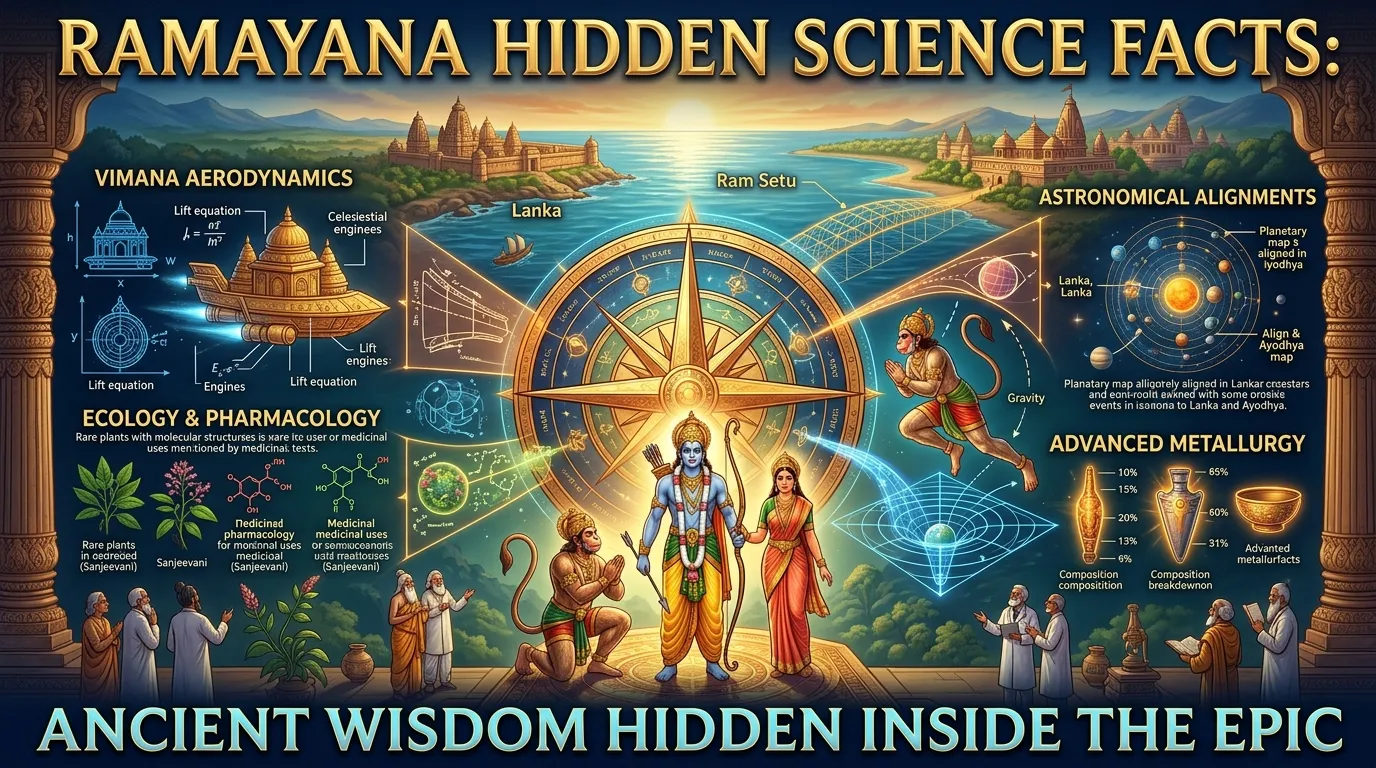
The Ramayana is one of the greatest epics in Indian tradition. Written by Valmiki, it is widely known as the story of Rama, devotion, and the victory of good over evil.
But beyond spirituality and storytelling, many people believe the Ramayana also contains fascinating references to science, engineering, medicine, astronomy, and ancient technology. While these ideas are interpretative and symbolic rather than proven scientific records, they continue to spark curiosity among researchers and readers.
1. Ram Setu: Ancient Engineering Wonder
One of the most discussed scientific mysteries in the Ramayana is Ram Setu, the bridge built between India and Lanka. According to the epic, the army of Rama constructed a massive bridge to cross the ocean.
Satellite images show a chain-like structure between India and Sri Lanka, often linked with Ram Setu. Some researchers believe it may have been a natural formation later connected by humans, while others see it as symbolic mythology.
The story reflects knowledge of civil engineering, team coordination, and ocean crossing techniques.
2. Pushpaka Vimana: Ancient Flying Vehicle
The Pushpaka Vimana is described as a flying chariot used by Ravana that could travel through the sky and carry many passengers. Some people compare it to aircraft, flying machines, and futuristic transportation concepts.
There is no archaeological evidence of ancient airplanes, but the imagination behind the concept is remarkable for its time. The Ramayana shows advanced thinking about aerial travel long before modern aviation.
3. Sanjeevani Herb and Ancient Medicine
During the war, Hanuman carried the Sanjeevani herb to save Lakshmana. This story reflects ancient India’s deep knowledge of herbal medicine, Ayurveda, and healing plants. Even today, Himalayan herbs are studied for powerful medicinal properties.
The epic highlights the importance of natural medicine and medical knowledge in ancient Indian civilization.
4. Astronomical References in Ramayana
The Ramayana contains detailed references to planets, stars, lunar positions, and eclipses. Some researchers use these descriptions to estimate possible historical timelines. The text demonstrates a sophisticated understanding of astronomy and celestial observation, showing that ancient Indian scholars closely studied the movement of heavenly bodies.
5. Psychological and Emotional Intelligence
The Ramayana deeply explores human emotions, leadership, relationships, and decision-making. Many management experts and psychologists study the Ramayana for lessons in leadership ethics, emotional control, conflict resolution, and duty and responsibility. The epic reflects an advanced understanding of human psychology.
6. Military Strategy and Warfare
The Ramayana describes battle formations, specialized weapons, communication systems, and intelligence gathering. The epic shows knowledge of strategic warfare and military organization. Weapons like the Brahmastra are often interpreted symbolically as highly powerful destructive forces.
7. Environmental Awareness
Nature plays a major role in the Ramayana. Forests, rivers, animals, and mountains are treated with respect. The epic promotes ecological balance, respect for wildlife, and harmony with nature — values that align strongly with modern environmental thinking.
8. Yogic and Spiritual Science
Many characters in the Ramayana practiced meditation, self-control, mental discipline, and breath regulation. Modern studies show meditation improves mental health, focus, and emotional stability. Ancient yogic practices described in spiritual texts are now widely researched scientifically.
Mythology or Ancient Science?
It is important to understand that the Ramayana is primarily a spiritual and cultural epic. Scientific interpretations are symbolic and speculative, and not all stories should be taken literally as historical science.
However, the epic clearly reflects advanced imagination, observational knowledge, and a deep understanding of nature and human behavior.
Conclusion
The Ramayana is much more than a mythological story. Hidden within its verses are fascinating ideas connected to engineering, astronomy, medicine, psychology, and environmental wisdom. Whether viewed spiritually or symbolically, the Ramayana continues to inspire curiosity and admiration even in the modern scientific age.
Ancient wisdom often speaks through stories before science gives it language.
Stay updated with the latest news and articles. Subscribe Now for more articles.
