
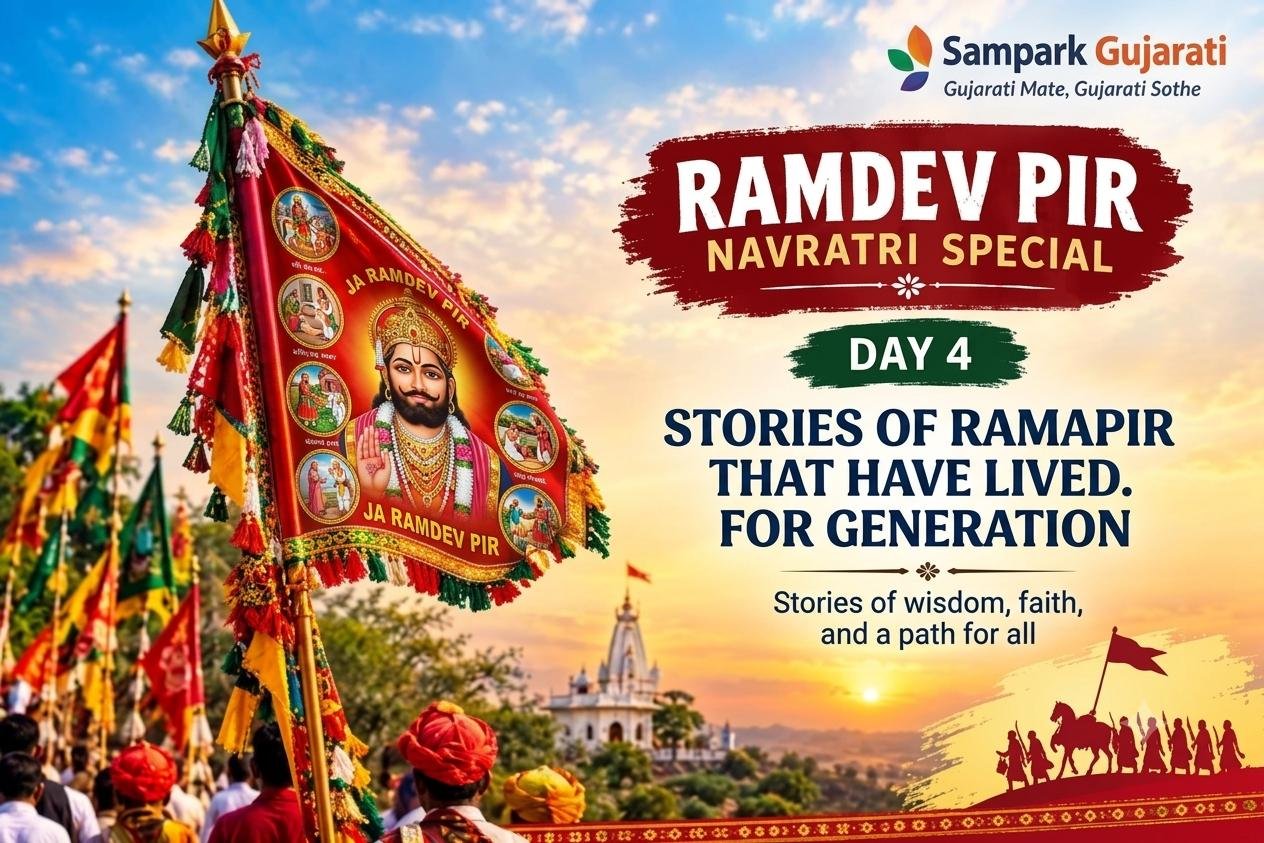
Ramdev Pir Navratri Special | Day 4
What if a story survives for centuries not because it is written in history books, but because generation after generation refuses to stop telling it?
The legacy of Ramdev Pir, also known as Ramapir or Baba Ramdevji, is filled with stories that have travelled through folk songs, bhajans, oral traditions and devotional gatherings.
Some of these stories describe extraordinary events and miraculous powers attributed to Ramdev Pir. Others focus on his compassion, spiritual strength and interactions with people from different communities.
For devotees, these narratives are an important part of Ramapir’s living tradition. From a historical perspective, however, such accounts should be understood as folk and devotional traditions rather than independently verified historical events.
On Day 4 of Sampark Gujarati’s Ramdev Pir Navratri Special, let’s explore some of the most famous stories associated with Ramapir and understand why they continue to fascinate devotees across Gujarat and Rajasthan.
Ramdev Pir: Where History Meets Folk Tradition
Rajasthan’s official tourism and government sources identify Baba Ramdevji as an important folk deity and note the significance of Ramdevra, where his final resting place is located. The Ramdevra shrine is visited by people of different faiths, and the annual fair attracts large numbers of devotees.
Alongside this documented cultural significance, generations have preserved numerous stories about Ramdev Pir through oral and devotional traditions.
These stories should not all be treated as historical records. Instead, they provide an insight into how communities remember a revered figure and the values they associate with him.
The Story of the Five Pirs
One of the best-known legends connected with Ramdev Pir involves five Pirs who came to test his spiritual powers.
According to a Rajasthan government development report for Ramdevra, the five Pirs are said to have come from Mecca to test Ramdev’s abilities.
Ramdev welcomed them and invited them to have a meal. The Pirs reportedly insisted that they could eat only from their own utensils, which they had left in Mecca.
The legend says that Ramdev then called for their utensils, and the vessels were believed to arrive from Mecca.
Impressed by what they witnessed, the five Pirs are said to have paid homage to Ramdev and addressed him as Rama Shah Pir. The same government report connects this story with the five Pir memorials at Ramdevra.
Why Is This Story Important?
Beyond the miraculous element, the story has a fascinating cultural dimension.
It connects Ramdev Pir’s tradition with both Hindu and Muslim devotional traditions and helps explain his identity as Ramapir/Ramasa Pir.
Rajasthan Tourism also describes Ramdevra as a place revered by people of all faiths and identifies Ramdevji as a symbol of Hindu-Muslim unity.
The Miracle Stories of Ramapir
Many popular stories surrounding Ramdev Pir describe extraordinary events attributed to his spiritual powers.
These stories have been preserved through:
– Folk songs
– Bhajans
– Oral storytelling
– Religious gatherings
– Community traditions
– Devotional literature
The exact details can differ from one region or community to another.
For devotees, these accounts are expressions of faith. For readers approaching them from a historical perspective, they are best understood as part of Ramdev Pir’s rich folklore and devotional heritage.
This distinction is important because faith traditions and historical documentation serve different purposes.
The Storytelling Power of Ramdev Pir’s Legends
Why have these stories survived for so long?
One reason is their ability to combine emotion, wonder and cultural identity.
A story about an extraordinary event is easy to remember and retell. When that story is connected with a respected spiritual figure, it can become part of a community’s collective memory.
In villages and families, such stories may be told during religious gatherings or passed from grandparents to children.
Over time, they become more than stories. They become part of the cultural identity of the people who preserve them.
Ramdev Pir and the Five Pirs Tradition
The connection between Ramdev Pir and the five Pirs is particularly significant.
The Ramdevra development report describes Baba Ramdevji as a 14th-century folk deity and records the tradition that five Pirs came to test him. It also notes that the five Pirs are associated with memorials at the site.
This tradition helps explain why Ramdev Pir’s identity has a distinctive place in Rajasthan’s shared religious culture.
It is not simply a story about supernatural powers. It is also a story about interaction between religious traditions.
Ramdevra: The Sacred Place Behind the Stories
The stories of Ramapir are closely connected with Ramdevra, located in Rajasthan.
Rajasthan Tourism states that Ramdevra Temple lies about 12 kilometres from Pokhran on the Jodhpur–Jaisalmer route and is dedicated to Baba Ramdevji rather than Lord Ram. The site is regarded as his final resting place.
The temple attracts devotees from different faiths.
During the annual Ramdevra Fair, large numbers of devotees gather at the site and devotional songs are sung through the night.
This makes Ramdevra more than a pilgrimage destination. It is also an important centre of the cultural traditions surrounding Ramapir.
Why Do Devotees Believe in These Stories?
Faith is personal.
A devotee may view a traditional story as evidence of divine power, while another person may see it as an important part of folk culture.
Both perspectives can coexist when the distinction between belief and historical verification is clearly maintained.
The continued popularity of these stories shows that their importance is not limited to whether every detail can be historically established.
They have emotional and cultural meaning for the communities that preserve them.
The Difference Between Faith and Historical Fact
This is an important point when discussing religious legends.
A story passed through generations can be culturally significant without being independently verified by modern historical methods.
Therefore, stories about Ramdev Pir’s miracles should be described as popular beliefs, legends or devotional traditions rather than proven supernatural events.
This approach allows readers to appreciate the richness of the tradition while maintaining historical responsibility.
Why Ramapir’s Stories Continue to Attract Young People
Today’s generation consumes stories differently.
Social media reels, short videos, podcasts and digital articles have created new ways to discover traditional stories.
A centuries-old folk legend can now reach someone within seconds through a smartphone.
This gives platforms such as Sampark Gujarati an opportunity to present traditional stories in a way that is both engaging and responsible.
Instead of simply repeating a legend, we can ask:
What does the story tell us about the culture that preserved it?
That question makes traditional storytelling relevant to modern readers.
The Cultural Legacy of Ramdev Pir
The popularity of Ramdev Pir demonstrates the power of India’s folk traditions.
His stories have survived through different forms of expression, including devotional songs, religious gatherings and pilgrimage traditions.
The government of Rajasthan itself recognizes Ramdevji as an important folk deity and has a dedicated Lok Devta Baba Ramdevji Panorama at Ramdevara.
His legacy therefore exists at multiple levels:
Religious: Through worship and devotion.
Cultural: Through songs, fairs and traditions.
Social: Through a broad following across communities.
Historical: Through places and traditions associated with his life and final resting place.
Folkloric: Through stories of extraordinary events and spiritual powers.
What Makes the Ramapir Stories Special?
Perhaps the most fascinating part is not whether every miracle can be proved.
It is the fact that people continue to remember, retell and celebrate these stories.
A tradition survives when people give it meaning.
The stories of Ramdev Pir have remained alive because they are connected with places, festivals, families, songs and personal faith.
That is the real power of folk storytelling.
Day 4 Takeaway
The legends of Ramdev Pir represent one of the most fascinating parts of his cultural legacy.
The story of the five Pirs, the traditions of his miraculous powers and the pilgrimage to Ramdevra have all contributed to the enduring popularity of Ramapir.
Some of these accounts belong to devotional folklore rather than independently verified history. Yet they remain culturally significant because generations of devotees have preserved them.
Ramdev Pir’s story is therefore not just about miracles.
It is also about memory, culture, devotion and the remarkable ability of stories to travel across generations.
🚩 Day 5: Ramdev Pir and the Power of Seva
Can serving another person also become an expression of devotion?
Tomorrow, Day 5 of the Ramdev Pir Navratri Special explores one of the most meaningful themes associated with Ramapir’s tradition: seva, compassion and helping others.
We’ll look at how the idea of service appears in Ramdev Pir’s cultural legacy and why the concept of helping those in need remains relevant in modern life.
Day 5: Ramdev Pir and the Power of Seva — coming next on Sampark Gujarati.
Jai Ramapir 🚩
Frequently Asked Questions
Are the miracles of Ramdev Pir historically proven?
Many miracle stories associated with Ramdev Pir belong to folk and devotional traditions. They are important expressions of faith but should not automatically be presented as independently verified historical events.
What is the story of the five Pirs?
According to a Rajasthan government report on Ramdevra, five Pirs are traditionally said to have come to test Ramdev’s spiritual powers. The legend says they were impressed after their utensils were brought from Mecca and subsequently honoured him as Rama Shah Pir.
Where is Ramdev Pir’s main shrine?
The famous Ramdevra Temple in Rajasthan is dedicated to Baba Ramdevji and is regarded as his final resting place. Rajasthan Tourism identifies it as an important pilgrimage site visited by people of different faiths.
What is Ramdevra Fair?
The Ramdevra Fair is a major annual religious gathering held at Ramdevra, with large numbers of devotees visiting the shrine and participating in devotional activities. Rajasthan Tourism notes that the fair takes place around August–September.
Suggested Featured Image Text:
RAMDEV PIR NAVRATRI SPECIAL
DAY 4
The Stories & Legends of Ramapir
Internal Linking:
Day 1 → Who Was Ramapir?
Day 2 → The Story & Meaning of Ramapir Neja
Day 3 → Ramapir and the Message of Equality
Day 5 → Ramdev Pir and the Power of Seva
Stay updated with the latest news and articles. Subscribe Now
