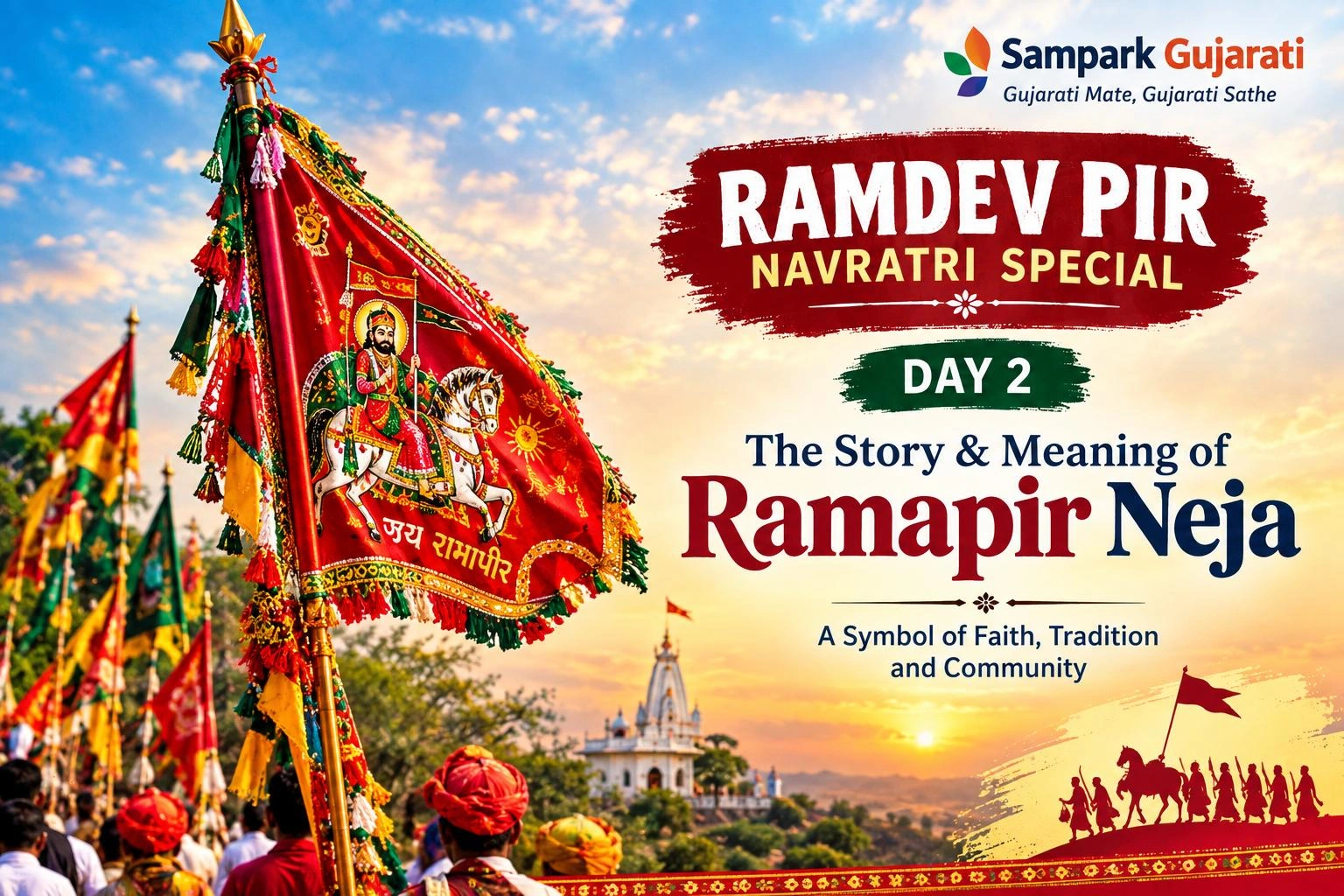
Ramdev Pir Navratri Special | Day 2
Have you ever noticed a colourful religious flag rising above a Ramdev Pir gathering and wondered what it means?
That flag is commonly known among devotees as the Ramapir Neja. For many communities in Gujarat and Rajasthan, the Neja is more than a decorated flag. It can represent devotion, family tradition, community participation and a visible connection with the worship of Ramdev Pir.
But there is no single design or universal ritual that defines every Neja. Its colours, decoration and use can vary according to local customs and family traditions.
As we continue the Ramdev Pir Navratri Special on Sampark Gujarati, Day 2 looks at the story behind this distinctive symbol and why it continues to hold cultural importance.
What Is Ramapir Neja?
The word Neja is generally used for a religious flag or banner carried or displayed during devotional occasions.
In traditions associated with Ramdev Pir, a Neja may appear during religious gatherings, processions, fairs and other community celebrations. For devotees, it provides a visible way to express their connection with Ramapir.
The exact appearance of a Neja is not identical everywhere.
Colours, patterns, borders, decorations and methods of carrying the flag can differ between communities. This variation is a normal feature of India’s living folk traditions.
Rather than seeing these differences as contradictory, they can be understood as evidence of how devotional traditions develop within different communities and regions.
Why Is the Ramapir Neja Important?
The importance of the Neja is largely connected with what it represents to the people who carry or display it.
It can be understood through three simple ideas:
- Faith: A visible expression of devotion toward Ramapir.
- Tradition: A practice that can be passed from parents and grandparents to younger generations.
- Community: A symbol that becomes part of collective religious gatherings.
For one family, carrying a Neja may be connected with a long-standing family custom. For another devotee, it may represent personal faith or participation in a religious event.
That personal meaning is an important part of folk devotion.
The Neja Is Not Just About Its Colours
One of the most noticeable features of a Ramapir Neja is its appearance.
Some Nejas may feature bright colours, decorative borders, religious motifs or other traditional designs. However, it would be misleading to suggest that one particular colour combination or design is followed by every Ramdev Pir devotee.
Local customs matter.
A family in one region may prepare its Neja differently from a community in another region. The occasion itself may also influence how the flag is decorated or displayed.
This diversity gives the tradition its distinctive folk character.
How the Neja Creates a Sense of Community
A religious gathering can be both personal and collective.
A devotee may have a deeply personal relationship with Ramapir, but when many people gather together, individual expressions of faith become part of a larger community experience.
A Neja can contribute to that atmosphere.
During a procession or religious gathering, several flags moving together can create a powerful visual expression of participation. The flag becomes part of the shared identity of the gathering rather than belonging only to one person.
This is one reason devotional symbols often become important cultural markers.
Ramapir Neja and Family Tradition
Folk traditions survive when they are practised and explained from one generation to another.
Children may first encounter the Neja by watching parents, grandparents or other family members participate in a Ramdev Pir celebration.
They may learn:
- Why the family follows the tradition
- When the Neja is used
- How it is prepared or decorated
- What Ramapir means to the family
- Why religious gatherings are important to the community
Over time, such experiences can become part of family memory.
The Neja therefore represents more than an object. For some families, it becomes a reminder of childhood, elders, religious occasions and shared experiences.
Is Ramapir Neja Only a Religious Symbol?
For devotees, its religious significance is central. But the Neja can also be viewed from a wider cultural perspective.
It connects several aspects of community life:
- Devotion and tradition
- Family and community
- Faith and folk culture
- Older generations and younger generations
- Personal belief and public celebration
This is what makes the Neja interesting from a cultural point of view.
Religious symbols can sometimes become part of a region’s visual identity, especially when they appear repeatedly during fairs, processions and community celebrations.
Ramdev Pir and the Folk Culture of Gujarat
Gujarat has a rich tradition of devotional songs, folk deities, saints, fairs and community-based religious practices.
Ramdev Pir has a strong devotional presence among communities in Gujarat as well as Rajasthan. The wider Ramdev Pir tradition is also associated with Ramdevra in Rajasthan, where the government identifies Baba Ramdevji as an important folk deity and records worship that crosses caste and religious boundaries.
The traditions followed by devotees are not necessarily identical from place to place.
Some communities may give greater importance to temple visits. Others may focus on bhajans, family observances, processions or traditional symbols such as the Neja.
That variety is part of the living nature of folk culture.
Ramapir Neja and the Meaning of Visible Faith
There is something unique about a religious flag.
Prayer can be silent and deeply personal. A flag, however, can be seen by an entire community.
That makes the Neja a form of visible faith.
When a Neja is carried during a religious gathering, it communicates participation without requiring words. It tells others that the person or group carrying it is taking part in a tradition associated with Ramapir.
For devotees, that visibility can make the experience of worship feel more collective.
Why Do Devotees Carry a Neja?
There is no single answer that applies to every devotee.
People may carry or display a Neja because of:
- Family tradition
- Personal devotion
- A religious commitment or vow
- Participation in a community celebration
- A desire to honour Ramapir
- A connection with childhood and family memories
Religious practices often have several layers of meaning at the same time.
What looks like a simple flag to one person may represent years of faith and memories for another.
That difference in personal meaning is worth respecting.
Ramdevra: The Wider Cultural Connection
The connection between Ramdev Pir and Ramdevra is central to understanding the broader tradition.
Rajasthan Tourism identifies Ramdevra Temple as the resting place associated with Baba Ramdevji. The temple is located about 12 kilometres from Pokhran on the Jodhpur–Jaisalmer route and attracts people of different faiths. A major Ramdevra fair is held around August and September, with devotional singing forming part of the celebrations.
The Rajasthan Devasthan Department also records the Ramdevji temple at Ramdevra and notes that devotees visit throughout the year, while major fairs are held during January–February and August–September.
These gatherings provide an important cultural setting in which Ramdev Pir traditions continue to be practised and passed forward.
What Makes the Neja Tradition Relevant Today?
Modern life has changed the way people communicate and participate in communities, but many traditional symbols remain meaningful.
The Neja continues to connect people with:
- Their family history
- Their religious beliefs
- Their regional culture
- Community celebrations
- Stories and traditions learned from previous generations
The Rajasthan government has also recognized Ramdevji’s cultural legacy through the Lok Devta Baba Ramdevji Panorama at Ramdevara, reflecting the continuing cultural importance of his story and tradition.
For younger generations, symbols such as the Neja can provide a simple entry point into understanding the larger cultural history surrounding Ramapir.
The Deeper Meaning of Ramapir Neja
The real significance of the Neja is not determined simply by its height, colour or decoration.
Its meaning comes from the people who carry it and the traditions they attach to it.
One community may see it as a devotional offering. Another may see it as a family tradition. Someone else may associate it with a religious procession or childhood memories.
All of these experiences can exist within the wider Ramapir tradition.
That is why the Neja remains more than a decorative flag.
It is a visible reminder that religious traditions are also carried through families, communities and generations.
Day 2 Takeaway
The Ramapir Neja is a powerful example of how faith can become part of everyday cultural expression.
For devotees, it can represent devotion, tradition, family identity and community participation. Its exact appearance and customs may differ across regions, but the tradition continues to hold meaning for people connected with Ramdev Pir.
Perhaps the most beautiful part of the Neja is its ability to turn an individual feeling of faith into something that can be shared with an entire community.
From Day 1 to Day 2
Day 1 of our Ramdev Pir Navratri Special explored who Ramdev Pir was and why Ramapir remains deeply respected across Gujarat and Rajasthan.
Day 2 takes that story one step further by looking at one of the most recognizable symbols associated with his devotional tradition.
The journey continues tomorrow.
🚩 Day 3: Ramdev Pir and the Message of Equality
On Day 3, we explore another important aspect of Ramdev Pir’s legacy: equality and social harmony.
Why has the tradition surrounding Ramapir attracted people across caste and religious boundaries?
What does the message of treating people with dignity mean in today’s world?
Follow the next chapter of the Ramdev Pir Navratri Special on Sampark Gujarati.
Frequently Asked Questions
What is Ramapir Neja?
Ramapir Neja is a traditional religious flag or banner associated with devotional practices connected with Ramdev Pir. Its use and appearance can vary according to local and community customs.
What does the Ramapir Neja represent?
For devotees, the Neja can represent faith, devotion, family tradition, community participation and a connection with Ramapir’s devotional culture.
Is there one fixed design for Ramapir Neja?
No. Colours, decoration, size and other characteristics can vary according to regional, family and community traditions.
Where can Ramapir Neja traditions be seen?
Neja-related practices can be found among communities associated with Ramdev Pir, particularly in Gujarat and Rajasthan, including during religious gatherings and celebrations.
Is carrying a Neja compulsory for Ramdev Pir devotees?
No single practice should be assumed to apply to every devotee. Religious customs can differ between individuals, families and communities.
Why is the Neja important in Gujarati culture?
For many devotees, it provides a visible connection to Ramapir devotion while also representing family tradition and participation in community religious celebrations.
Continue the Ramdev Pir Navratri Special
The Ramapir tradition is much larger than any single symbol.
From the story of Ramdev Pir to the Neja, from equality and seva to the traditions surrounding Ramdevra, each part reveals another dimension of Gujarat and Rajasthan’s living folk culture.
Day 3 is coming next on Sampark Gujarati.
Stay connected with the complete Ramdev Pir Navratri Special.
Stay updated with the latest news and articles. Subscribe Now
Authoritative Sources
- Rajasthan Tourism – Ramdevra Temple
- Rajasthan Devasthan Department – Ramdevji Temple Profile
- Rajasthan Government – Ramdevra Development & Cultural Significance Report
- Rajasthan Tourism – Baba Ramdevji Panorama
