
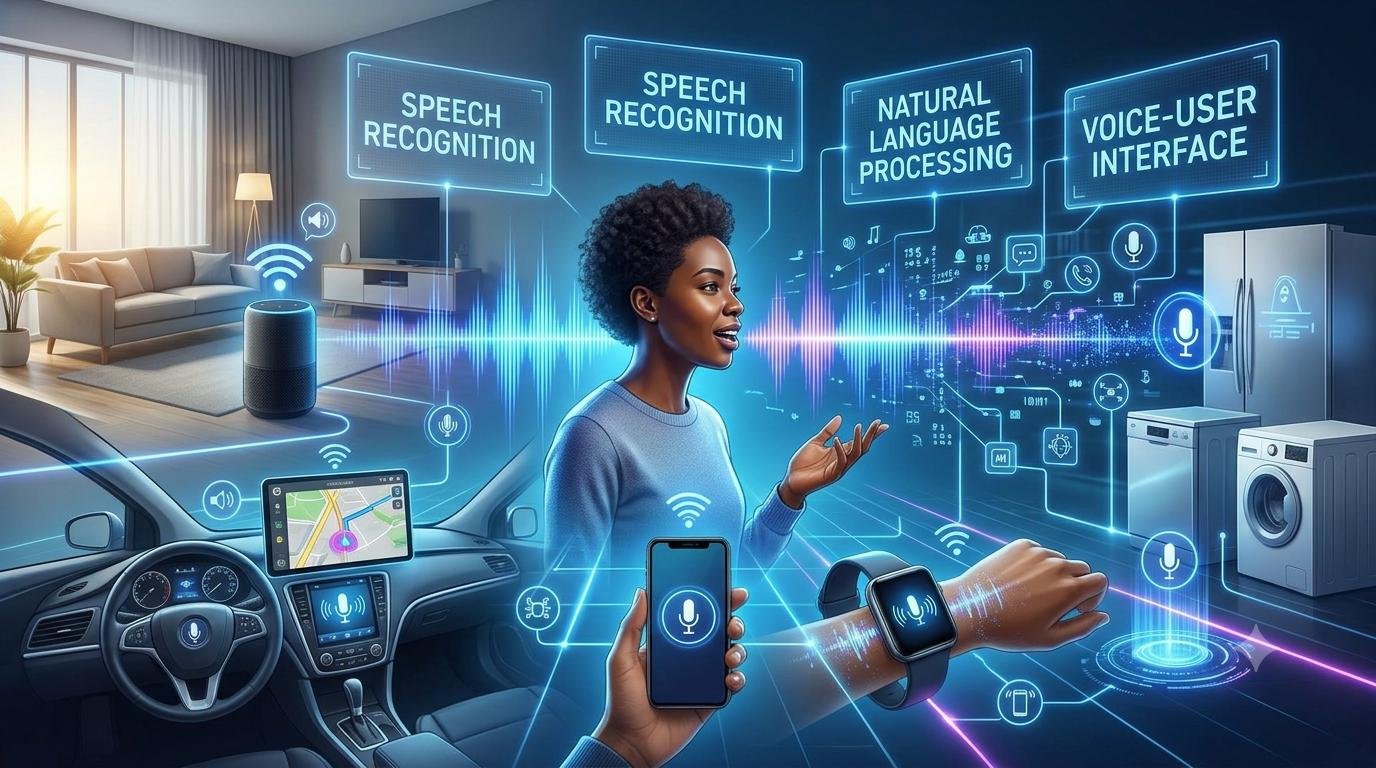
What if you could control your smartphone learn a skill manage your daily schedule or get help with a task simply by speaking naturally?
You no longer need to type every question or navigate through applications to interact with digital technology. Voice technology and conversational AI are making it possible for people to communicate with machines using language.
From voice assistants and smart speakers to AI-powered customer support and hands-free controls this technology is changing how humans interact with computers.
How does it work and could talking to technology become as common as typing a message?
What Is Voice Technology?
Voice technology enables computers and digital devices to recognize, interpret or respond to language.
It includes related technologies:
- Speech recognition: Converts spoken words into text or machine-readable instructions.
- Natural language processing: Helps software interpret the meaning of language.
- Conversational AI: Enables systems to respond through a dialogue.
- Text-to-speech: Converts written text into spoken audio.
- Voice assistants: Help users perform tasks through spoken commands.
These technologies can work together to create experiences in which people ask questions receive spoken responses and complete activities without using a keyboard.
What Is AI?
Conversational AI is a type of artificial intelligence designed to interact with people through natural language.
Unlike a command system that recognizes only a limited set of phrases modern conversational systems may be able to interpret context answer follow-up questions and respond to more complex requests.
For example a user might say:
“Help me plan tomorrow.”
The system could ask about priorities organize tasks and suggest a schedule.
Depending on its capabilities and permissions it might also connect to calendars or other digital tools.
However not every conversational AI system can perform actions. Some can only provide information while others can interact with supported applications.
How Does Voice Technology Work?
A typical voice interaction involves stages.
1. Capturing the Voice
A microphone captures the users speech.
Some devices listen for a wake word while others begin processing after the user presses a button or activates a voice feature.
2. Recognizing Speech
Speech-recognition software analyzes the audio. Identifies the words being spoken.
The quality of recognition can depend on background noise, pronunciation, microphone quality and the language being used.
3. Understanding the Request
The system processes the words to determine what the user wants.
For example “Set an alarm for six tomorrow morning” contains an action, a time and a date reference.
4. Generating a Response
The AI or software determines a response or action.
5. Speaking or Completing the Task
The system may respond using synthesized speech, display text. Perform an authorized action.
Advanced systems can support ongoing conversations instead of treating every interaction as a separate command.
Voice Technology in Life
Voice interaction is already useful in many common situations.
Smartphone Assistance
People can use voice commands to make calls dictate messages, set reminders, search for information or control supported phone features.
This can be particularly convenient when typing is difficult or when a users hands are occupied.
Navigation
Drivers can use voice-controlled navigation systems to request directions or change destinations while keeping their attention on the road.
Drivers should still follow road-safety rules. Avoid interactions that distract them from driving.
Smart Home Control
Voice technology can operate lights, speakers, thermostats and other connected devices.
For example saying “Turn off the living-room lights” may activate a supported automation.
Writing and Dictation
Speech-to-text tools can convert spoken words into written messages, notes, documents and drafts.
This can help people capture ideas quickly or compose text without typing everything
Voice Technology for Smart Homes
Voice assistants are becoming an interface for connected homes.
Of opening a separate application for every device users may be able to control multiple compatible products through one voice interface.
Possible uses include:
- Switching lights on and off
- Adjusting compatible temperature controls
- Playing music
- Setting timers
- Checking reminders
- Controlling appliances
- Activating predefined routines
For example a user could create a “Good Night” routine that turns off selected lights and adjusts supported devices.
The routine works only if the devices, software and permissions support the requested actions.
Voice Technology in Healthcare
Voice technology can help healthcare professionals and patients in selected situations.
Potential applications include:
- Dictating notes
- Transcribing conversations with appropriate consent
- Managing appointment reminders
- Providing voice-based access to information
- Supporting people who have difficulty using conventional interfaces
Voice systems may reduce some administrative work but healthcare information requires careful handling.
Speech recognition can make mistakes and AI-generated medical documentation should be checked by professionals. Sensitive recordings and transcripts also require privacy protections.
How Voice AI Could Transform Education
Students can use AI to explore subjects, practise languages and ask questions.
Of reading only a written explanation a learner might request a spoken explanation of a difficult concept.
Voice-based systems can also support pronunciation practice interactive quizzes and conversational language exercises.
For example a student learning English could practise a conversation. Receive feedback on selected aspects of their speaking.
These tools can make learning more interactive. They should complement rather than replace teachers, reliable educational materials and independent thinking.
Voice Technology in Business
Businesses are using voice-enabled systems in customer service, communication and workplace productivity.
Customer Support
Conversational systems can answer questions explain basic procedures and direct customers to relevant services.
Meeting Transcription
Speech-recognition tools can turn meetings into notes and transcripts subject to the available features and consent requirements.
Sales and Service
Voice systems may help employees retrieve information, record notes or navigate supported business applications.
Accessibility
Voice interfaces can help users interact with services without relying entirely on a keyboard or touchscreen.
Human assistance remains important when a request is complex, sensitive or beyond the systems capabilities.
Voice Technology and Accessibility
One of the meaningful benefits of voice technology is its potential to make digital services more accessible.
People with visual, motor or reading difficulties may find spoken interaction easier than traditional interfaces.
Voice interfaces can support tasks such as reading information dictating text and controlling compatible devices.
However voice interfaces are not equally accessible to everyone. People with speech differences hearing impairments or unfamiliar accents may encounter difficulties.
The best digital services offer ways to interact, including voice, text, touch and other assistive technologies.
Multilingual Voice AI: An Opportunity for India
Indias diversity creates an important opportunity for voice technology.
People who are comfortable typing in English may benefit from systems that understand and respond in their preferred languages.
Gujarati voice technology for example could potentially support:
- information searches
- Voice-based customer service
- Gujarati speech-to-text
- Educational assistance
- Digital content creation
- Access to selected online services
For regional-language publishers such as Sampark Gujarati improvements in speech recognition and transcription could also support the creation and organization of Gujarati content.
However performance varies by language, dialect, accent and product. Users should verify translations, names, dates and factual information.
Privacy and Security Challenges
Voice technology introduces privacy considerations because audio may contain personal information.
Depending on the product and its settings voice interactions may be processed on the device or through servers.
Before using a voice-enabled service users should consider:
- Whether audio is recorded or retained
- How recordings and transcripts are used
- Whether conversations can be reviewed or deleted
- Which applications can access the microphone
- Whether sensitive information is being spoken in public
- Whether the system supports secure authentication
Voice recordings can also be misused in impersonation attempts. A sounding voice should not be treated as sufficient proof of someones identity.
For financial or personal actions use the services official verification process.
Limitations of Voice Technology
Although voice AI is improving it still has limitations.
Background noise: Crowded or noisy environments can affect speech recognition.
Accents and dialects: Some systems perform better with speech patterns, than others.
Instructions: The system may misunderstand a request that lacks context.
Incorrect responses: Conversational AI can create information.
Internet dependency: Some parts need an internet connection.
Privacy concerns: People might not want to say details out loud.
Action limitations: A voice assistant might not be able to finish tasks without permission or compatible apps.
For choices people should check the information and make sure about any actions they take.
What Is the Future of Voice Technology?
Voice interaction is expected to become more connected with types of AI.
Future systems could mix speech, visual details, understanding of context and digital tools.
Possible changes could be:
- natural talking experiences
- Stronger support for different languages
- Better voice recognition in busy places
- Real-time
- Real-time translation
- Personalized voice interfaces
- Voice-controlled AI assistants
- More easy-to-use digital services
- Better connection with smart home devices
The path of development is to make digital interaction feel more natural and give users more control over privacy, accuracy and what they do.
Final Thoughts
Voice technology and conversational AI are changing how people talk to devices.
By letting users speak naturally these tools can make certain jobs easier like writing messages controlling homes learning languages and getting information.
Their biggest benefit is making the connection between people and technology
Voice systems need to keep getting better at being accurate supporting more languages keeping privacy safe and making things easier for everyone.
The future might not remove keyboards or screens. Instead people might choose between speaking, typing and touching depending on what’s best for them.
As conversational AI gets better technology could be easier to use because people can talk to it in a natural way.
Stay updated with the latest news and articles. Subscribe Now for more articles.
