
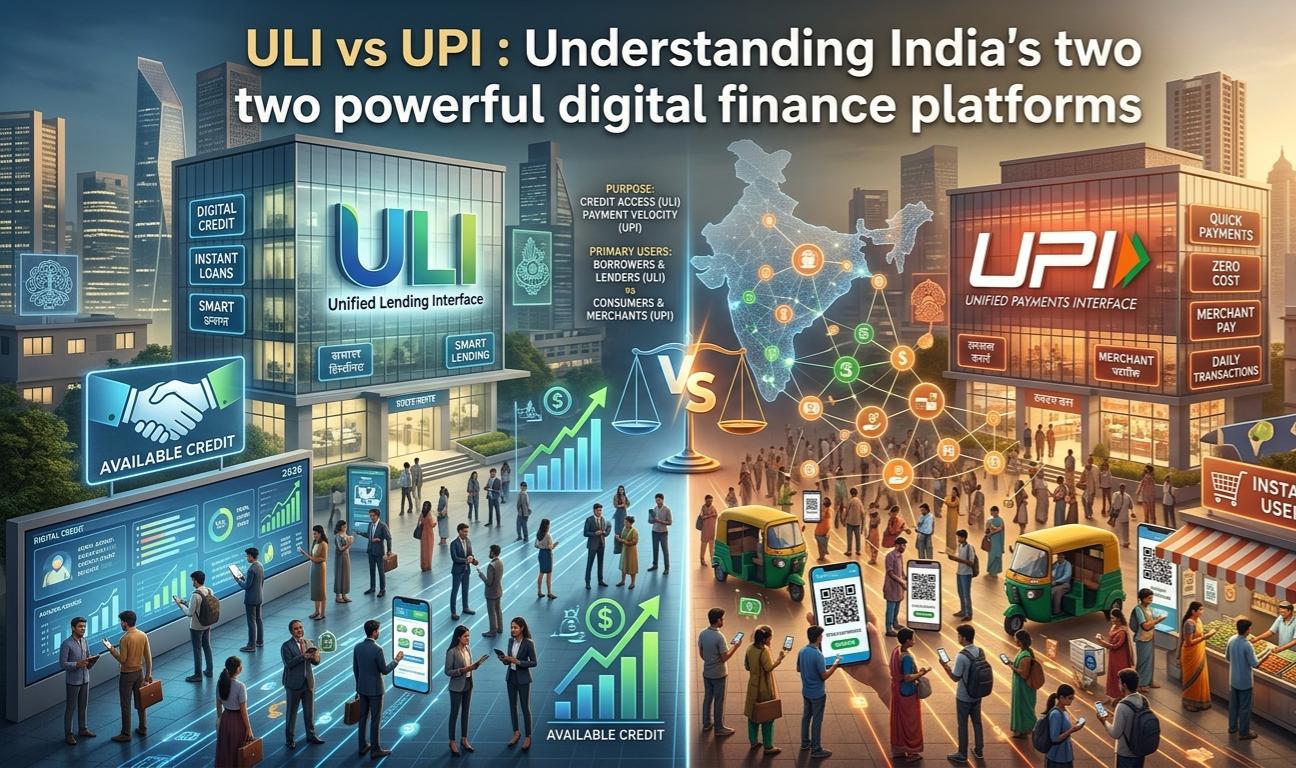
India’s digital transformation has fundamentally changed the way people handle money. Over the last few years, millions of users have adopted digital payments for shopping, bill payments, fund transfers, and business transactions. While most Indians are now familiar with UPI, a newer digital initiative called ULI is gaining significant attention for its potential to transform the lending sector. Although both platforms are part of India’s growing digital financial ecosystem, they serve completely different purposes — one focuses on payments while the other is designed to simplify and accelerate loan access. Understanding the difference between these two systems can help individuals, businesses, and entrepreneurs take full advantage of the next wave of financial innovation in India.
What Is UPI and How Did It Transform India’s Financial System?
The Unified Payments Interface, better known as UPI, has become one of the most successful digital payment systems in the world since its launch by the Reserve Bank of India and the National Payments Corporation of India. It allows users to transfer money instantly between bank accounts using smartphones, without the need to enter lengthy bank details. Users can send money through a simple UPI ID, mobile number, or QR code — whether paying a local shopkeeper, splitting a restaurant bill, or shopping online. UPI has played a decisive role in reducing cash dependency across India, with small businesses, street vendors, and large retailers all now accepting digital payments with ease. The platform operates around the clock throughout the year, supports multiple bank accounts, is widely accepted across the country, and processes billions of transactions every month — making it the undisputed backbone of India’s digital payment revolution.
What Is ULI and How Does It Differ from UPI?
The Unified Lending Interface, or ULI, is a newer initiative developed under the direction of the Reserve Bank of India to improve and modernise the lending ecosystem in the same way UPI transformed payments. Traditionally, applying for a loan involved lengthy paperwork, multiple verification processes, time-consuming documentation, and long waiting periods that were particularly burdensome for small borrowers and first-time applicants. ULI seeks to solve these challenges by creating a secure digital infrastructure that allows lenders to access verified borrower information more efficiently and with proper consent. The platform connects different data sources — including income records, property data, banking history, and business information — enabling banks and financial institutions to evaluate loan applications faster and with greater accuracy. The core vision behind ULI is to make credit more accessible, particularly for individuals and small businesses that have historically struggled with traditional lending procedures.
How ULI Can Transform the Lending Landscape
One of the most persistent challenges in lending has always been the difficulty of gathering reliable, verified information about a borrower quickly and at low cost. Financial institutions typically require data related to income, property ownership, business activities, banking history, and other records — a process that can take days or weeks through traditional channels. ULI is expected to streamline access to this relevant data through a secure, consent-based digital framework that gives lenders what they need while protecting borrower privacy. As a result, borrowers could benefit from significantly faster loan approvals, reduced paperwork burdens, improved access to formal credit, better financial inclusion, and simplified application processes overall. For small entrepreneurs and rural borrowers in particular, this could open meaningful new opportunities to access formal credit that was previously difficult or time-consuming to obtain.
ULI vs UPI: The Key Differences Explained
Although their names sound similar and both operate within India’s digital financial ecosystem, ULI and UPI have completely different objectives, users, and functions. UPI focuses on enabling instant digital payments between individuals and businesses, while ULI focuses on enabling faster and more efficient lending processes. In terms of who uses each platform, UPI is used directly by consumers for daily transactions of all sizes, while ULI is primarily intended for banks, financial institutions, and credit providers who need reliable borrower data to make lending decisions. Functionally, UPI moves money from one account to another, while ULI helps lenders evaluate and process loan applications. In terms of impact, UPI has already transformed digital payments at a national scale, while ULI aims to bring the same kind of transformation to digital lending — a sector that still relies heavily on manual, paper-intensive processes in much of the country.
Why ULI Matters for India’s Economy and Financial Inclusion
Access to affordable credit remains one of the most critical factors for sustained economic growth in India. Individuals, farmers, startups, and small businesses all require loans to expand operations, purchase equipment, manage cash flow, or invest in new opportunities. However, traditional lending processes can be slow, documentation-heavy, and structurally biased toward borrowers who already have established financial histories. By reducing delays and simplifying data sharing between verified sources, ULI has the potential to improve financial access across the country in ways that could meaningfully support small business growth, agricultural development, startup expansion, rural entrepreneurship, and broader economic inclusion. World Bank research on financial inclusion consistently demonstrates that easier access to formal credit is one of the strongest drivers of poverty reduction and small business growth in developing economies.
The Future of Digital Finance in India
India has already demonstrated through UPI how the right technology platform can transform an entire sector of financial services with remarkable speed and scale. The success of digital payments has encouraged policymakers and financial institutions to pursue similar innovations in other areas — and ULI represents the most significant of these next-generation efforts. Experts believe that digital lending infrastructure could eventually become as important to India’s credit ecosystem as UPI is to its payments ecosystem. As adoption grows, borrowers may experience quicker loan approvals, better customer experiences, and more personalised financial products tailored to their specific circumstances. The integration of digital identity systems like Aadhaar, financial records, and connected technology platforms is expected to further strengthen and deepen the lending ecosystem in the years ahead.
Benefits of ULI for Small and Medium-Sized Businesses
Small and medium-sized enterprises have historically faced some of the most significant barriers when applying for loans. Documentation requirements, lengthy approval timelines, and inconsistent access to formal credit have repeatedly delayed business expansion and limited entrepreneurial ambition. ULI could directly address these challenges by creating a smoother, more efficient flow of verified information between borrowers and lenders — reducing the friction that has made small business lending so cumbersome for both sides. Potential advantages for entrepreneurs include faster working capital loans, reduced documentation burden, improved access to formal credit channels, better financing opportunities for growth, and ultimately enhanced business development prospects. Easier access to credit, delivered efficiently and fairly, can lead to greater innovation, new employment, and stronger communities across India’s diverse small business ecosystem.
Challenges That Must Be Addressed for ULI to Succeed
While ULI offers significant and genuine promise, successful implementation will require serious and sustained attention to data privacy, cybersecurity, and user consent frameworks. Financial institutions must ensure that customer information is handled with the highest levels of responsibility and security, and that borrowers retain meaningful control over how their data is accessed and used. Building trust among both borrowers and lenders will be essential for achieving the widespread adoption that would allow ULI to deliver on its potential. Robust regulatory oversight from the Reserve Bank of India and strong technological safeguards will play a critical role in ensuring the platform operates both effectively and safely — protecting all participants in the ecosystem as it scales.
Final Thoughts: Two Platforms Building India’s Digital Financial Future
India’s digital financial journey continues to evolve at an impressive and inspiring pace. UPI revolutionised the way people make payments, bringing convenience, speed, and financial access to hundreds of millions of users across every corner of the country. Now, ULI aims to bring that same spirit of innovation and efficiency to the lending sector — helping financial institutions provide credit more quickly, more fairly, and more accessibly than traditional processes have ever allowed. Together, these two platforms represent a major step toward a more inclusive, technology-driven financial ecosystem that serves not just the already-connected urban consumer but the farmer, the small shopkeeper, the first-generation entrepreneur, and the rural borrower who have too long been underserved by conventional banking. For consumers, businesses, and entrepreneurs across India, understanding the difference between UPI and ULI is becoming an increasingly important part of navigating the era of digital finance.
Stay updated with the latest news and articles. Subscribe Now for more articles.
