
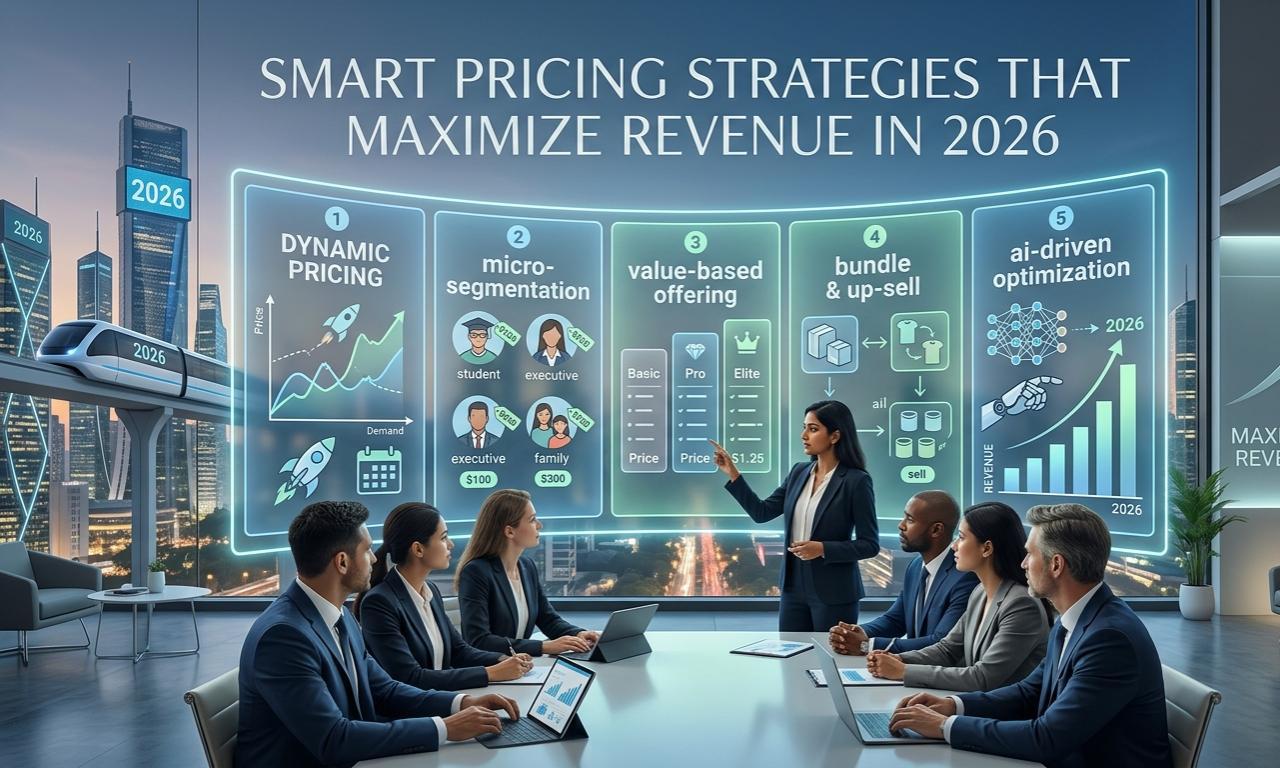
Pricing is one of the most powerful tools in business. A great product with poor pricing can struggle, while a well-priced product can significantly increase revenue and profitability. Many businesses focus heavily on marketing and sales but overlook the transformative impact that strategic pricing can have on growth. In 2026, businesses are using data, customer insights, and value-based approaches to create pricing strategies that maximise revenue while maintaining genuine customer satisfaction. This guide explores the most effective pricing strategies that entrepreneurs and business owners can use to improve profitability and strengthen their market position.
Why Pricing Strategy Matters More Than Most Businesses Realise
Pricing influences revenue generation, profit margins, customer perception, market positioning, and overall business growth simultaneously. A small, well-considered change in pricing can have a major impact on profitability — often more impact than a much larger investment in sales or marketing. Increasing prices strategically while maintaining and clearly communicating customer value can frequently generate more profit than significantly growing sales volume at the same price point. Pricing is not simply an administrative decision — it is a strategic lever that deserves the same serious attention as product development or customer experience.
Understanding the Relationship Between Price and Value
Customers do not make purchasing decisions based on price alone. They evaluate quality, benefits, brand reputation, the overall customer experience, and the trust they place in a business before deciding whether a price is acceptable. Successful businesses understand this and focus on communicating value rather than competing solely on low prices. When customers genuinely believe they are receiving excellent value — that what they gain far outweighs what they pay — they are not only willing to pay premium prices but often become loyal advocates who return and refer others.
Strategy 1: Value-Based Pricing
Value-based pricing sets prices according to the perceived value of a product or service to the customer rather than simply its production cost. This strategy works best when a business solves a significant problem, offers something genuinely unique, and has built credible brand authority. The benefits are substantial — higher profit margins, stronger brand positioning, and increased customer loyalty. In 2026, value-based pricing is increasingly recognised as one of the most effective revenue-maximising approaches available, particularly for businesses with differentiated offerings and strong customer relationships.
Strategy 2: Premium Pricing
Premium pricing positions products or services as high-quality solutions that command higher prices by design. This strategy is most effective when a brand has established genuine authority in its market, the quality of its offering is demonstrably superior, and the customer experience consistently justifies the price. Premium pricing attracts customers who prioritise quality over cost and are actively seeking the best rather than the cheapest option. Rather than competing in crowded low-price markets where margins are thin and differentiation is difficult, businesses that price at a premium build exclusivity, brand strength, and significantly higher profitability per transaction.
Strategy 3: Product Bundling
Bundling combines multiple products or services into a single package, offering customers greater perceived value while increasing the average order value for the business. Common examples include service packages, product kits, and subscription bundles that combine complementary offerings at a combined price that feels like a genuine advantage. Bundles encourage customers to spend more while genuinely feeling that they are getting a better deal — a rare pricing outcome where both parties benefit. Done well, bundling also improves customer satisfaction by simplifying decision-making and providing a more complete solution.
Strategy 4: Tiered Pricing
Tiered pricing offers multiple pricing options structured to serve different customer segments with different needs and budgets. A typical structure includes a basic package as an affordable entry-level option, a standard package as the most popular offering with a balanced set of features, and a premium package as an advanced solution with additional benefits for customers who need more. Tiered pricing allows customers to self-select based on their specific requirements while simultaneously creating a natural upgrade path that encourages movement toward higher-value options over time as customer needs and confidence in the product grow.
Strategy 5: Psychological Pricing
Consumer purchasing decisions are significantly influenced by psychology, and pricing is one of the most powerful areas where these effects play out. Setting a price at ₹999 rather than ₹1,000, or ₹499 rather than ₹500, creates a perception of meaningfully lower cost even when the actual difference is negligible. Consumer behaviour research consistently demonstrates that these small framing choices have a real and measurable impact on purchasing decisions across industries and price points. Psychological pricing is one of the simplest and most accessible strategies available to any business, requiring no additional cost to implement.
Strategy 6: Dynamic Pricing
Dynamic pricing adjusts prices in real time or near-real time based on market conditions including demand levels, seasonality, competitive activity, and inventory availability. Many online businesses and platforms already use dynamic pricing to maximise revenue during periods of high demand and maintain volume during quieter periods. Technology and artificial intelligence are making this strategy increasingly accessible to businesses of all sizes in 2026, enabling sophisticated price optimisation that was previously only available to large enterprises with significant data infrastructure and technical resources.
Strategy 7: Subscription Pricing
Subscription models provide businesses with predictable recurring revenue while giving customers convenient, ongoing access to products or services they use regularly. Examples include software subscriptions, membership programmes, and premium content access. The business benefits of subscription pricing are compelling — predictable income that makes financial planning significantly easier, increased customer retention driven by the ongoing relationship, and higher lifetime customer value compared to one-time purchase models. Subscription-based businesses consistently demonstrate stronger financial stability and more resilient revenue during economic uncertainty.
Strategy 8: Competitive Pricing
Competitive pricing involves monitoring market rates and positioning strategically relative to competitors — but this does not always mean being cheaper. The most effective competitive pricing strategies differentiate through value, highlight unique benefits that justify a price difference, and focus on delivering a superior customer experience rather than simply undercutting on cost. Competing solely on price is one of the most common and most damaging mistakes in business, as it erodes margins, attracts price-sensitive customers with low loyalty, and triggers a race to the bottom that benefits nobody in the long run.
Strategy 9: Limited-Time Offers and Strategic Promotions
Special promotions and limited-time offers create genuine urgency that encourages faster purchasing decisions and can meaningfully increase short-term revenue. Seasonal discounts, launch offers, and exclusive deals all serve this purpose effectively when deployed with care. The critical discipline here is using discounts strategically rather than habitually — frequent or poorly timed discounting trains customers to wait for sales rather than paying full price and can gradually erode the perceived value and brand positioning that premium pricing depends on. Used sparingly and purposefully, time-limited offers are a powerful tool; used carelessly, they undermine everything that good pricing strategy is designed to build.
Strategy 10: Rewarding Loyal Customers
Loyal customers are among the most valuable assets any business possesses. Offering VIP pricing, structured loyalty programmes, and exclusive benefits to repeat customers acknowledges and reinforces the relationship while generating significant business value. Customer retention is consistently more profitable than customer acquisition — studies across industries show that existing customers spend more, require less marketing investment, and refer others far more reliably than new customers acquired through paid channels. A well-designed loyalty pricing strategy turns satisfied customers into long-term revenue engines.
The Critical Role of Data in Modern Pricing Decisions
Successful businesses in 2026 use data systematically to improve pricing decisions and reduce costly guesswork. Tracking customer behaviour, sales trends, market demand, and conversion rates at different price points provides the intelligence needed to make pricing changes with confidence rather than hope. McKinsey research on pricing has consistently shown that companies which apply rigorous data analysis to their pricing decisions achieve meaningfully better profitability than those that rely on intuition or competitive imitation alone.
Common Pricing Mistakes That Damage Profitability
Several common pricing mistakes consistently undermine business profitability and should be actively avoided. Underpricing products is perhaps the most widespread — many businesses charge less than their value warrants out of fear of losing customers, when in reality a price increase would often improve both revenue and brand perception. Copying competitors blindly ignores the unique value a business offers and ties its fortunes to decisions made by others. Making frequent price changes confuses customers and erodes trust. Ignoring customer perception of value leads to pricing decisions that make sense on spreadsheets but fail in the market. And competing primarily on discounts trains customers to expect reduced prices and makes it extremely difficult to ever charge full value again.
Future Pricing Trends Shaping Business in 2026 and Beyond
The future of pricing is being shaped by several powerful converging trends. AI-powered pricing optimisation is enabling more sophisticated, real-time adjustments than were previously possible. Personalised pricing experiences — where different customer segments are offered pricing tailored to their specific value perceptions and behaviours — are becoming more technically feasible and strategically important. Subscription-based models continue their expansion across new industries. Data-driven decision-making is replacing gut-feel pricing at every level of business. Businesses that adapt thoughtfully to these trends will position themselves to improve profitability and competitive strength significantly in the years ahead.
Conclusion: Price Reflects Value, Value Drives Revenue
Pricing is much more than assigning a number to a product or service. It is a strategic tool that shapes customer behaviour, defines brand perception, and determines overall profitability. By implementing smart pricing strategies — including value-based pricing, bundling, subscriptions, tiered offerings, and data-driven optimisation — businesses can maximise revenue while delivering greater genuine value to their customers. In 2026, the most successful businesses will not necessarily be the cheapest. They will be the ones that communicate value most clearly and price with the confidence to match. Price reflects value. Value drives revenue. Revenue fuels growth.
Stay updated with the latest news and articles. Subscribe Now for more articles.
