
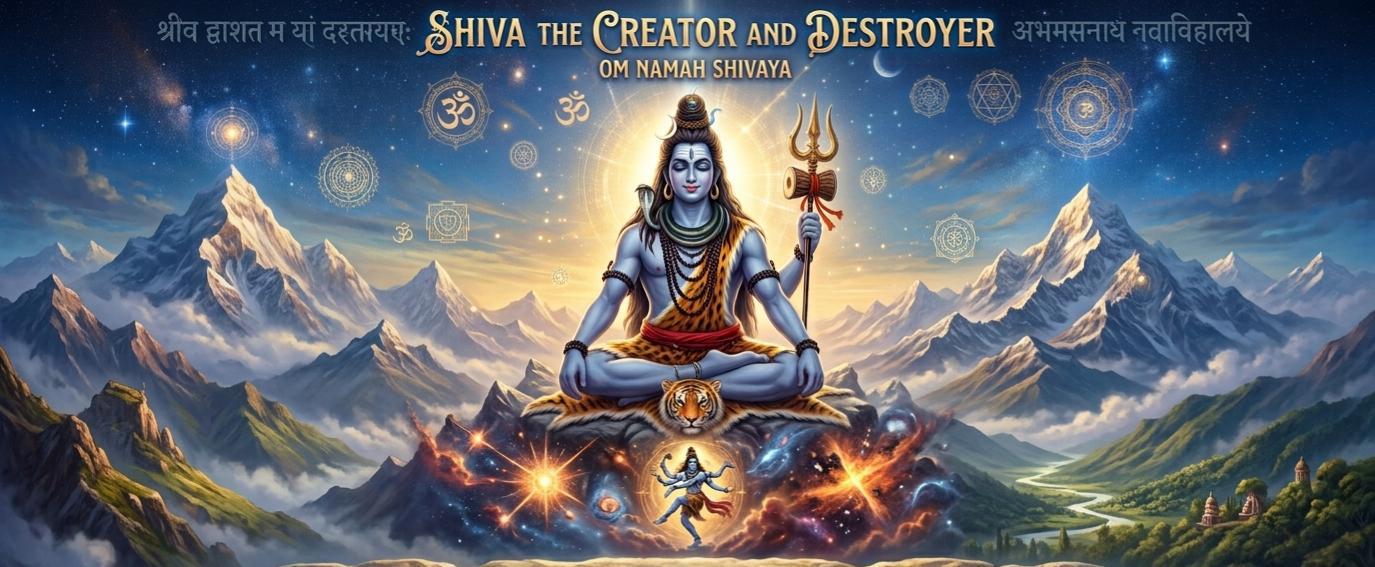
Among all the deities in Sanatan Dharma, Lord Shiva holds a uniquely profound place. Millions of devotees worship him as Mahadev — the Supreme Lord who represents both infinite stillness and immense cosmic power. While many people know Shiva primarily as the Destroyer, Hindu philosophy reveals a much deeper and more complete truth: Shiva is not only the destroyer but also the source of creation, transformation, and liberation. This understanding is especially emphasised in the Shaiva tradition, where Shiva is regarded as the Supreme Reality from whom the entire universe emerges and into whom it ultimately returns.
Why Is Shiva Called the Destroyer?
In the concept of the Hindu Trimurti, three deities represent the major cosmic functions — Brahma as Creator, Vishnu as Preserver, and Shiva as Transformer and Dissolver. However, the word destroyer is frequently and significantly misunderstood. Shiva does not destroy out of anger or cruelty. His role is to dissolve what has completed its purpose, creating the conditions for new life and new possibilities to emerge from what has ended. Nature itself follows this same principle — old leaves fall before fresh ones grow, night ends before sunrise, and every ending prepares the way for a new beginning. Shiva represents this eternal and necessary cycle of renewal that underlies all existence.
Shiva Is Also the Creator
Many scriptures and Shaiva traditions describe Shiva as the Supreme Consciousness from which creation itself originates. Rather than seeing creation and destruction as separate and opposing events, these traditions explain that they are two inseparable parts of one continuous cosmic process. The universe is born, grows, changes, dissolves, and is created again — and Shiva is present and active throughout this entire unbroken cycle. This understanding makes Mahadev not only the Lord of transformation but also the very origin of all existence, a figure whose significance extends far beyond any single moment in the cosmic drama.
The Five Divine Acts of Shiva
According to Shaiva philosophy, Shiva continuously performs five cosmic actions known as Panchakritya, each of which reveals a different dimension of his divine role. The first is Srishti — creation — in which Shiva brings the universe into existence and initiates the cycle of life. The second is Sthiti — preservation — in which he sustains creation by maintaining balance and harmony throughout its duration. The third is Samhara — dissolution — in which, at the appropriate time, Shiva dissolves the universe so that a new cycle of existence can begin afresh. The fourth is Tirobhava — concealment — in which Shiva allows souls to experience the world through Maya, or illusion, enabling the learning and spiritual evolution that embodied existence makes possible. The fifth and perhaps most merciful act is Anugraha — grace — in which Shiva grants wisdom, removes ignorance, and guides sincere seekers toward liberation, or Moksha. These five acts together reveal that Shiva’s role extends immeasurably beyond the single dimension of destruction with which he is most commonly associated.
The Third Eye: Destroying Ignorance from Within
One of Shiva’s most recognisable and symbolically rich attributes is his third eye, positioned at the centre of his forehead. Spiritually, this eye represents higher knowledge and inner awareness rather than physical perception. When the third eye opens, it burns away ignorance, ego, attachment, and false understanding — the internal obstacles that prevent human beings from perceiving reality clearly. The true destruction most deeply associated with Shiva is therefore not the destruction of the external world but the destruction of negativity, illusion, and limitation within ourselves. Contemporary research on meditation and self-awareness consistently aligns with this ancient insight — that turning attention inward and dissolving mental obstacles is one of the most powerful forms of personal transformation available to human beings.
The Story of Neelkanth: Absorbing Poison to Protect the World
During the Samudra Manthan — the great churning of the cosmic ocean described in Hindu scripture — a deadly poison emerged that threatened to destroy all creation. Without hesitation, Shiva drank the poison to protect the universe, holding it in his throat rather than allowing it to spread. His throat turned blue from the contact with this cosmic venom, and from that moment he became known as Neelkanth, the blue-throated one. This story carries a profound symbolic meaning far beyond its mythological narrative — it represents the strength, courage, and compassion required to absorb negativity on behalf of others without being destroyed by it. It teaches sacrifice, responsibility, and the willingness to bear what others cannot for the welfare of the whole.
Shiva’s Cosmic Dance as Nataraja
As Nataraja — the Lord of Dance — Shiva performs the cosmic dance known as Tandava, a form that simultaneously symbolises creation, preservation, transformation, dissolution, and renewal in a single dynamic image. This iconic representation, which has fascinated philosophers, scientists, and artists across cultures for centuries, captures the idea that the universe is not static but in constant, purposeful motion. The European Organisation for Nuclear Research (CERN) famously placed a statue of Nataraja at its headquarters in Geneva as a symbol of the cosmic dance of subatomic particles — a striking acknowledgement of how ancient symbolic wisdom and modern scientific understanding can converge on the same fundamental insight about the dynamic nature of reality.
What Shiva’s Philosophy Teaches Modern Society
Shiva’s philosophy remains profoundly relevant to the challenges of contemporary life in ways that transcend any particular religious tradition. His life and symbolism encourage acceptance of change rather than fear of it, the gradual release of ego and pride that prevent genuine growth, the practice of meditation and honest self-awareness, simple living without excessive material attachment, and the courage to face difficulties with both compassion and strength. His example of transforming anger into wisdom and fear into strength speaks directly to the psychological challenges of modern life, where reactive emotional states so often undermine both personal wellbeing and collective harmony. In a fast-paced and often overwhelming world, Shiva’s consistent teaching is that inner peace is not a luxury but the greatest and most enduring form of power.
Creator and Destroyer Are Not Opposites
One of the most beautiful and counterintuitive teachings embedded in the symbolism of Shiva is that creation and destruction are not opposites but inseparable partners in the same continuous process. Without the end of one season, another cannot begin. Without letting go of old habits and limiting beliefs, personal growth remains impossible. Without transformation — which always involves the dissolution of something that was — life cannot evolve into what it is capable of becoming. Shiva represents this eternal law of nature itself: that every genuine ending carries within it the seed of a new beginning, and that the courage to allow endings is the same courage that makes new beginnings possible.
Conclusion: True Power Is the Ability to Transform
Lord Shiva is far more than the God of Destruction — that description, while not inaccurate, captures only the smallest fraction of what this extraordinary figure represents in Hindu thought and in universal human experience. He is the eternal force of creation, preservation, transformation, and liberation. His stories and symbols teach humanity to embrace necessary change, overcome the obstacles of ego and ignorance, and seek the higher consciousness that lies beneath the surface of ordinary experience. Whether worshipped as Mahadev, Adiyogi, Nataraja, or Neelkanth, Shiva continues to inspire millions with a timeless and universally applicable message: true power is not the ability to destroy others — it is the ability to transform yourself and thereby help create a better world for all who share it.
Stay updated with the latest news and articles. Subscribe Now for more articles.
