
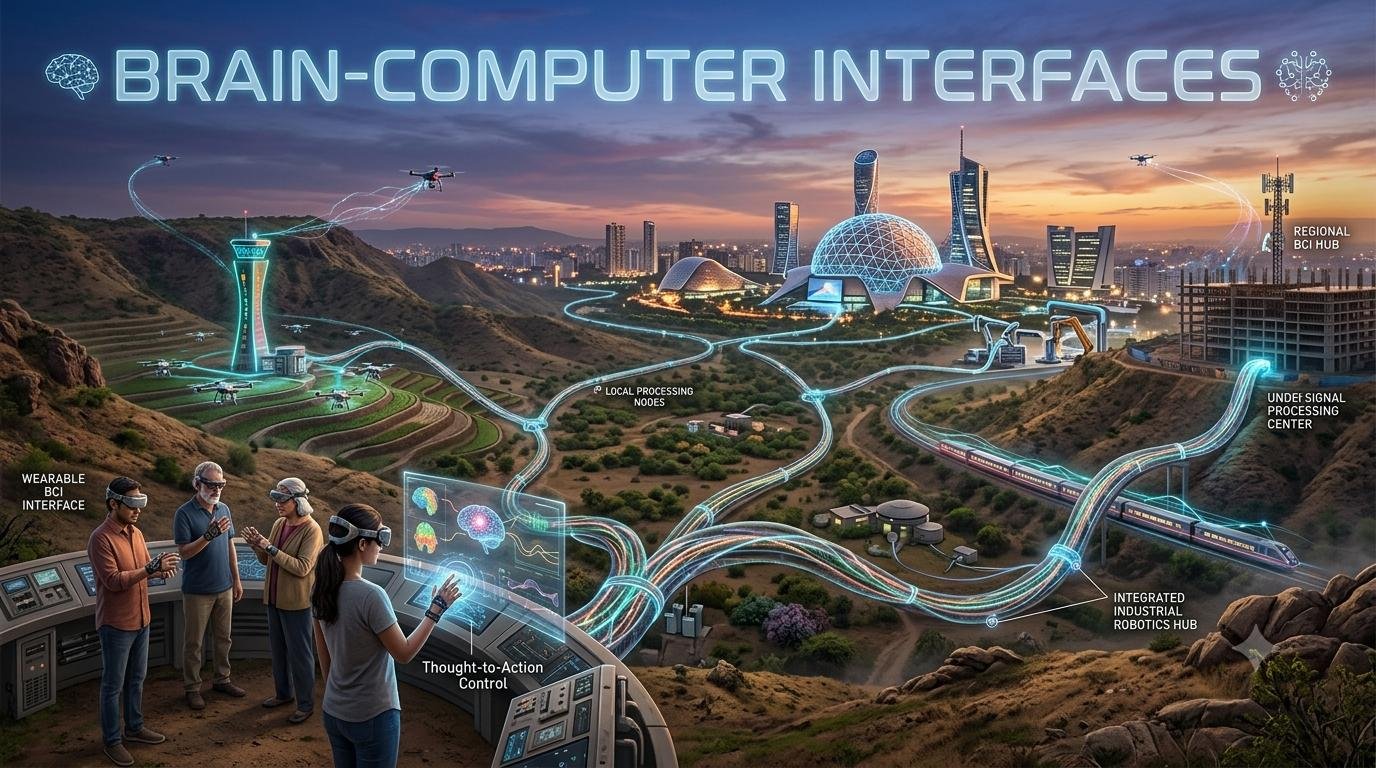
What if a person could control a computer simply by thinking? What if someone who cannot move could communicate through brain signals? These ideas once belonged mainly to science fiction, but Brain-Computer Interface (BCI) technology is turning some of them into real research and emerging applications.
A Brain-Computer Interface creates a communication pathway between the brain and an external computer or device. Instead of relying only on keyboards, touchscreens, or voice commands, BCI systems can interpret certain patterns of brain activity and convert them into commands.
Although the technology is still developing, BCI could have a significant impact on healthcare, accessibility, rehabilitation, communication, gaming, robotics, and human-computer interaction.
🔍 What Is a Brain-Computer Interface?
A Brain-Computer Interface, commonly called BCI, is a technology that allows brain activity to interact directly with an external device.
The basic idea is simple: the brain produces electrical and other measurable signals when a person thinks, moves, or performs certain mental tasks. Specialized sensors can capture these signals, while software processes them and attempts to identify meaningful patterns.
The resulting information can then be translated into commands.
For example, a BCI could potentially allow a user to select a letter on a screen, control a robotic device, or interact with a computer using detected brain activity.
⚙️ How Does BCI Technology Work?
A typical BCI system involves several stages.
Basic Process:
1. Sensors detect brain activity.
2. Signals are collected and processed.
3. Software identifies relevant patterns.
4. An AI or machine-learning system interprets those patterns.
5. The interpreted signal becomes a command.
6. The connected device performs the requested action.
The technology can be designed using different types of brain-signal measurements, depending on the application.
🧠 Different Types of BCI
Brain-computer interfaces can broadly be classified according to how brain signals are collected.
Non-Invasive BCI
Non-invasive systems collect brain activity without surgery. Technologies such as electroencephalography (EEG) can be used to measure electrical activity through sensors placed on the scalp.
These systems are attractive because they avoid surgical procedures, although signal quality can be challenging.
Invasive BCI
Invasive systems use sensors implanted inside or near the brain. They can potentially provide more detailed signals but require medical procedures and involve additional risks.
Partially Invasive Approaches
Some approaches attempt to collect signals from areas around the brain while avoiding deeper implantation.
Different approaches are being researched for different medical and technological purposes.
🏥 BCI in Healthcare
Healthcare is one of the most promising areas for Brain-Computer Interface technology.
BCI research could help people who have lost certain physical abilities communicate or interact with technology.
Potential Applications:
Communication assistance
Robotic limb control
Movement rehabilitation
Computer control for people with paralysis
Assistive technology
The long-term goal is to help people regain greater independence.
🦾 Brain-Controlled Prosthetics
One exciting area of BCI research involves prosthetic limbs.
Traditional prosthetics can restore physical functionality, but advanced systems are being developed to create more intuitive control.
A future BCI-enabled prosthetic could potentially interpret a user’s intended movement and translate it into mechanical movement.
This could make artificial limbs feel more natural and responsive.
💬 Helping People Communicate
BCI technology could also transform communication for people who cannot speak or physically operate conventional devices.
Brain signals may be translated into selections on a digital interface, allowing users to construct messages.
This could provide an alternative communication channel for individuals with severe physical disabilities.
🏃 BCI and Rehabilitation
Brain-computer interfaces are also being explored in rehabilitation.
A BCI system can potentially detect a person’s intention to move and combine that information with physical therapy or robotic assistance.
Possible Benefits:
Supporting motor rehabilitation
Encouraging repeated movement
Providing real-time feedback
Measuring progress
BCI-based rehabilitation remains an active research area.
🤖 BCI and Robotics
The combination of BCI and robotics could create new forms of human-machine interaction.
Imagine controlling a robotic arm, wheelchair, or other assistive device through brain signals rather than traditional controls.
Such systems could be especially useful when conventional physical controls are difficult or impossible to operate.
🎮 BCI in Gaming and Entertainment
BCI could eventually change how people interact with digital entertainment.
Possible Applications:
Brain-controlled gaming
Immersive virtual reality
Hands-free interfaces
Interactive digital environments
Instead of relying entirely on controllers, future entertainment systems could incorporate brain activity as an additional input method.
🤖 Artificial Intelligence and BCI
Artificial Intelligence plays an important role in interpreting complex brain signals.
Brain activity can vary significantly between individuals and even between different situations for the same person. Machine-learning models can help identify patterns and improve signal interpretation.
AI Can Help With:
Signal classification
Pattern recognition
Personalized calibration
Real-time interpretation
The combination of AI and BCI technology could accelerate the development of more intuitive interfaces.
🔐 Privacy and Ethical Concerns
BCI technology introduces a new category of privacy concerns because brain-related information can be highly personal.
Important questions include:
Who owns brain-related data?
How should neural information be protected?
Can users completely control their data?
What happens if a BCI system is hacked?
How should companies use neural information?
Strong privacy protections and ethical standards will be essential as BCI technology develops.
⚠️ Challenges of Brain-Computer Interfaces
BCI technology still faces significant technical and practical challenges.
Major Challenges:
Limited signal quality
Difficult signal interpretation
Expensive equipment
Individual differences in brain activity
Long training or calibration requirements
Safety considerations for implanted systems
Limited real-world reliability
Researchers are working to make BCI systems more accurate, comfortable, affordable, and accessible.
🌍 Future Applications of BCI
The future of Brain-Computer Interfaces could extend beyond healthcare.
Emerging Possibilities:
Advanced assistive devices
Brain-controlled robotics
Next-generation gaming
Immersive virtual environments
Hands-free computer interaction
New communication technologies
However, many of these applications remain experimental and should not be treated as established consumer technology.
🔮 The Future of Human-Computer Interaction
For decades, humans have interacted with computers through keyboards, mice, touchscreens, and voice commands. BCI represents a fundamentally different approach: using brain activity as another communication channel.
The technology does not necessarily mean computers will “read every thought.” Instead, many current BCI approaches focus on detecting specific neural patterns associated with intended actions or tasks.
As research improves, BCI could make technology more accessible and create new ways for humans and machines to interact.
🌟 Conclusion
Brain-Computer Interface technology is opening an exciting new chapter in human-computer interaction. By connecting brain signals with computers and machines, BCI has the potential to assist people with disabilities, improve rehabilitation, control advanced prosthetics, and create new digital experiences.
The technology is still developing, and important challenges surrounding accuracy, safety, affordability, privacy, and ethics must be addressed. But as neuroscience, Artificial Intelligence, robotics, and computing continue to advance, BCI could become one of the most transformative technologies of the future.
Stay updated with the latest news and articles. Subscribe Now for more articles.
