
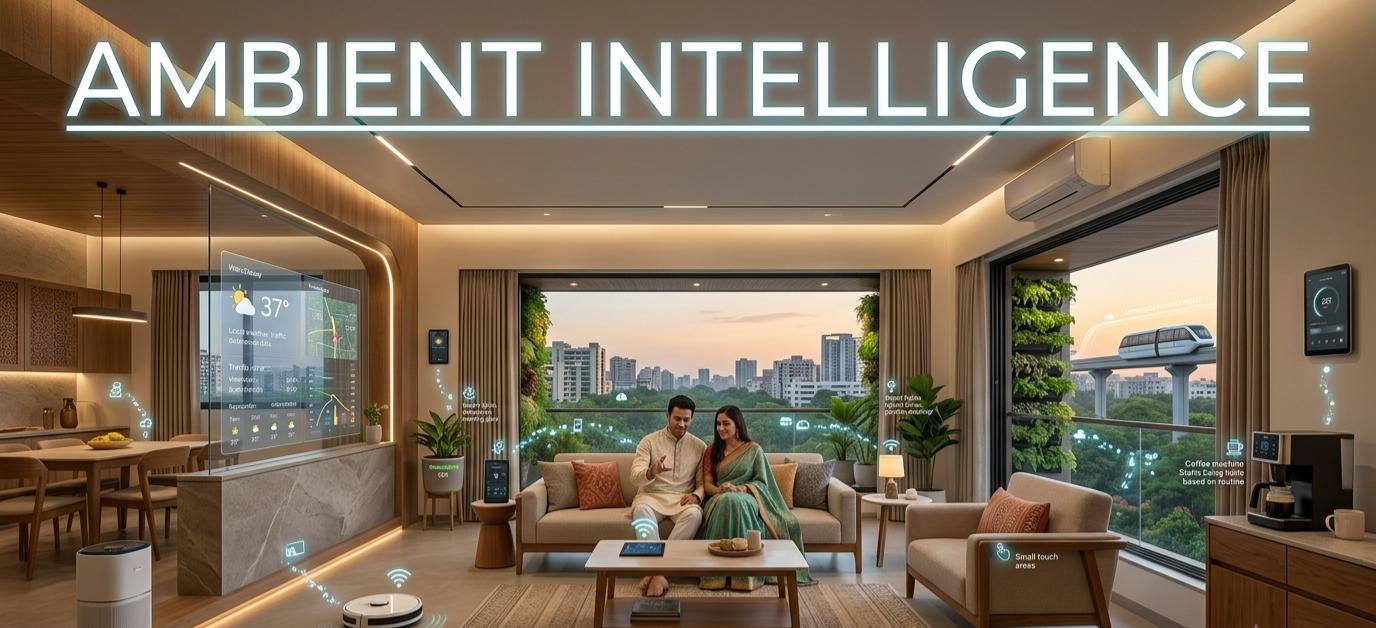
Technology is becoming more intelligent, connected, and personalised than ever before. One of the most exciting innovations leading this transformation is Ambient Intelligence, or AmI. Unlike traditional technology that requires constant user interaction and deliberate commands, Ambient Intelligence creates environments that understand human needs and respond automatically — making the technology itself almost invisible. Imagine entering your home and having the lights adjust to your preference, the room temperature change to your comfort level, your favourite music begin playing, and your digital assistant remind you about your schedule, all without touching a single button. By combining Artificial Intelligence, the Internet of Things, smart sensors, cloud computing, edge computing, and machine learning, Ambient Intelligence is creating smart environments that improve comfort, productivity, safety, and energy efficiency simultaneously.
What Is Ambient Intelligence?
Ambient Intelligence is a digital environment where connected devices, sensors, and intelligent software work together to recognise people, understand their needs, and respond automatically without requiring explicit commands. Rather than people continuously adapting to technology, Ambient Intelligence reverses this relationship — enabling technology to adapt to people. Its core features include intelligent automation, context-aware computing, real-time decision making, deeply personalised user experiences, and seamless interaction between multiple devices and systems. The ultimate goal is to make technology functionally invisible while continuously improving the quality and convenience of everyday life.
How Ambient Intelligence Works
Ambient Intelligence relies on multiple sophisticated technologies working in close coordination. Artificial Intelligence learns and anticipates user behaviour over time, becoming more accurate and personalised as it accumulates data. Internet of Things devices collect real-time information from the surrounding environment. Smart sensors detect movement, temperature, light levels, and a wide range of other environmental variables. Cloud and edge computing enable fast data processing close to where it is needed, reducing latency. And machine learning algorithms continuously improve system performance over time as patterns become clearer and predictions more accurate. These technologies communicate with each other constantly and seamlessly to create genuinely responsive, context-aware environments.
Ambient Intelligence in Smart Homes
Smart homes are among the most accessible and widely recognised applications of Ambient Intelligence. Automatic lighting control that adjusts brightness based on time of day and occupancy, smart climate management that maintains comfortable temperatures without manual adjustment, voice-controlled home systems that respond to natural speech, intelligent security cameras that distinguish between familiar faces and potential threats, and smart kitchen appliances that adapt to usage patterns are all expressions of AmI principles in the domestic environment. These systems reduce manual effort while meaningfully improving both comfort and energy efficiency for everyday residents.
Ambient Intelligence in Healthcare
Healthcare is being transformed through intelligent environments in ways that have the potential to save lives and meaningfully improve patient outcomes. Continuous patient monitoring that alerts medical staff to changes in vital signs before they become critical, smart hospital rooms that adjust to patient comfort and clinical needs, automated medication reminders, fall detection systems for elderly patients living independently, and real-time emergency health alerts all represent Ambient Intelligence in healthcare settings. The World Health Organization increasingly recognises digital health technologies as essential tools for improving care quality and extending health system capacity globally.
Ambient Intelligence in Transportation
Modern transportation systems are becoming increasingly intelligent through the application of Ambient Intelligence principles. Smart traffic management systems that reduce congestion by adjusting signal timing in real time, advanced driver assistance systems that monitor road conditions and driver alertness, intelligent public transportation networks that optimise routes and schedules dynamically, and continuous vehicle safety monitoring are all transforming how people and goods move. Real-time data flowing through connected transportation infrastructure is helping reduce accidents, cut travel times, and improve the overall efficiency of urban mobility.
Ambient Intelligence in Workplaces
Businesses are increasingly using smart environments to improve productivity and operational efficiency. Automated meeting rooms that prepare themselves for booked sessions, intelligent lighting systems that adjust to occupancy and task type, comprehensive energy management that reduces consumption without sacrificing comfort, smart office security that responds intelligently to access patterns, and workspace optimisation tools that help organisations understand how their physical spaces are actually being used are all becoming standard features of forward-thinking workplaces. Employees working in these environments consistently report more comfortable and more efficient working conditions.
Ambient Intelligence in Smart Cities
Cities around the world are adopting Ambient Intelligence to improve public services and the quality of urban life. Intelligent street lighting that adjusts based on pedestrian and vehicle presence, smart parking systems that guide drivers directly to available spaces, real-time environmental monitoring that tracks air and noise pollution, waste management systems that optimise collection schedules based on actual fill levels, and public safety surveillance that supports faster emergency response are all active deployments in leading smart cities globally. These technologies are helping make cities genuinely cleaner, safer, and more resource-efficient than was previously achievable through conventional infrastructure.
Ambient Intelligence in Education
Educational institutions are also beginning to benefit from intelligent environments designed around the needs of learners and teachers. Smart classrooms that adapt lighting, temperature, and audio to optimise learning conditions, genuinely personalised learning experiences that adjust content difficulty and pacing to each student’s progress, automated attendance systems that reduce administrative burden, and interactive digital learning tools that respond to student engagement are all emerging applications. Teachers gain richer insights into learning patterns and outcomes, while students receive more responsive and customised support throughout their educational journey.
Privacy and Security Challenges in Ambient Intelligence
Because Ambient Intelligence depends on continuous and pervasive data collection, protecting user privacy is not optional — it is foundational to building the trust that widespread adoption requires. Key concerns include personal data protection, cybersecurity risks across interconnected device networks, the threat of unauthorised device access, and questions around responsible and transparent AI decision-making in contexts that affect people’s lives. Strong encryption, secure network architectures, clear and accessible privacy policies, and robust regulatory frameworks are all necessary components of deploying Ambient Intelligence in ways that earn and maintain public confidence.
Broader Challenges Facing Ambient Intelligence Adoption
Beyond privacy and security, Ambient Intelligence faces several other significant challenges on the path to widespread adoption. High initial deployment costs remain a barrier for many organisations and households. Integration between devices from different manufacturers and operating on different protocols creates technical complexity. Reliable internet connectivity is a prerequisite that is not yet universally available. Data management at the scale that comprehensive AmI systems generate is operationally demanding. And ethical questions around automated decision-making — particularly in healthcare, security, and justice contexts — require careful consideration and robust governance. Addressing these issues thoughtfully and systematically will be essential to supporting broader adoption at the scale AmI’s potential warrants.
The Future of Ambient Intelligence
Ambient Intelligence is expected to become significantly more advanced as AI and connected technologies continue to evolve. Emerging trends point toward AI-powered personal assistants that anticipate needs rather than simply responding to them, smart hospitals with genuinely predictive healthcare capabilities, autonomous smart buildings that manage themselves with minimal human oversight, intelligent retail environments that personalise the shopping experience in real time, and energy-efficient homes and offices that optimise consumption automatically. World Economic Forum analysis projects that future AmI systems will become progressively more personalised, adaptive, and capable of understanding human behaviour with far greater accuracy than current systems can achieve.
Conclusion: Technology That Adapts to People
Ambient Intelligence is fundamentally transforming the way people interact with technology by creating smart environments that respond naturally and intuitively to human needs. From homes and hospitals to workplaces and entire smart cities, this innovation is improving convenience, safety, productivity, and sustainability across virtually every domain of modern life. As Artificial Intelligence, the Internet of Things, and advanced computing continue to evolve together, Ambient Intelligence will become an increasingly essential part of everyday experience — making technology more seamless, more intelligent, and more genuinely human-centred than any previous generation of digital innovation has managed to achieve.
Stay updated with the latest news and articles. Subscribe Now for more articles.
