
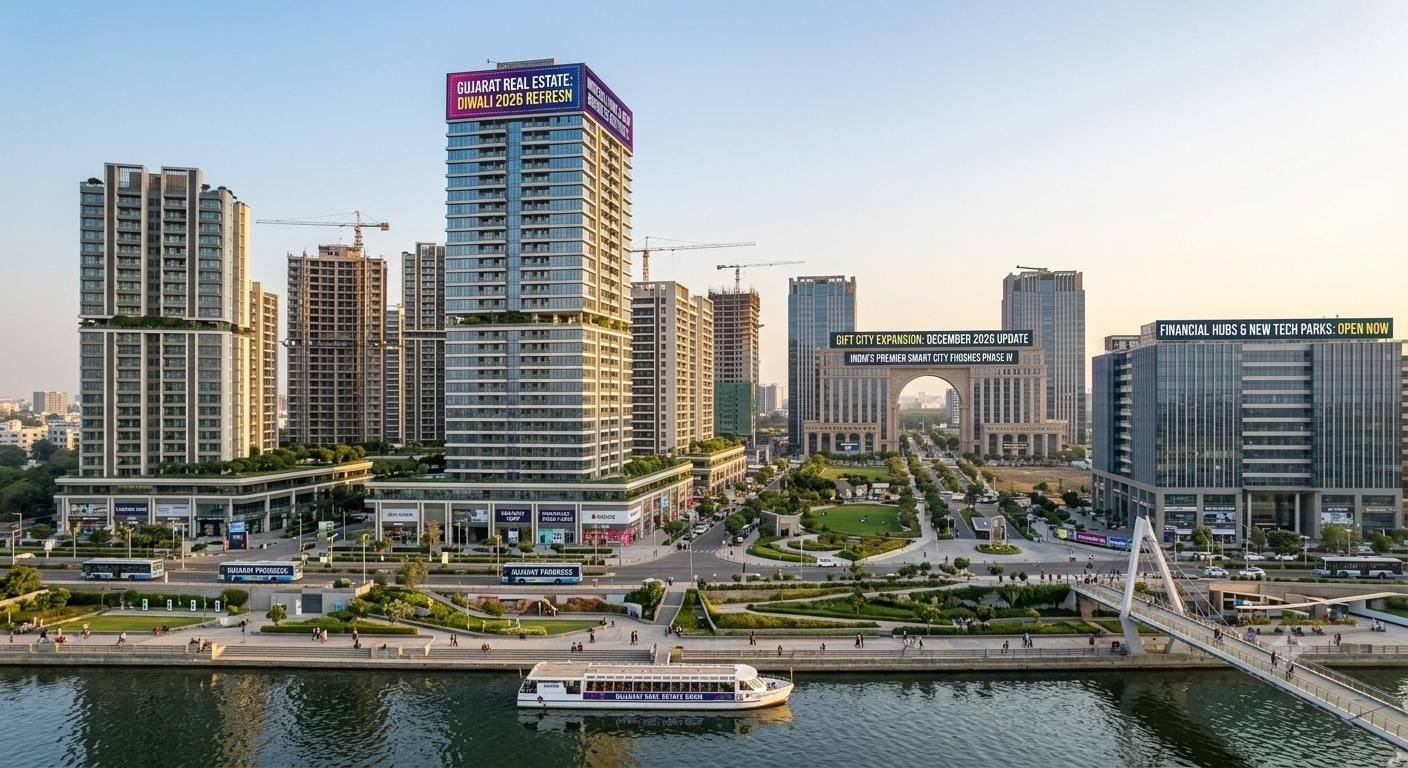
What Could Happen to Gujarats Property Market After Diwali?
Diwali is one of Indias busiest times for buying homes. Many homebuyers think about buying a home during the festive season because of family traditions, auspicious dates, developer offers and the desire to start the new year with a major investment.
In Gujarat the festive period is especially important for the real estate industry. Ahmedabad, Surat, Vadodara and Gandhinagar keep attracting homebuyers while GIFT City and Dholera offer opportunities linked to business growth and new infrastructure.
However will Gujarat real estate market after Diwali 2026 experience another boom or will buyers become more selective?
Recent market signals show a picture. Developers hope for a sales revival during the period but new project registrations have slowed. Ahmedabads residential sales still grow,. At a slower pace than in previous years. Rising borrowing costs may also influence buyers decisions.
For buyers and investors the period after Diwali could offer opportunities—. Careful selection will matter more than simply buying property because of a seasonal trend.
1. Ahmedabad: A Market Moving Towards Selective Buying
Ahmedabad property market 2026 is expected to remain a key market to watch after Diwali 2026 because it has established residential neighbourhoods developing suburbs, commercial districts and growth corridors driven by infrastructure.
According to Knight Frank data reported by Ahmedabad Mirror, the city recorded 14,300 residential sales between January and September 2026 compared with 14,064 during the same period in 2025. That is a growth of 1.7%, which is slower than growth in earlier comparable periods.
This suggests that demand has not disappeared. The market is becoming more measured.
Areas to watch
- Shela and South Bopal: communities and suburban housing.
- Science City and Thaltej: Established residential and commercial connections.
- Ambli and Sindhu Bhavan Road: Premium housing and lifestyle developments.
- SG Highway: Residential, retail and office demand.
- Naroda and Nikol: Areas to evaluate for budget‑conscious buyers and developing residential supply.
These areas have price points, supply levels and buyer profiles. Investors should compare projects rather than assume that every neighbourhood will appreciate at the same rate.
Post-Diwali outlook: Established locations with end‑user demand may be more resilient than projects priced mainly around future expectations.
2. GIFT City and Gandhinagar: Business Growth Meets Property Demand
GIFT City remains one of Gujarat real estate market after Diwali 2026’s distinctive stories because it combines financial services, technology, international business and planned urban infrastructure.
GIFT City property market is closely connected to company growth, employment and demand for space. Expansion in these areas can create needs for residential accommodation, hotels, retail and other services.
After Diwali, buyers and investors should monitor the following:
- New financial‑services activity.
- Commercial office occupancy and leasing.
- Connectivity between Ahmedabad, Gandhinagar and GIFT City.
- Demand for accommodation.
- The delivery status of mixed‑use projects.
The wider Gandhinagar region may appeal to buyers who want access, to this corridor without necessarily buying within GIFT City itself.
However not every property that is advertised as close to GIFT City will benefit in the way. You should check the travel time the transport choices, the nearby infrastructure and how far it is from work centres before you buy.
Post-Diwali outlook: The market led by business looks promising,. You must compare property prices with real rental demand and the basics of the project.
3. Surat: Business Wealth and Residential Demand
Surat is another market for Gujarats property outlook after Diwali.
The city’s business scene, which includes the diamond and textile industries fuels demand for property, retail spaces and commercial premises. Premium residential areas like Vesu, Piplod, Althan and parts of the Dumas Road corridor are worth looking at depending on your budget and what you need.
For investors the central question is whether a property has a source of demand.
A residential apartment should appeal to homebuyers or tenants.
A commercial unit should have a prospect of attracting businesses.
A retail property should be supported by accessibility, visibility and surrounding spending activity.
Buying solely because a location is described as a luxury destination can expose investors to purchase prices and disappointing rental returns.
Post-Diwali outlook: Selective opportunities in established business locations with project‑level research essential.
4. Vadodara: A Market for Practical Long‑Term Buyers
Vadodara offers a proposition from Ahmedabad’s largest luxury corridors and GIFT City’s financial ecosystem.
Its residential market serves families, professionals, business owners and people connected to the city’s educational institutions.
After Diwali buyers can compare established neighbourhoods with residential developments on the city’s expanding edges.
Key considerations include:
- Distance from workplaces and educational institutions.
- Access to hospitals, public transport and daily services.
- Construction quality and possession timelines.
- Maintenance costs and community facilities.
- Availability of properties for rent and resale.
A property that meets housing needs may be more suitable for a long‑term homeowner than an expensive project purchased mainly for speculative appreciation.
Post‑Diwali outlook: Worth considering for buyers prioritising usability, affordability relative to premium markets and long‑term residence.
5. Dholera SIR: Think Long Term, Not Quick Profit
Dholera Special Investment Region is frequently discussed as an industrial and infrastructure‑led growth destination.
Its investment case is linked to planned development, industrial activity, connectivity and the possibility of employment opportunities.. This is a different proposition from buying a ready apartment in Ahmedabad or Surat.
Industrial investment does not automatically create demand for every nearby land parcel.
Buyers need to establish whether the property is legally transferable zoned, supported by approved development plans and realistically connected to future economic activity.
Before investing verify:
- Land title and ownership records.
- Permitted land use and applicable restrictions.
- Development plans and infrastructure status.
- Access roads and essential services.
- The developer’s. All relevant approvals.
- The likely holding. Ability to exit the investment.
Post‑Diwali outlook: suitable for patient investors who understand the risks of emerging locations. It is not a guaranteed short‑term profit opportunity.
6. Will Property Prices Rise After Diwali 2026?
There is no answer for the entire state.
Some well‑located properties may continue to see price growth if demand remains stronger than supply. Other developments may offer discounts, flexible payment plans or additional benefits if developers need to improve sales.
Nationally industry forecasts ahead of the 2026 season pointed to continued housing demand but more moderate growth with buyers scrutinising prices, payment terms and construction quality more closely. <Cite refs={[“turn335769search3”]}/>
A further consideration is the cost of borrowing. Reports on the Reserve Bank of India’s October 2026 rate increase indicate that higher home‑loan costs could put pressure on affordability and delay some purchase decisions. <Cite refs={[“turn335769search8”]}/>
For buyers this could mean that the best opportunity is not necessarily the property with the advertised discount. It may be the property, with a price, credible developer, useful location and manageable total cost.
7. What Should Homebuyers Do After Diwali?
Before making a purchase use a checklist.
Calculate the cost: Add the down payment, loan interest, registration fees, taxes, interior fittings, maintenance costs and any other fees.
Compare properties: Look at projects in the same neighbourhood rather than trusting a builders promised future price.
Check project approvals: Make sure the project has the required Gujarat RERA registration and that all disclosures are verified through channels.
Evaluate rental demand: When buying for investment calculate rent and yearly expenses. Do not depend solely on projected price growth.
Review the developer: Inspect the construction progress, past delivery record, approvals and contractual promises.
Keep an emergency reserve: Do not spend all savings on a property.
Negotiate carefully: Request a written breakdown of any festive or post-festive offer and compare the final cost with other properties.
8. What Could Shape Gujarats Property Market in 2027?
The market’s direction after Diwali will hinge on factors that go beyond festive mood.
Employment growth can create housing demand. Infrastructure improvements can make areas that were less connected more useful. Commercial growth can help rental housing and retail. At the time oversupply, higher financing costs or delays in infrastructure projects can weaken the investment case for certain locations.
In
Investors should monitor the link between launches and real sales. A large number of projects does not automatically mean that all available homes will sell quickly.
Gujarat’s future property performance will likely differ by city, price bracket and property type than move the same way across the whole state.
Final Verdict: Opportunity After Diwali but Choose Carefully
Gujarat’s real estate market could benefit from -Diwali buying activity, infrastructure growth and economic expansion. Still the latest numbers show that the market is becoming selective and higher borrowing costs may challenge some buyers.
For buyers Ahmedabad and Vadodara offer established urban markets for comparison. Surat remains significant for business-related housing demand. GIFT City stands out for its corporate ecosystem while Dholera needs a longer-term and more cautious investment approach.
The smartest post-Diwali property investment is not always the cheapest or the one with the price promise. It is the property that has legal documents, a realistic price, real demand and a holding period that matches your financial goals.
Disclaimer: This article is for information only and is not personalized financial or property-investment advice. Market conditions, prices and project status can change. Verify data, legal documents and approvals before making a purchase.
Stay updated with the latest news and articles. Subscribe Now for more articles.
