
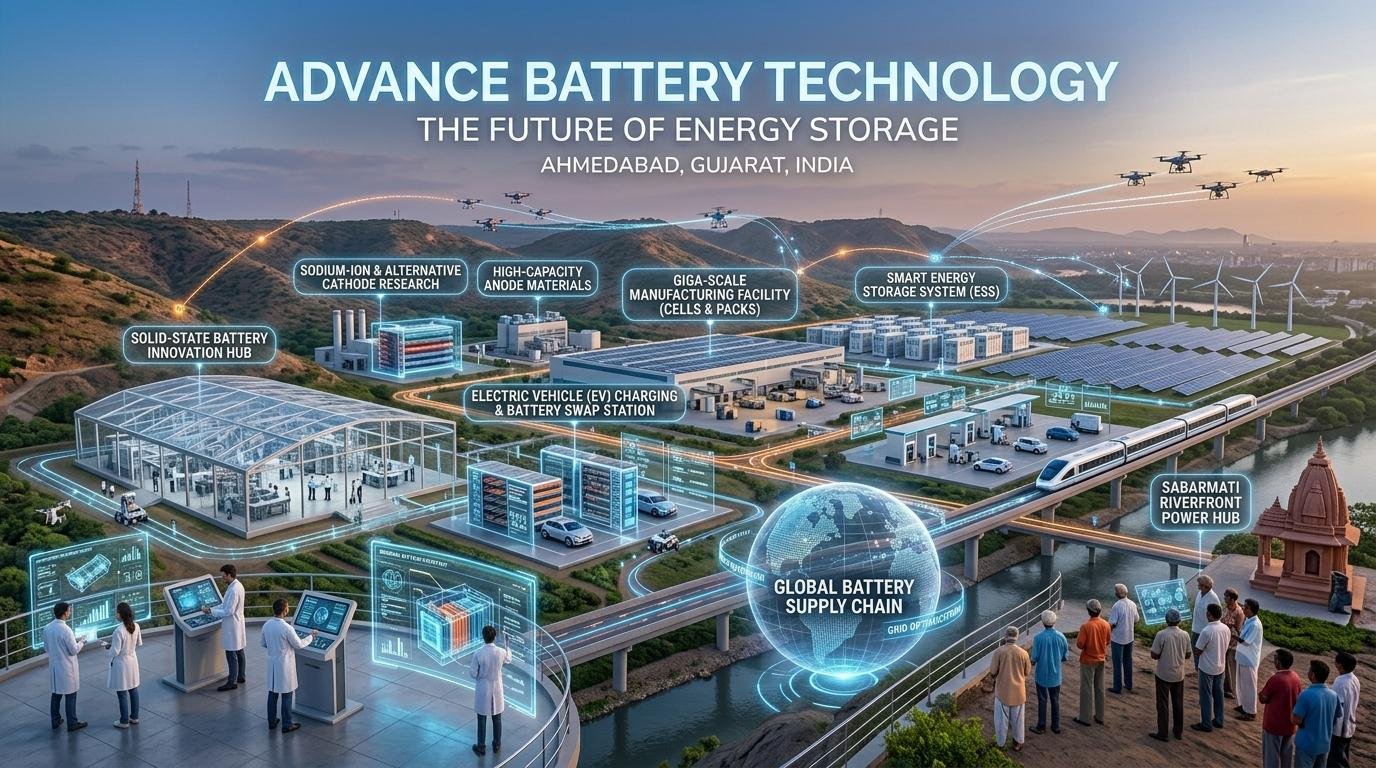
From smartphones and laptops to electric vehicles and renewable-energy systems, batteries have become an essential part of modern life.
But today’s batteries still have limitations. Charging can take time, battery capacity eventually decreases, and larger energy storage systems can be expensive and technically challenging.
This is why researchers and companies are exploring next-generation battery technologies that could provide higher energy density, faster charging, improved safety and longer operating life.
The development of advanced batteries could have a major impact on how people travel, work, communicate and use renewable energy.
What Is Advanced Battery Technology?
Advanced battery technology refers to new battery designs, materials and manufacturing methods intended to improve the performance of energy-storage systems.
Research is taking place across several areas, including:
– Solid-state batteries
– Lithium-ion improvements
– Sodium-ion batteries
– Lithium-metal batteries
– Silicon-based anodes
– Advanced battery-management systems
– Large-scale energy-storage batteries
Different technologies have different advantages and limitations. There is no single battery technology that is automatically suitable for every application.
Why Do We Need Better Batteries?
Modern technology increasingly depends on portable and rechargeable energy.
A better battery could potentially offer:
More energy: Devices and vehicles could operate longer between charges.
Faster charging: Less time could be spent waiting for a battery to recharge.
Longer lifespan: Batteries could potentially retain useful capacity for more charging cycles.
Improved safety: Better materials and battery-management systems could reduce certain risks.
Better energy storage: Renewable electricity could be stored and used when needed.
These improvements could influence everything from consumer electronics to national energy infrastructure.
Better Batteries for Electric Vehicles
Electric vehicles are one of the biggest areas driving battery innovation.
For EV users, important factors include:
– Driving range
– Charging time
– Battery lifespan
– Vehicle weight
– Safety
– Cost
Advances in battery chemistry and manufacturing could help address some of these challenges.
Higher energy density, for example, could potentially allow a vehicle to store more energy without proportionally increasing battery size or weight.
However, battery performance depends on many factors, including vehicle design, temperature, charging conditions and driving behavior.
What Are Solid-State Batteries?
One of the most discussed next-generation technologies is the solid-state battery.
Many conventional lithium-ion batteries use liquid or gel-like electrolytes. Solid-state designs seek to use a solid electrolyte instead.
Potential advantages being investigated include:
– Higher energy density
– Improved safety characteristics
– Potentially faster charging
– Longer operating life
However, solid-state batteries also face significant challenges involving manufacturing, cost, durability and large-scale production.
The technology is developing, and commercial availability varies depending on the application and manufacturer.
Better Batteries for Smartphones and Laptops
Consumers often judge a device partly by how long its battery lasts.
Future battery improvements could allow smartphones, tablets and laptops to operate longer without increasing their physical size.
Another important development is faster charging.
Instead of waiting a long time for a device to reach a useful charge level, improved battery systems could potentially make short charging sessions more practical.
However, charging speed must be balanced with battery temperature, safety and long-term battery health.
Batteries and Renewable Energy
Solar and wind power are valuable renewable-energy sources, but their electricity generation can vary depending on weather and time of day.
Energy storage can help address this challenge.
For example:
Solar panels → generate electricity during sunlight → battery stores excess energy → stored electricity is used later.
Large battery-storage systems can therefore become an important component of modern electricity networks.
They can potentially help manage fluctuations in renewable generation and electricity demand.
Home Energy Storage
Battery technology could also change how households use electricity.
A home with solar panels and battery storage could potentially store excess electricity generated during the day and use some of it later.
A smart energy system could combine:
Solar + battery + smart meter + connected appliances + energy-management software.
This could give households greater control over when electricity is generated, stored and consumed.
Actual financial and energy benefits depend on local electricity prices, solar production, battery costs and household consumption.
Batteries for Industry
Advanced batteries are not only about cars and smartphones.
Industries need energy storage for backup power, grid support, remote operations and equipment.
Large-scale battery systems can be used alongside other energy-storage technologies depending on the application.
As renewable electricity expands, energy storage could become increasingly important for balancing supply and demand.
Could Advanced Batteries Help the Environment?
Battery technology could support the transition toward electrification and renewable energy, but batteries themselves also have environmental impacts.
Battery production requires raw materials, energy and manufacturing infrastructure.
Important areas of development include:
– Improving material efficiency
– Recycling used batteries
– Recovering valuable materials
– Developing alternative chemistries
– Reducing manufacturing waste
– Increasing battery lifespan
A battery that lasts longer and can be efficiently recycled may have different environmental impacts from a short-lived battery that is difficult to recover.
Therefore, the future of battery technology is not only about more energy. It is also about better lifecycle management.
The Importance of Battery Recycling
As the number of electric vehicles, electronics and energy-storage systems increases, responsible battery recycling becomes increasingly important.
Recycling can potentially recover materials from used batteries and reduce the need for some new raw-material extraction.
However, recycling technologies differ by battery chemistry and application.
Safe collection, transportation and processing are essential because damaged batteries can create fire and safety hazards.
Smart Battery Management
Battery innovation is not limited to chemistry.
Battery Management Systems (BMS) are also becoming increasingly sophisticated.
A BMS can monitor factors such as:
– Battery temperature
– Voltage
– Current
– State of charge
– Cell performance
It can help control charging and discharging within appropriate operating limits.
Future battery systems may increasingly combine advanced sensors, software and analytics to monitor battery condition and identify potential problems.
What Could the Future of Batteries Look Like?
Battery development is moving in several directions rather than toward one universal solution.
Future technologies may include:
Solid-State Batteries
Potentially higher energy density and different safety characteristics.
Sodium-Ion Batteries
An alternative chemistry that is being explored for applications where cost and material availability are important considerations.
Silicon-Based Battery Materials
Silicon can store more lithium than conventional graphite in theory, and researchers are working on ways to overcome practical durability challenges.
Lithium-Metal Batteries
These are being investigated for potentially higher energy density.
Large-Scale Grid Batteries
These can support electricity networks and renewable-energy integration.
Each technology has its own engineering and commercial challenges.
Challenges Ahead
Advanced batteries still face several major obstacles.
Cost: New technologies can initially be expensive.
Manufacturing: Producing batteries consistently at large scale is difficult.
Raw materials: Supply chains for battery materials require careful management.
Safety: Battery systems need robust design, testing and monitoring.
Durability: High performance must be maintained over many charging cycles.
Recycling: Large-scale end-of-life systems need to develop alongside battery adoption.
Solving these challenges will determine how quickly different battery technologies become widely available.
Final Thoughts
Battery technology is one of the hidden foundations of the modern digital world.
Every improvement in energy storage can influence other technologies.
Better batteries could support longer-lasting electronics, more practical electric transportation, renewable-energy storage and increasingly connected homes.
The future is unlikely to depend on one perfect battery.
Instead, different battery technologies may emerge for different purposes—from smartphones and electric vehicles to homes, factories and electricity grids.
As energy storage improves, the impact may extend far beyond the battery itself.
It could help create a future where electricity is easier to store, transportation becomes increasingly electrified and renewable energy becomes more flexible and useful.
Stay Updated With the Latest Articles
Stay updated with the latest news, insights, and articles.
Subscribe Now for more articles and updates.
