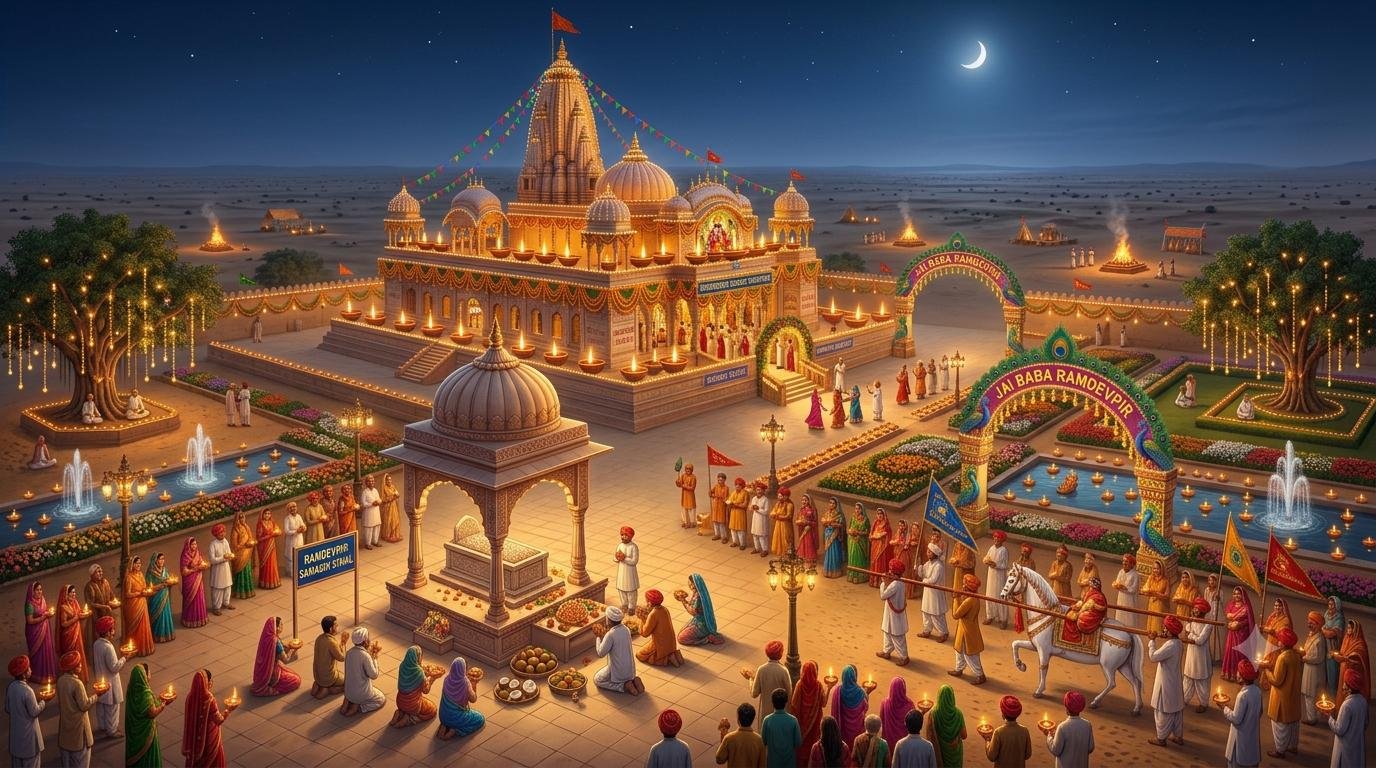
Ranuja, also known as Ramdevra, is one of the most revered pilgrimage places associated with Baba Ramdev Pir. Located in Rajasthan’s Jaisalmer region, this sacred land is remembered as the place where Ramdev Pir took Samadhi, according to devotional tradition.
For devotees from Rajasthan, Gujarat, Madhya Pradesh and other parts of India, Ranuja is not simply a temple destination. It is a place of faith, devotion, equality and spiritual remembrance.
The central shrine is built around the Samadhi of Baba Ramdevji. Rajasthan’s Devasthan Department identifies the tomb/cenotaph of Shri Ramdevji as the centre of the temple campus, while the present cenotaph was constructed by Maharaja Ganga Singh of Bikaner.
But what is the story behind this sacred Samadhi?
Why did Ramdev Pir choose Samadhi?
And why does Ranuja continue to attract devotees centuries later?
Who Was Ramdev Pir?
Baba Ramdev Pir, also known as Ramdevji, Ramapir or Ramsha Pir, is one of the most respected folk saints of Rajasthan and Gujarat.
Traditional accounts associate him with the Tanwar Rajput lineage and the region around Pokhran. Devotees remember him as a spiritual figure who dedicated his life to helping ordinary people and challenging social discrimination.
The Rajasthan government’s development report describes Ramdevji as a saint who devoted his life to the upliftment of disadvantaged people and emphasizes his message of equality. It also notes that his worship crosses caste and Hindu-Muslim boundaries.
Over generations, stories of his compassion, spiritual powers and service became deeply established in the folk traditions of western India.
This is why devotees do not remember him only as a saint of the past.
They call him Ramapir with the belief that his spiritual presence continues.
Ranuja: The Sacred Land of Ramdev Pir
The place now widely known as Ramdevra is traditionally associated with Runicha/Ranuja, the sacred place of Baba Ramdevji.
The village lies in Jaisalmer district, near Pokhran, and receives large numbers of pilgrims, particularly during the major annual devotional period. The Government of India’s Incredible India tourism portal describes Ramdevra Temple as an important pilgrimage destination dedicated to Baba Ramdevji.
For devotees, entering Ranuja is itself considered a spiritual experience.
The atmosphere changes with the sound of:
“Jai Ramapir!”
Bhajans, devotional songs and the movement of pilgrims create an environment in which the name of Ramdev Pir remains constantly present.
The Story of Ramdev Pir’s Samadhi
The most sacred chapter in the Ranuja tradition is the story of Ramdev Pir’s Samadhi.
According to devotional tradition, after spending his life serving people and spreading the message of equality and devotion, Baba Ramdevji decided to leave his physical body through Samadhi.
This is understood by devotees not simply as death but as a spiritually conscious departure from the physical world.
Traditional sources place the event in the Bhadrapada Shukla Ekadashi period. The exact historical chronology and Vikram Samvat/AD conversion can differ among sources, so devotional accounts should be treated as tradition rather than as a single universally agreed historical record.
The age is also reported differently in popular sources.
The important spiritual point, however, is consistent:
Ramdev Pir chose Samadhi at Ranuja and the place became the centre of his continuing devotional tradition.
The Emotional Final Moments
According to traditional narratives, when Ramdevji announced his decision to take Samadhi, his devotees were deeply saddened.
For those who had seen him as their protector and spiritual guide, the thought of his physical departure was extremely painful.
Ramdevji is said to have reminded them that the physical body is temporary, while spiritual truth is eternal.
His final teachings are remembered in different forms through regional oral traditions and devotional literature.
The message attributed to him focuses on values such as:
– Avoiding sinful actions
– Showing compassion toward every living being
– Feeding the hungry
– Remaining devoted to God
– Helping others
– Staying away from ego
– Respecting the spiritual path
– Living a truthful life
These teachings are especially meaningful because they turn devotion into action.
Dalibai and the Sacred Connection
One of the most touching stories associated with Ranuja is that of Dalibai, a devoted follower of Ramdev Pir.
Traditional accounts remember Dalibai as a spiritually devoted woman from the Meghwal community who was deeply connected with Ramdevji.
Her story is important because it reflects Ramdev Pir’s message that devotion is not determined by caste or social status.
Rajasthan’s cultural heritage material records the tradition that Dalibai took Samadhi shortly before Ramdevji. Her shrine is located close to Ramdevji’s Samadhi.
For devotees, the closeness of the two Samadhis has become a powerful symbol.
It represents a spiritual relationship in which social boundaries disappear.
Ramdev Pir’s Message of Equality
This is perhaps the most powerful lesson connected with Ranuja.
Ramdev Pir’s devotion has historically attracted followers from different communities.
The Rajasthan government’s official planning document specifically highlights the saint’s message that human beings are equal, regardless of whether they are rich or poor or socially powerful or disadvantaged.
That message remains relevant even today.
A temple can be made of stone.
A pilgrimage can be completed on foot.
A prayer can be spoken with words.
But the true test of devotion is how we treat another human being.
This is the deeper meaning devotees find in Ramapir’s legacy.
The Five Pirs from Mecca
Another famous story connected with Ramdev Pir is the legend of the five Pirs from Mecca.
According to the traditional account, the five Pirs came to test Ramdevji’s spiritual powers.
Ramdevji welcomed them and invited them to have food.
The Pirs reportedly said that they would eat only from their own utensils, which were far away in Mecca.
The devotional story says that Ramdevji then caused their utensils to appear before them.
Impressed by what they witnessed, the Pirs accepted his spiritual greatness and paid homage to him.
This story is traditionally used to explain why Ramdevji became known as Ramsha Pir/Ramapir among Muslim devotees.
The Rajasthan government’s cultural report also records this legend and notes that the tombs of the five Pirs are associated with the temple complex.
Whether one reads this story as a sacred miracle, folk tradition or symbol of interfaith harmony, its central message is powerful:
True spirituality can bring people together.
The Ranuja Temple
The present Ramdev Pir temple is centred around his sacred Samadhi.
The Rajasthan Devasthan Department states that the present cenotaph was built by Maharaja Ganga Singh of Bikaner, with the temple associated with Ramdevji’s Samadhi at Ramdevra.
A Rajasthan government planning document also records 1931 as the year associated with the construction of the temple around the Samadhi.
Thus, while the spiritual tradition surrounding Ramdev Pir is centuries old, the present temple structure represents a much later phase of the site’s architectural history.
Why Devotees Visit Ranuja
People visit Ranuja for many reasons.
Some come to fulfil a religious vow.
Some arrive to seek blessings.
Some undertake the journey as an expression of gratitude.
Others come because Ramdev Pir has been their family’s Ishta Devata for generations.
For many devotees, the journey itself is part of the worship.
People sing bhajans while travelling.
Some pilgrims walk long distances.
Others arrive in groups carrying the name of Ramapir.
The Government of India’s tourism portal notes that pilgrims travel to the shrine from different regions and that devotional singing and folk traditions form an important part of the temple’s cultural atmosphere.
Ranuja and Gujarat’s Deep Connection
Although Ranuja is in Rajasthan, its spiritual connection with Gujarat is extremely strong.
Ramdev Pir is deeply respected across Gujarat, where he is often lovingly called Ramapir.
Gujarati devotional songs, folk traditions and family worship have helped carry his story from one generation to another.
For many Gujarati devotees, travelling to Ranuja is not simply a Rajasthan pilgrimage.
It is a journey to the sacred land of their beloved Ramapir.
This is why the name “Ranuja na Ramapir” carries such emotional power in Gujarati devotional culture.
The Spiritual Meaning of Samadhi
The word Samadhi carries a deep meaning in Indian spiritual traditions.
It is associated with a state of profound spiritual absorption and, in traditions concerning saints, can refer to the conscious departure from the physical body.
For Ramdev Pir devotees, his Samadhi does not represent an ending.
It represents a transition.
The belief is that although Ramdevji left his physical form, his spiritual presence continues to guide devotees.
This is why people still bow before his Samadhi and pray to him centuries later.
The temple therefore becomes more than a historical monument.
It becomes a living centre of faith.
What Ranuja Teaches Us Today
The story of Ramdev Pir and Ranuja can be understood through five powerful lessons.
1. Equality
Never judge a person by birth, wealth or social position.
2. Compassion
A hungry person’s need can be more important than our own comfort.
3. Service
Helping others can itself become a form of worship.
4. Faith
Difficult moments test faith, but they can also deepen it.
5. Unity
Spirituality can connect people across communities and traditions.
The Eternal Presence of Ramapir
Centuries have passed since the traditional account of Ramdev Pir’s Samadhi.
Yet his name continues to echo across Ranuja.
The temple remains a destination for pilgrims.
Bhajans continue to be sung.
Families continue to tell his stories to their children.
And devotees continue to say:
“Jai Ramapir.”
That is the real story of Ranuja.
It is not only about a temple.
It is about a spiritual legacy that survived generations because it spoke about something universal—humanity, equality, faith and service.
Conclusion
The Ranuja Ramdev Pir Temple is one of the most significant pilgrimage sites associated with Baba Ramdevji. At its heart lies the sacred Samadhi that devotees believe marks the place where Ramapir consciously departed from his physical life.
The stories surrounding his Samadhi, Dalibai, the five Pirs and his final teachings form an important part of the devotional heritage of Rajasthan and Gujarat.
For believers, Ranuja is a place where Ramdev Pir’s presence can still be felt.
For travellers, it is a window into Rajasthan’s living folk culture.
And for anyone seeking a spiritual lesson, the message is simple:
Serve humanity, respect everyone, remain humble and keep faith.
That is the timeless path of Ramapir.
Stay updated with the latest news and articles. Subscribe Now for more articles.
