
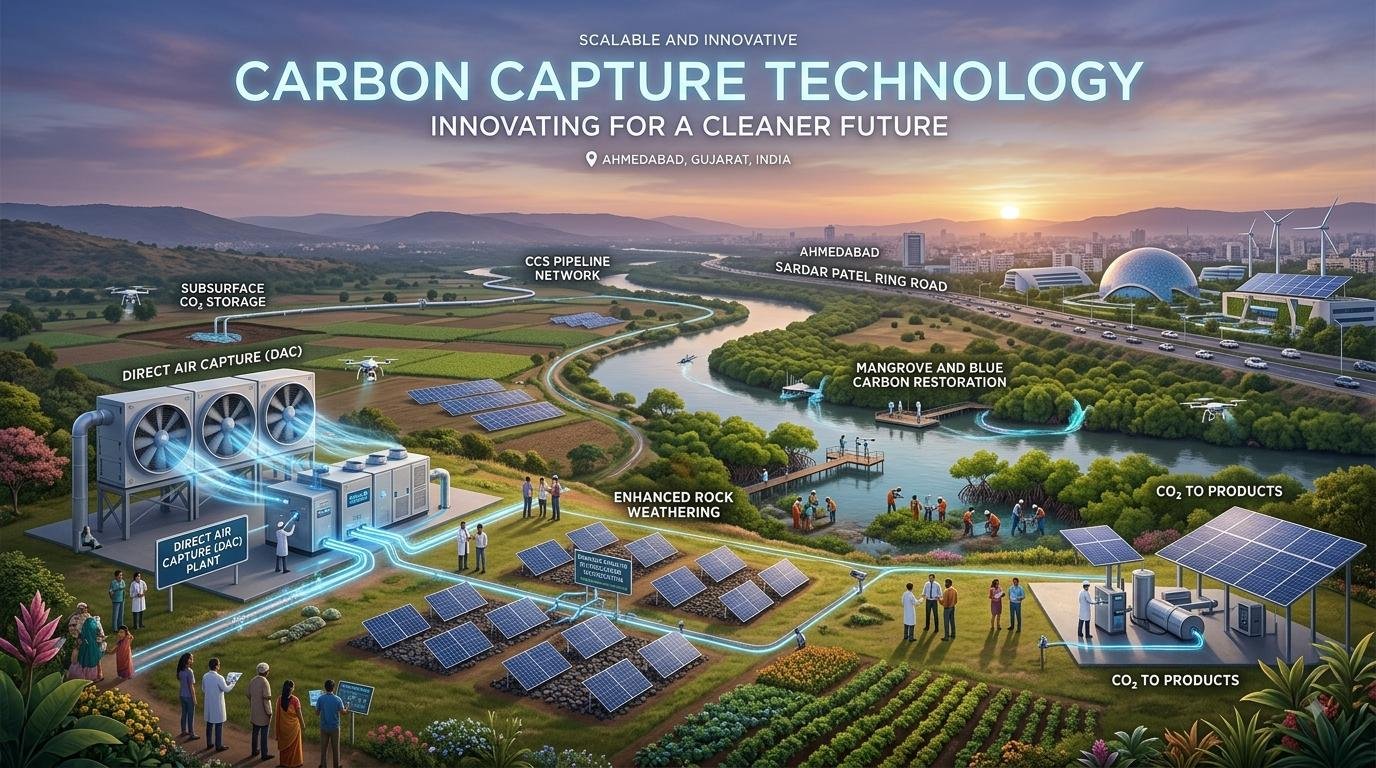
As the world searches for practical ways to address climate change, Carbon Capture Technology is attracting growing attention. Reducing greenhouse gas emissions remains essential, but some industries—such as cement, steel, chemicals, and heavy manufacturing—can be difficult to fully decarbonize.
Carbon capture aims to address part of this challenge by capturing carbon dioxide (CO₂) from industrial processes or directly from the atmosphere before it contributes to long-term warming. The captured CO₂ can then be transported, stored underground, or in some cases used to produce other materials.
Although carbon capture is not a replacement for renewable energy or emissions reduction, it could become one component of a broader strategy for building a lower-carbon economy.
🔍 What Is Carbon Capture Technology?
Carbon capture refers to technologies designed to separate CO₂ from industrial gases or, in some systems, remove it directly from the atmosphere.
There are three commonly discussed approaches:
– Post-combustion capture — removes CO₂ after fuel has been burned.
– Pre-combustion capture — separates carbon before combustion in certain industrial processes.
– Direct Air Capture (DAC) — removes CO₂ directly from ambient air.
Each approach has different costs, energy requirements, and potential applications.
⚙️ How Does Carbon Capture Work?
A typical carbon capture system involves several stages.
Basic Process
1. CO₂ is separated from an industrial gas stream or air.
2. The captured gas is compressed.
3. It is transported through pipelines, ships, or other infrastructure.
4. CO₂ is permanently stored underground or used in selected applications.
The objective is to prevent captured carbon from returning to the atmosphere.
🏭 Carbon Capture in Heavy Industry
Some industrial activities produce emissions through chemical reactions rather than simply from burning fossil fuels.
Potential Applications
– Cement manufacturing
– Steel production
– Chemical industries
– Refining
– Waste-to-energy facilities
Carbon capture could help reduce emissions from sectors where alternatives are technically difficult or expensive.
🌬️ Direct Air Capture
Direct Air Capture is a particularly interesting area of climate technology.
Instead of capturing CO₂ from a factory, DAC systems attempt to remove carbon dioxide directly from surrounding air.
Because atmospheric CO₂ is relatively diluted, direct air capture currently requires significant energy and specialized equipment. Researchers and companies are working to improve efficiency and reduce costs.
🌍 Carbon Capture and Climate Action
Carbon capture can potentially contribute to climate strategies in two major ways.
Reducing Industrial Emissions
Capturing emissions at their source can prevent some CO₂ from entering the atmosphere.
Removing Existing CO₂
Some technologies can remove CO₂ that is already present in the atmosphere. When this captured carbon is permanently stored, the process can contribute to net carbon removal.
This distinction is important because simply preventing new emissions is different from removing carbon that has already accumulated in the atmosphere.
⚡ Role of Renewable Energy
The environmental benefits of carbon capture depend partly on the energy used to operate the system.
If carbon capture requires large quantities of fossil-fuel-based energy, some of its climate benefits can be reduced.
Combining carbon capture systems with increasingly low-carbon electricity and energy-efficient processes could improve their overall environmental performance.
🏗️ Carbon Storage Technology
Captured CO₂ needs to be stored safely if it is not being used.
One approach is geological carbon storage, where compressed CO₂ is injected into suitable underground formations.
Potential storage locations can include certain deep saline formations and depleted oil and gas reservoirs, subject to geological suitability, monitoring, and regulation.
Long-term monitoring is essential to ensure stored carbon remains securely contained.
♻️ Carbon Capture and Carbon Utilization
Captured CO₂ can also become a raw material for selected products.
Potential Uses
– Synthetic fuels
– Building materials
– Chemicals
– Industrial products
However, utilization does not automatically mean permanent carbon removal. The climate benefit depends on how the CO₂ is used, how long it remains stored, and what energy sources are involved.
🤖 Artificial Intelligence and Carbon Capture
Artificial Intelligence could help improve the efficiency of carbon capture systems.
AI Applications
– Monitoring equipment performance
– Predicting maintenance requirements
– Optimizing energy consumption
– Analyzing geological storage data
– Improving operational efficiency
Combining AI with climate technology could help reduce the cost and complexity of future carbon management systems.
💰 Economic Opportunities
Carbon capture could create new opportunities across multiple industries.
Potential Growth Areas
– Carbon management infrastructure
– Specialized engineering
– Environmental monitoring
– CO₂ transportation
– Clean industrial technologies
As governments and industries pursue lower-emission production, demand for carbon-management expertise could increase.
⚠️ Challenges of Carbon Capture
Carbon capture also faces significant challenges.
Major Concerns
– High capital costs
– Significant energy requirements
– Difficult infrastructure development
– Long-term storage monitoring
– Transportation challenges
– Regulatory complexity
Technology improvements and large-scale deployment will be important for reducing these barriers.
❓ Is Carbon Capture a Replacement for Renewable Energy?
No.
Carbon capture should not be viewed as a substitute for renewable energy, energy efficiency, electrification, or reducing fossil-fuel consumption where practical.
Instead, it can potentially complement broader climate strategies, particularly in sectors where eliminating emissions completely is technically difficult.
🔮 Future of Carbon Capture Technology
The future of carbon capture will depend on technological progress, economics, environmental performance, infrastructure, and government policies.
Emerging Trends
– More efficient capture materials
– Lower-energy Direct Air Capture
– Carbon-negative industrial processes
– Improved geological monitoring
– AI-powered carbon management
– Integration with renewable energy
– Carbon capture in hard-to-abate industries
If costs decline and performance improves, carbon capture could become an important part of the global clean-technology ecosystem.
🌟 Conclusion
Carbon Capture Technology represents an important area of climate innovation. By capturing CO₂ from industrial processes and, in some cases, removing it from the atmosphere, the technology could help address emissions that are difficult to eliminate through conventional methods.
However, carbon capture is not a single solution to climate change. Its success will depend on responsible deployment, lower energy requirements, secure storage, transparent monitoring, and integration with broader efforts to reduce emissions.
The future of climate technology will likely involve multiple solutions working together—and carbon capture could be one important piece of that larger puzzle.
Stay updated with the latest news and articles. Subscribe Now for more articles.
