Shravan Maas, also known as Sawan, is one of the most sacred months in the Hindu calendar. It is especially associated with ****, and devotees across India observe fasting, prayers, temple visits, Rudrabhishek, and Shravan Somvar Vrat during this period.
But every year, an interesting question confuses many devotees:
Why does Shravan start on a different date in Gujarat compared with many North Indian states?
If you live in Gujarat, you may notice that people in Uttar Pradesh, Bihar, Rajasthan, Delhi, or other regions sometimes celebrate Shravan according to dates that do not match the Gujarati calendar.
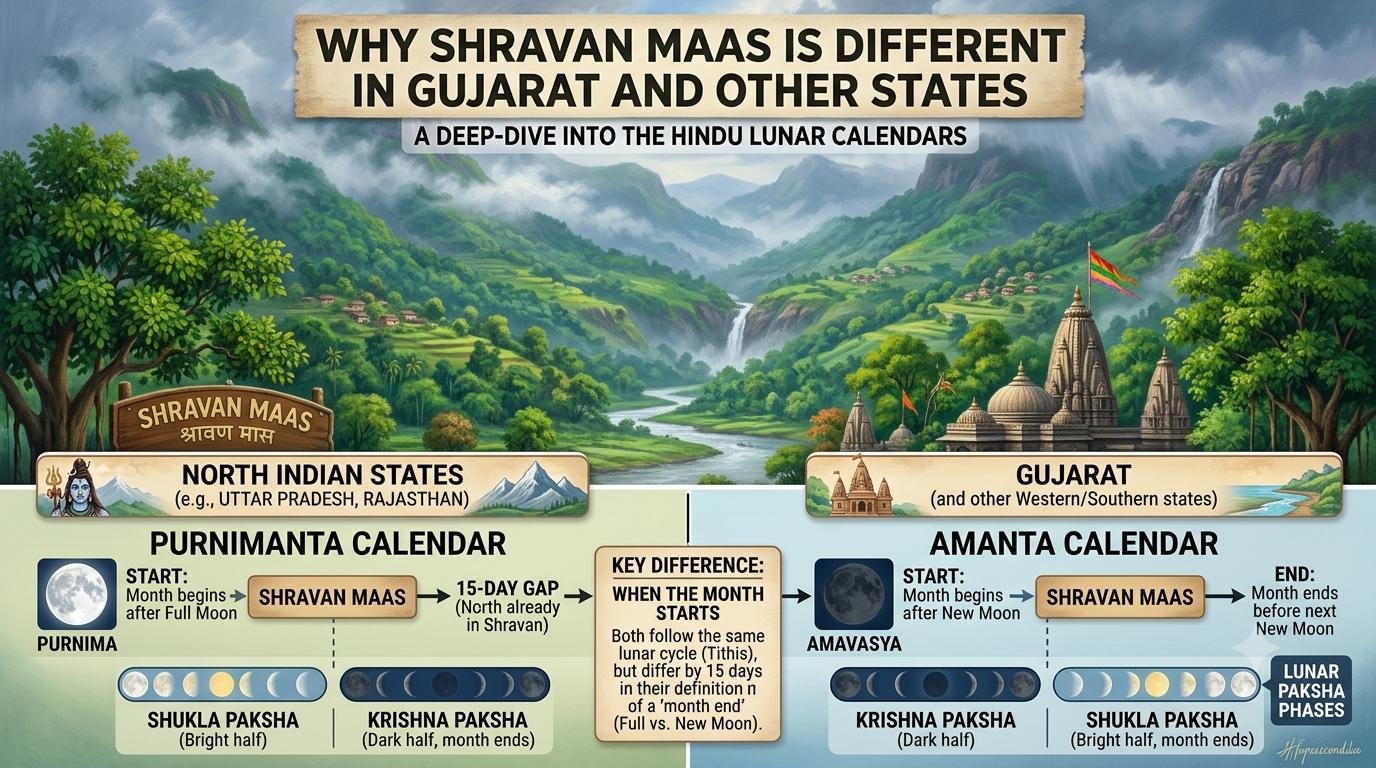
The reason is not that Gujarat has a different Shravan festival. The main reason is the different lunar calendar systems used to determine when a Hindu month begins and ends.
Let’s understand the fascinating reason behind this difference.
🌙 What Is Shravan Maas?
Shravan is traditionally the fifth month in several Hindu lunar calendar traditions. It generally falls during the monsoon season and is considered particularly sacred for Shiva worship.
During this month, devotees commonly:
– Worship Lord Shiva
– Offer water to the Shiva Linga
– Offer bilva leaves
– Observe Somvar Vrat
– Chant Om Namah Shivaya
– Perform Rudrabhishek
– Visit Shiva temples
– Practice charity and spiritual discipline
The exact dates, however, can differ depending on the regional calendar followed.
🗓️ The Main Reason: Amanta and Purnimanta Calendars
The biggest reason for the difference is the use of two traditional systems for calculating lunar months:
Amanta Calendar
In the Amanta system, the lunar month ends on Amavasya, the New Moon.
After Amavasya, the next lunar month begins.
This system is commonly followed in Gujarat, Maharashtra, Goa and several other parts of India.
Purnimanta Calendar
In the Purnimanta system, the lunar month ends on Purnima, the Full Moon.
The next lunar month begins after the Full Moon.
This system has traditionally been used across much of North India.
This difference in month-ending conventions is the key reason why the same festival or lunar month can appear to have different dates in different regions.
🌑 How Does the Difference Actually Work?
Imagine a lunar cycle moving from New Moon to Full Moon and then back toward the next New Moon.
Under the Amanta system, the month is named according to the period ending at Amavasya.
Under the Purnimanta system, the month is named according to the period ending at Purnima.
Therefore, the same sequence of lunar days can receive different month names depending on which calendar tradition is being followed.
This can make Shravan appear to begin at different times in Gujarat and North India.
🌿 Important Point
The Moon is not following a different cycle in Gujarat.
The astronomical lunar cycle is the same.
What changes is the calendar convention used to name the lunar month.
🔱 Why Is Shravan So Important to Gujaratis?
Shravan has a special place in Gujarati religious and cultural life.
For many Gujarati families, the month is associated with:
– Shiva worship
– Shravan Somvar
– Fasting
– Temple visits
– Religious storytelling
– Charity
– Devotional activities
– Family traditions
The month is also connected with the wider rhythm of the monsoon season, when Gujarat’s landscapes receive much-needed rainfall.
Devotees may visit famous Shiva temples such as ****, one of India’s most revered Shiva pilgrimage sites.
🙏 What Is Shravan Somvar?
Shravan Somvar means Monday observed during the Shravan month.
Monday is traditionally associated with Lord Shiva, making Mondays during Shravan especially significant for devotees.
People may observe a fast, visit a Shiva temple, perform abhishek, chant Shiva mantras, or simply spend time in prayer.
However, because Gujarat and North India can use different lunar month conventions, the dates of Shravan Somvar can also differ between regions.
This is why two devotees from different states may have different calendars while both are correctly following their respective traditions.
🌺 Is Gujarati Shravan Different From North Indian Shravan?
Not in the sense of being a completely different religious month.
It is better to say that different calendar systems assign the name “Shravan” to different portions of the lunar cycle.
The traditions are connected to the same broader Hindu lunar calendar framework.
This is similar to how different regions can have different names, customs, or dates for festivals while sharing the same underlying religious tradition.
🌧️ Why Does Shravan Usually Come During Monsoon?
Shravan generally falls around the monsoon period in the Indian subcontinent.
Rain transforms the landscape, fills rivers and lakes, and brings new growth to plants and crops.
This seasonal transformation also has a beautiful spiritual symbolism.
Shravan encourages devotees to think about:
Renewal → Purification → Devotion → Inner Growth
Just as nature becomes fresh during the rains, devotees use this sacred period to refresh their thoughts and strengthen their spiritual practices.
🪔 Why Do Devotees Offer Water to Shiva?
Offering water to the Shiva Linga is one of the most common Shravan traditions.
The practice is associated with devotion and with the story of Samudra Manthan, during which a deadly poison emerged. According to Hindu tradition, Shiva consumed the poison to protect creation and became known as Neelkanth, the blue-throated Lord.
Devotees offer water and other traditional offerings as expressions of gratitude, reverence, and prayer.
The ritual also symbolizes cooling the intensity of worldly negativity and cultivating peace within oneself.
🌿 Why Are Bilva Leaves Offered to Shiva?
The bilva (bael) leaf has a special place in Shiva worship.
Its three-part leaf is traditionally associated with different spiritual meanings and is considered especially sacred in Shiva puja.
During Shravan, devotees commonly offer bilva leaves along with water and prayers.
The ritual is simple, but its deeper message is about faith, humility, and surrender.
📿 What Should Devotees Do During Shravan?
There is no single compulsory method followed by every Hindu family. Customs vary by region and tradition.
Common devotional practices include:
🔱 1. Chant “Om Namah Shivaya”
Spend a few minutes each day in peaceful mantra chanting.
🪔 2. Visit a Shiva Temple
Offer prayers and participate in abhishek according to temple customs.
🌿 3. Observe Somvar Vrat
Devotees who traditionally observe fasting can follow their family’s or spiritual teacher’s guidance.
📖 4. Read Sacred Texts
Reading or listening to Shiva-related scriptures and devotional stories can become part of the month’s spiritual practice.
❤️ 5. Practice Charity
Helping people in need is an important expression of compassion and devotion.
🧘 6. Practice Self-Control
Shravan can be used as an opportunity to reduce anger, negativity, excessive consumption, and unhealthy habits.
🌸 The Deeper Meaning of Shravan
The greatest message of Shravan is not simply about dates on a calendar.
It is about transformation.
Lord Shiva represents detachment, meditation, simplicity, courage, and transformation.
Therefore, Shravan can become a time to ask ourselves:
– What negativity should I release?
– Which habits should I change?
– How can I become more compassionate?
– How can I bring more peace into my life?
– Can I spend more time helping others?
These questions make the festival meaningful even beyond religious rituals.
🗓️ Why You Should Check Your Regional Panchang
Because lunar calendars differ by region, devotees should not assume that dates found on a calendar from another state will automatically apply to their local tradition.
For religious observances such as:
– Shravan beginning
– Shravan Somvar
– Nag Panchami
– Janmashtami
– Raksha Bandhan
– Purnima
– Amavasya
it is useful to follow the local Panchang and regional tradition.
This is especially important in Gujarat, where the Amanta calendar is traditionally followed.
🌺 Gujarat’s Shravan: Different Date, Same Devotion
The difference between Gujarati Shravan and Shravan observed in many North Indian regions can initially seem confusing.
But once the Amanta and Purnimanta systems are understood, the mystery becomes simple.
Different calendar convention ≠ different God or different festival.
The lunar cycle remains the same. The regional method of naming the month changes.
And the devotion remains exactly the same:
🔱 Har Har Mahadev!
🌟 Conclusion
Shravan Maas is one of India’s most spiritually significant periods, especially for devotees of Lord Shiva. The difference in Shravan dates between Gujarat and other parts of India is primarily the result of regional lunar calendar traditions.
Gujarat traditionally follows the Amanta system, in which the lunar month ends with Amavasya, while many North Indian traditions follow the Purnimanta system, in which the month ends with Purnima.
Understanding this distinction helps explain why Shravan and Shravan Somvar dates can appear different across India.
But behind the different calendars is one shared spiritual message: devotion, self-discipline, compassion, and remembrance of Mahadev.
The calendar may change from region to region, but the faith remains one.
Har Har Mahadev! 🔱🕉️🔥
Stay updated with the latest news and articles. Subscribe Now for more articles.
