
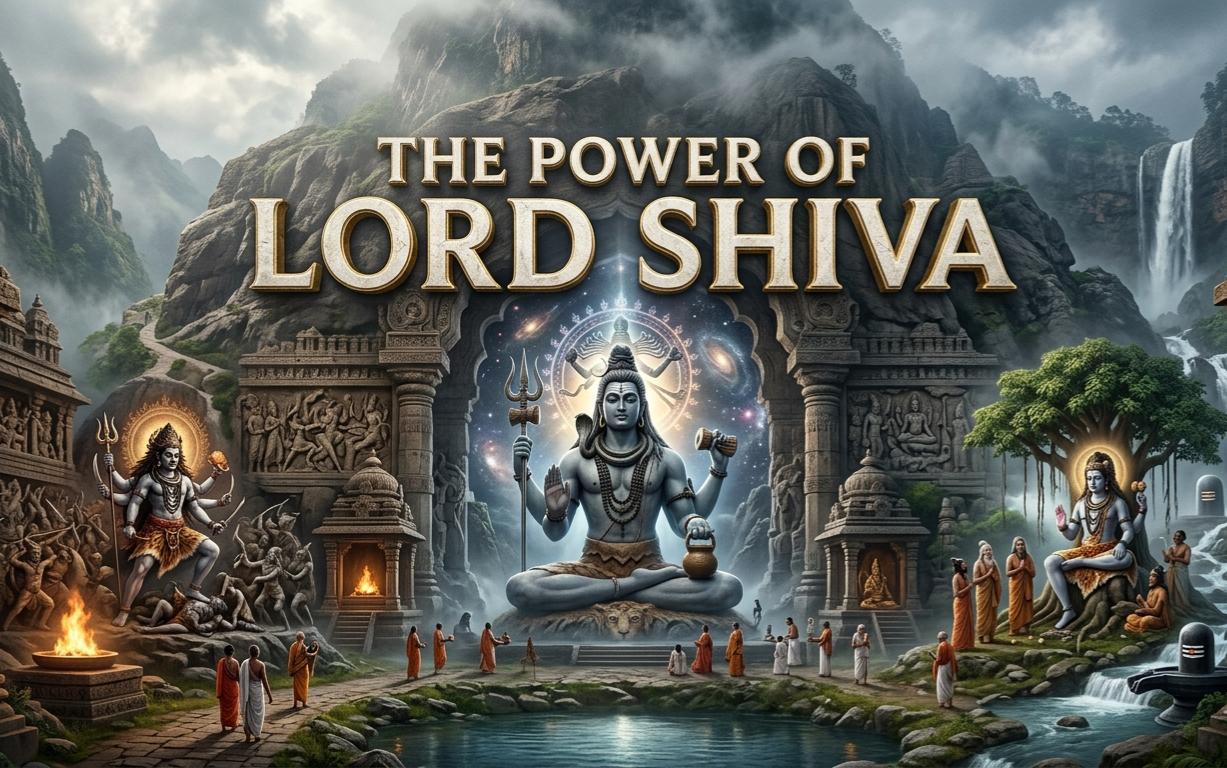
Lord Shiva is one of the most revered deities in Hinduism. Known as Mahadev, or the Great God, Shiva represents the power of transformation, the destruction of negativity, spiritual awakening, and inner peace. Unlike ordinary destruction, Shiva’s power is about removing what is false so that truth can emerge. This is why he is worshipped as both a fierce protector and a deeply compassionate yogi — a figure who embodies the paradox that genuine strength and genuine gentleness are never truly opposites.
Shiva: The Lord of Transformation
In the Hindu Trinity, or Trimurti, Brahma creates, Vishnu preserves, and Shiva transforms and renews. His power reminds us that change is necessary for growth — just as old leaves must fall before new ones can grow, Shiva destroys negativity to make way for positive transformation. The spiritual lesson embedded in this role is profound and simple at once: every ending can become a new beginning. Rather than fearing endings, Shiva’s symbolism invites us to trust the cycle of destruction and renewal as fundamental to all genuine growth.
Shiva: The First Yogi
Shiva is often called Adiyogi — the first yogi — and is widely regarded as the original source of yogic wisdom and practice. He symbolises deep meditation, self-control, inner awareness, and complete mastery of the mind. His characteristic meditative posture, seated in stillness atop Mount Kailash, teaches that true power comes not from controlling others but from mastering oneself. This teaching resonates deeply within the broader tradition of yoga as a discipline, which traces its philosophical roots directly to Shiva’s role as the first practitioner and teacher of this ancient science of the self.
The Third Eye of Shiva
One of Shiva’s most famous and recognisable symbols is his third eye, positioned at the centre of his forehead. According to tradition, when opened, it burns away ignorance and illusion entirely. Symbolically, the third eye represents wisdom, higher consciousness, and profound spiritual insight. The lesson embedded in this powerful image is that knowledge and awareness can destroy ignorance far more effectively than force ever could — a teaching with striking relevance to how conflicts and misunderstandings might be resolved through understanding rather than confrontation.
The Power to Hold Poison: The Story of Neelkanth
During the Samudra Manthan, the great churning of the cosmic ocean, a deadly poison emerged that threatened to destroy all creation. To save the universe, Shiva drank the poison and held it in his throat rather than allowing it to spread, becoming known as Neelkanth — the blue-throated one. The spiritual lesson here is striking in its clarity: true strength is the ability to absorb negativity without spreading it further. In modern life, this translates into the practice of remaining calm and balanced during difficult situations, rather than passing on stress, anger, or harm to others simply because one has received it oneself.
Nataraja: The Cosmic Dancer
As Nataraja, Shiva performs the cosmic dance that symbolises creation, preservation, and transformation occurring simultaneously and continuously throughout the universe. Many scholars and devotees see this dance as a powerful representation of the constant movement and change inherent within existence itself. The message embedded in this iconic image is that life is fundamentally dynamic — growth happens not through stagnation but through movement, adaptation, and continuous transformation, an idea that resonates as strongly with modern understandings of personal development as it does with ancient cosmology.
The Deeper Meaning of Shiva’s Symbols
Every symbol associated with Shiva carries layered meaning that rewards deeper reflection. The snake coiled around his neck represents mastery over fear and ego rather than fear of the snake itself. The crescent moon resting in his hair signifies control over time and emotions. The river Ganga flowing from his locks symbolises purity and wisdom continuously descending into the world. The trishul, or trident, that he carries represents control over mind, body, and spirit in unified balance. And the damru, the small hand drum, represents the rhythm of creation and the cosmic energy that pulses through all existence. Together, these symbols remind devotees of the balance that is needed across every dimension of a well-lived life.
Shiva and the Power of Silence
Modern life is filled with noise, stress, and constant distraction in ways that ancient practitioners could scarcely have imagined. Shiva’s teachings emphasise the power of silence, reflection, and meditation as counterweights to this relentless external stimulation. Contemporary research on meditation consistently shows that regular practice can improve focus, emotional stability, mental clarity, and stress management — findings that align closely with what Shiva’s iconography and teachings have communicated for thousands of years. This is one of the central reasons Shiva is so closely associated with inner peace across Hindu spiritual tradition.
Shiva as the Destroyer of Ego
One of Shiva’s greatest powers, according to spiritual teaching, is the destruction of ego. Ego is understood as the root of conflict, the source of much human suffering, and a persistent block to genuine wisdom. Shiva’s example encourages humility and continuous self-awareness rather than pride or self-importance, regardless of one’s accomplishments or status. The modern relevance of this teaching is significant — the strongest and most genuinely respected people are often precisely those who remain humble despite considerable success, while those consumed by ego frequently find their achievements undermined by the very pride that helped create them.
Shiva and the Practice of Simplicity
Unlike kings and rulers depicted with great wealth and possessions, Shiva is often shown living simply in the Himalayas with minimal material possessions. This symbolises detachment from material excess, freedom from greed, and a deep sense of contentment that does not depend on external accumulation. His example teaches that genuine happiness comes from inner fulfilment rather than the endless pursuit of more — a lesson that feels particularly pointed in a contemporary culture often defined by consumption and constant acquisition.
What Is the Greatest Power of Shiva?
Many devotees and scholars believe Shiva’s greatest power is not physical strength or cosmic destruction at all, but something far more subtle and far-reaching. It is the power to transform darkness into light, to turn fear into courage, to convert anger into wisdom, and ultimately to lead the soul toward liberation. This understanding reframes Shiva not primarily as a deity associated with endings, but as a profound symbol of the transformative potential present within every difficult experience — a teaching that offers genuine comfort and direction to anyone navigating hardship or uncertainty in their own life.
Conclusion: The True Power of Shiva
Lord Shiva is far more than a deity of destruction. He represents transformation, wisdom, meditation, fearlessness, and spiritual freedom in equal measure. His symbols and stories continue to inspire millions of devotees to develop inner strength and to face life’s inevitable challenges with courage and awareness rather than fear or avoidance. As the tradition reminds us, the true power of Shiva is the ability to transform oneself — a teaching that remains as relevant to the struggles of modern life as it was to the cosmic dramas described in ancient scripture.
Stay updated with the latest news and articles. Subscribe Now for more articles.
