
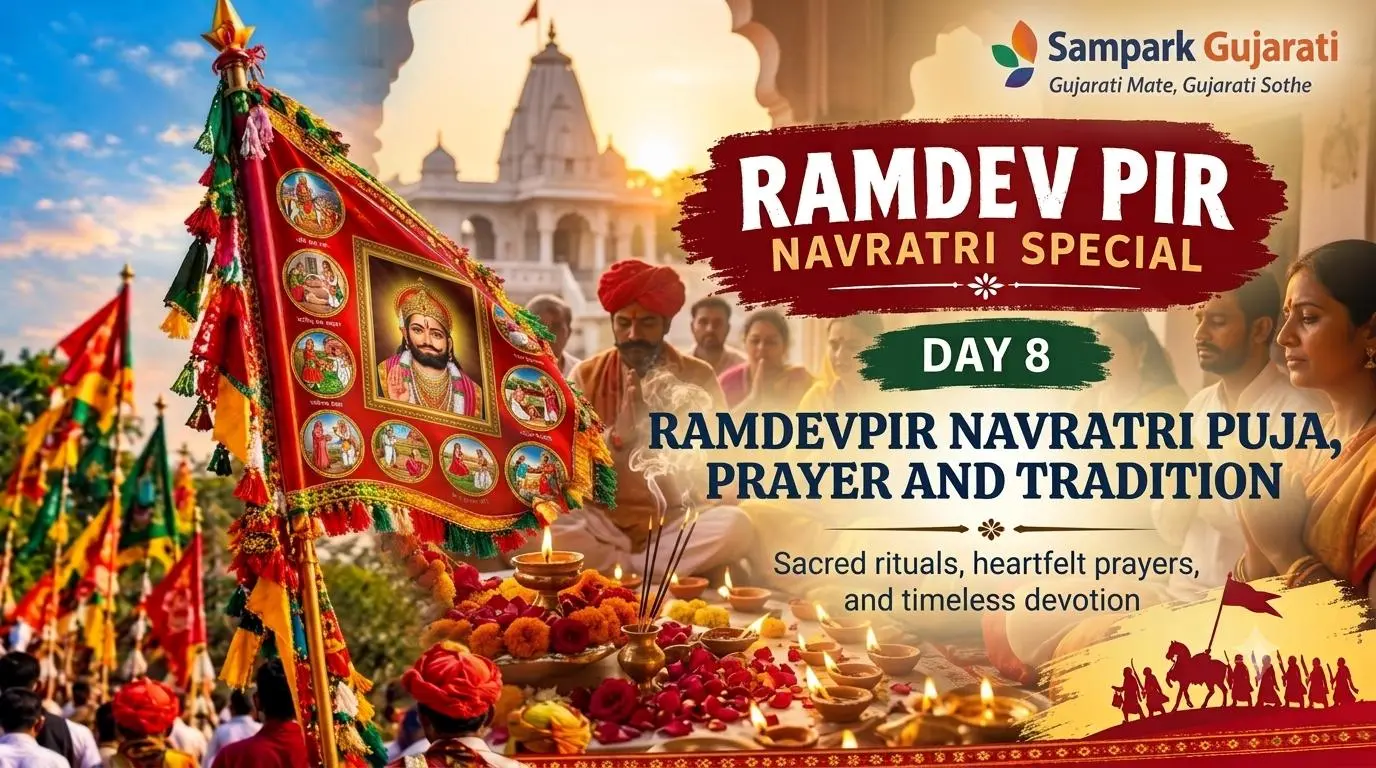
Ramdev Pir Navratri Special | Day 8
For many devotees, devotion begins with something much simpler: faith, respect, remembrance and a sincere heart.
Ramdev Pir, also known as Ramapir, Baba Ramdevji and Ramsha Pir, is remembered across Rajasthan, Gujarat and other parts of western India through temples, bhajans, pilgrimage, Neja traditions, family prayers and community gatherings.
The most important pilgrimage centre associated with Baba Ramdevji is Ramdevra in Rajasthan. Rajasthan Tourism identifies the Ramdevra Temple as dedicated to Baba Ramdevji and notes that it attracts devotees from different faiths. The annual Ramdevra Fair is also associated with devotional singing and large gatherings.
But devotion does not necessarily require a journey to Ramdevra.
For many families, remembering Ramapir begins at home.
As the Sampark Gujarati Ramdev Pir Navratri Special reaches Day 8, let’s explore simple and respectful ways devotees may express their devotion while recognising that customs can differ between families, communities and regions.
Ramdev Pir Puja: Devotion Before Formality
There is no single universal Ramdev Pir puja procedure that every devotee must follow.
Religious customs can vary according to family tradition, community practice and region.
Some devotees may:
- Visit a Ramdev Pir temple
- Keep a devotional image at home
- Sing Ramapir bhajans
- Light a diya
- Offer flowers, fruits or sweets
- Participate in pilgrimage
- Carry or display a Neja
- Join devotional gatherings
- Pray privately
- Express devotion through seva
The important point is that a devotional practice does not have to be elaborate to be meaningful.
For one family, worship may involve a traditional puja. For another, it may simply mean sitting quietly, remembering Ramapir and expressing gratitude.
The form can change.
The feeling of devotion remains personal.
How to Worship Ramdev Pir at Home
If your family follows a home-based Ramdev Pir worship tradition, you can keep the practice simple and respectful.
1. Prepare a Clean Prayer Space
Begin by creating a peaceful place for prayer.
You can:
- Clean the prayer area
- Place a respectful image or representation of Ramdev Pir
- Keep flowers if they are part of your family tradition
- Light a diya if appropriate
- Keep the surroundings quiet and clean
There is no need to create an elaborate arrangement simply for appearance.
The purpose of the space is to help you pray and reflect without unnecessary distraction.
2. Begin With a Simple Prayer
A prayer does not need complicated words.
You can remember Baba Ramdevji with gratitude and reflect on values traditionally associated with his devotional legacy, such as:
- Equality
- Compassion
- Courage
- Service
- Honesty
- Respect for others
Your prayer may ask for strength during difficult times, wisdom in decision-making, peace within the family or the ability to help people around you.
Rather than viewing prayer as a guarantee of a particular outcome, it can be approached as a moment of faith, reflection and remembrance.
3. Light a Diya
For devotees whose family tradition includes it, lighting a diya can become a simple part of prayer.
The flame may serve as a personal reminder of:
- Hope
- Awareness
- Purity
- Devotion
- Inner strength
The lamp does not need to be large or decorative.
A simple diya can be meaningful when accompanied by sincere remembrance.
Always use appropriate fire-safety precautions when lighting a diya.
4. Offer Flowers, Fruits or Traditional Offerings
Offerings can differ from one family or community to another.
Depending on local practice, devotees may offer:
- Flowers
- Fruits
- Sweets
- A diya
- Other traditional devotional items
There is no need to assume that one particular offering is compulsory for every Ramdev Pir devotee.
If your family has followed a specific Ramapir puja tradition for generations, preserving that tradition can be more meaningful than copying an unfamiliar ritual found online.
5. Sing a Ramdev Pir Bhajan
Devotional music is an important part of the wider Ramapir tradition.
Rajasthan Tourism notes that large numbers of devotees gather at Ramdevra during the annual fair and sing devotional songs through the night.
At home, a Ramdev Pir bhajan can be a simple way to create a devotional atmosphere.
You can:
- Listen to a traditional bhajan
- Sing with family members
- Play devotional music during prayer
- Learn a traditional song from an elder
- Teach younger family members a familiar devotional song
A bhajan can preserve more than words.
It can preserve memory, language, emotion and family tradition.
For more on this connection between Ramapir, bhajans and folk culture, read our Ramapir Bhajans, Neja & Folk Culture article.
6. Understand the Meaning of the Ramapir Neja
The Ramapir Neja is a well-known devotional symbol associated with Ramdev Pir traditions.
In simple terms, it can be understood as a religious flag or banner, although its colour, appearance and use may differ according to local customs.
For devotees, the Neja may represent:
- Faith
- Pilgrimage
- Community
- Devotional identity
- Connection with Ramapir
- Family tradition
However, carrying or owning a Neja should not be treated as a universal requirement for proving devotion.
A religious symbol can support faith.
It does not replace faith.
You can learn more about its cultural significance in our Ramapir Neja: Meaning, Tradition and Cultural Significance article.
7. Read and Listen to Ramapir Stories
Another way to spend a devotional day is to learn about the stories and traditions associated with Ramdev Pir.
You may explore stories connected with:
- Baba Ramdevji’s life
- Ramdevra
- The five Pirs
- Equality and social harmony
- Seva
- Compassion
- Pilgrimage
- Devotional music
However, it is important to distinguish between history, folklore, devotional narratives and legends.
Some stories have been preserved through oral tradition and religious storytelling. They can be culturally important without necessarily being independently verified historical events.
Our earlier article on Stories of Ramapir That Have Lived for Generations explores this distinction in greater detail.
This approach allows readers to appreciate devotional stories while understanding their cultural context.
8. Turn Worship Into Seva
Perhaps the most practical way to connect prayer with everyday life is through seva.
If you want to make your Ramdev Pir observance meaningful, consider helping someone.
You could:
- Feed someone in need
- Donate useful food items
- Help an elderly person
- Give water where appropriate
- Volunteer your time
- Support a community initiative
- Help someone facing difficulty
- Spend time helping a family member
The action does not need to be large.
Seva begins when devotion becomes kindness.
This connects directly with the values associated with Ramdevji’s legacy. Rajasthan government material describes Baba Ramdevji in connection with welfare, equality and the upliftment of disadvantaged communities.
Read more about this idea in our article on The Power of Seva in Ramapir’s Legacy.
9. Visit a Ramdev Pir Temple
If there is a Ramdev Pir temple near you, visiting it can be another way to express devotion.
Depending on the temple’s local customs, devotees may:
- Take darshan
- Offer prayers
- Participate in bhajans
- Make permitted offerings
- Join community activities
- Attend religious celebrations
Temple practices can differ.
Always follow the individual temple’s rules regarding queues, offerings, photography and other activities.
10. Make a Pilgrimage to Ramdevra
For devotees who are able to travel, Ramdevra holds special significance.
Rajasthan Tourism states that Ramdevra Temple is located about 12 kilometres from Pokhran on the Jodhpur–Jaisalmer route and is dedicated to Baba Ramdevji. The site is visited by people of different faiths, while the annual Ramdevra Fair takes place around August–September.
For a pilgrim, the journey can involve much more than reaching a temple.
It can include:
- Walking
- Singing
- Prayer
- Community participation
- Seva
- Reflection
Rajasthan Tourism also identifies Ramdevra as the sacred site associated with Baba Ramdevji’s final resting place.
You can also read our detailed article on Ranuja Ramdev Pir Temple and the Sacred Samadhi Story.
What Should You Avoid During Ramdev Pir Worship?
Devotion should not become a source of unnecessary fear.
Be cautious about claims such as:
- “You must perform this exact ritual or something bad will happen.”
- “This particular offering guarantees wealth.”
- “This prayer guarantees a specific result.”
- “You must pay a certain amount to receive blessings.”
- “Only one particular ritual is accepted by Ramapir.”
Such statements should not automatically be treated as established religious facts.
Different families and communities may follow different traditions.
Faith should encourage devotion and reflection rather than unnecessary fear.
A Simple Ramdev Pir Home Prayer Routine
For readers who want a straightforward approach, here is a simple routine.
Step 1 — Clean the Prayer Space
Keep the area peaceful and tidy.
Step 2 — Place a Ramdev Pir Image
Use a respectful devotional image or representation.
Step 3 — Light a Diya
Do this only if it is part of your family practice, and observe fire safety.
Step 4 — Offer Flowers or Fruit
Follow your family’s customary practice rather than assuming one universal offering.
Step 5 — Pray
Speak sincerely in your own words.
Step 6 — Sing a Bhajan
Choose a traditional Ramapir devotional song.
Step 7 — Reflect
Think about equality, compassion, courage and seva.
Step 8 — Do One Act of Kindness
Turn your devotional thought into practical action.
The entire process can be simple.
Devotion does not have to become a complicated ceremony.
Can You Worship Ramdev Pir During Navratri?
Devotees may choose to remember Ramdev Pir during Navratri as part of their personal or family devotional practice.
However, Ramdev Pir devotion and Navratri worship are distinct religious traditions, and practices can vary by family, community and region.
The Sampark Gujarati nine-day series uses Navratri as a cultural and editorial framework to explore Ramdev Pir’s stories, symbols, values and traditions.
Readers should follow the customs of their own family and community rather than assuming that one practice applies to everyone.
Why Simple Worship Can Be Meaningful
Modern life often encourages people to search for the perfect ritual, perfect offering or perfect prayer.
But devotion can also be quiet.
One person may experience faith during a pilgrimage to Ramdevra.
Another may sing a bhajan with family.
Someone else may sit quietly at home and remember Ramapir.
These experiences do not need to be compared.
Devotion is personal.
What matters is whether the practice creates an opportunity to reflect on values and how we treat others.
From Prayer to Practice
After exploring Ramdev Pir’s stories, Neja, equality, seva, bhajans and life lessons throughout this series, Day 8 brings these ideas into everyday practice.
If the tradition reminds us of equality, treat people with dignity.
If it emphasizes seva, help others.
If its stories inspire courage, face difficulties with courage.
If its devotional culture values community, contribute positively to your community.
If the tradition has been passed from one generation to another, share its cultural meaning with the next generation.
This is where worship can become more than a ceremony.
It can become a way of living.
The Bigger Meaning of Ramdev Pir Worship
Ramdev Pir’s devotional tradition has continued across generations and regions.
Rajasthan Tourism describes Ramdevra as a place visited by people of different faiths, while government material records the wider cultural significance of Baba Ramdevji and his association with equality and social welfare.
Within this tradition:
A temple can become a place of prayer.
A bhajan can become a form of remembrance.
A Neja can become a symbol of faith and community.
A pilgrimage can become a personal journey.
And seva can turn devotion into action.
That is why Ramdev Pir worship can be understood not only through rituals, but also through the values devotees associate with the tradition.
Day 8 Takeaway
You do not need an elaborate ceremony to remember Ramapir.
You can begin with something simple:
- Clean your prayer space.
- Light a diya if appropriate.
- Offer a flower or traditional offering.
- Sing a bhajan.
- Say a sincere prayer.
- Remember equality and compassion.
- Practice seva.
- Help someone who needs support.
Ultimately, devotion is not only about what we place before a sacred image.
It is also about what we carry into the world after the prayer is over.
Frequently Asked Questions
How do devotees worship Ramdev Pir?
Practices vary by family and region. Devotees may pray, visit Ramdev Pir temples, sing bhajans, participate in pilgrimage, follow traditional offerings and engage in seva.
Can Ramdev Pir be worshipped at home?
Devotees who follow a home practice may keep a respectful image or representation of Ramdev Pir and pray according to their family tradition.
Is there one compulsory Ramdev Pir puja method?
There is no single universal procedure that every devotee must follow. Customs can differ between communities, families and regions.
What can be offered during Ramdev Pir puja?
Offerings can vary according to local and family traditions. Flowers, fruits, sweets, lamps and other devotional items may be used.
Can I visit Ramdevra Temple?
Yes. Ramdevra Temple is a major pilgrimage site associated with Baba Ramdevji in Jaisalmer district, Rajasthan. Rajasthan Tourism describes the temple as a place visited by people of different faiths.
What is the most important part of Ramdev Pir worship?
For many devotees, sincere remembrance and devotion are central. The wider cultural tradition also connects Ramdev Pir with values such as equality, compassion and service.
Stay Updated With the Latest Articles
Stay updated with the latest news and articles from Sampark Gujarati.
Sampark Gujarati — Gujarati Mate, Gujarati Sathe
