
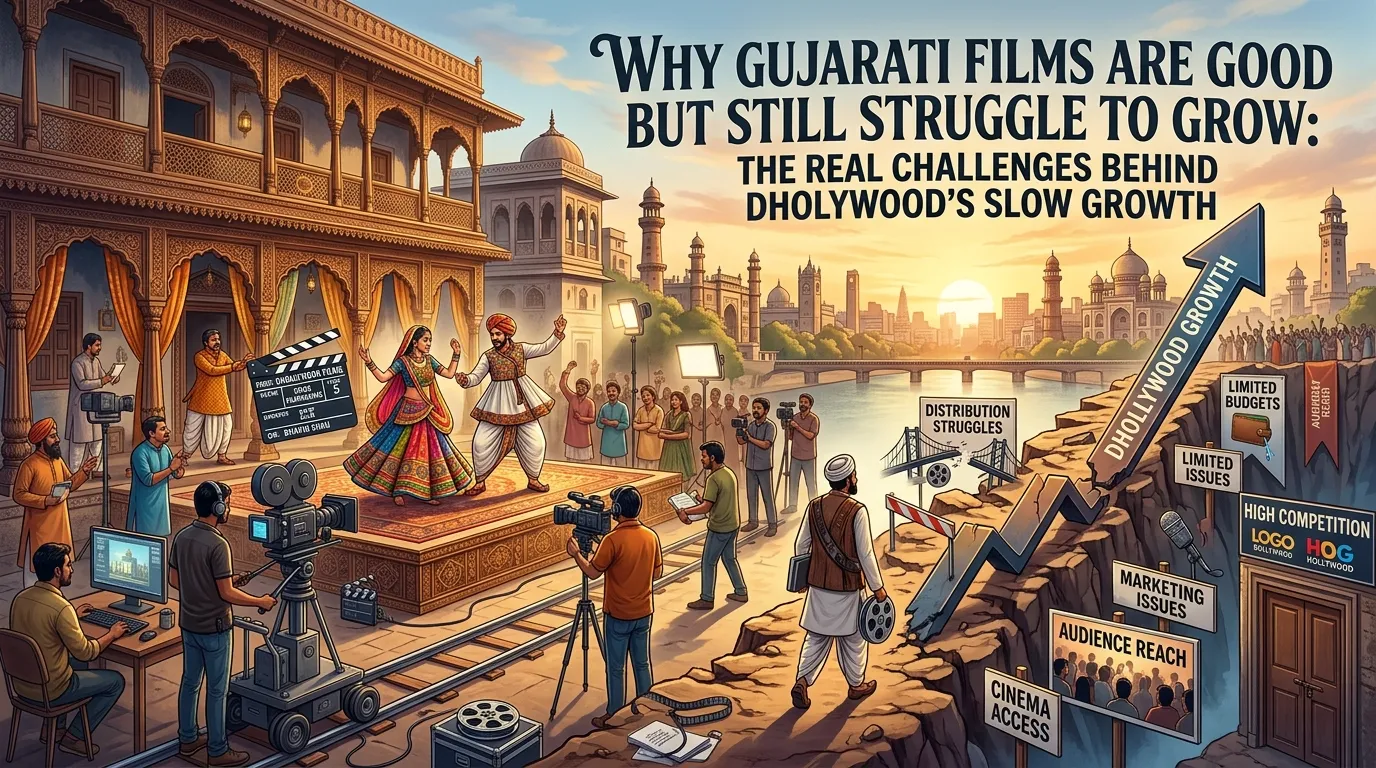
Gujarati cinema has improved massively in the last decade. Films today feature better storytelling, strong acting performances, improved cinematography, fresh genres like thrillers and sci-fi, and multiplex-friendly content. Movies like Chaal Jeevi Laiye, Hellaro, Vash, and Wrong Side Raju proved that Gujarati cinema can create genuinely quality content. Yet the industry still struggles to become a large mainstream market like Telugu, Tamil, or Malayalam cinema. If Gujarati films are good, why do many people still not watch them? The answer lies in a combination of audience mindset, marketing limitations, and industry structure.
The Old Image Problem Still Holds Gujarati Cinema Back
For many years, Gujarati cinema was associated mainly with low-budget comedy, rural stories, repetitive storytelling, and weak technical quality. Even though modern Gujarati films have changed dramatically — now including thrillers, urban dramas, experimental films, and high-quality OTT-ready content — many audiences still carry the old perception. Public perception changes slowly, and this outdated image continues to discourage potential viewers from giving new Gujarati films a fair chance despite the significant improvements the industry has made.
Bollywood Dominates the Attention of Gujarati Audiences
One of the biggest challenges facing Dhollywood is that Gujarati audiences heavily consume Bollywood films, Hindi OTT content, South Indian dubbed films, and Hollywood franchises. Because of this, Gujarati films often struggle to compete for attention. When a big Hindi or South Indian film releases alongside a Gujarati movie, audiences almost always choose the larger spectacle. The sheer scale and marketing power of Bollywood makes it extremely difficult for regional films to hold their ground at the box office.
Limited Marketing and Promotion Keep Good Films Invisible
Many Gujarati films are genuinely good, but people simply do not know they exist. Compared to Bollywood productions, Gujarati films operate with smaller promotional budgets, limited PR campaigns, fewer viral marketing strategies, and weak nationwide promotion. Even excellent Gujarati films sometimes fail commercially because awareness remains low. A great film that nobody knows about cannot find its audience, no matter how strong the content is. Stronger investment in marketing and digital promotion is one of the most critical needs for Dhollywood’s growth.
Limited Theatre Screens Restrict Box Office Growth
Gujarati films consistently receive fewer show timings, shorter theatrical windows, and limited multiplex support. Large Hindi releases dominate theatre screens across Gujarat and Maharashtra, reducing opportunities for Gujarati cinema to build momentum at the box office. This directly affects revenue potential and makes it harder for Gujarati films to justify larger production budgets. Without adequate screen space, even well-made films cannot generate the numbers needed to encourage further investment in the industry.
A Global Diaspora Without Strong International Distribution
Gujarati people are spread across the world — in Mumbai, across Gujarat, and in large communities in the USA, UK, Africa, and Canada. This represents an enormous potential audience for Gujarati cinema. However, the industry still lacks strong international distribution systems comparable to what the Telugu or Tamil film industries have built. The Gujarati diaspora represents significant untapped overseas revenue potential that better distribution infrastructure could unlock in the coming years.
OTT Growth Started Late but Is Now Gaining Momentum
Regional industries like Malayalam and Tamil cinema entered the OTT space aggressively at an earlier stage, giving them a head start in digital audiences. Gujarati cinema entered the OTT race later, though platforms like ShemarooMe, Sony LIV, and Amazon Prime Video are now helping Gujarati films reach wider audiences than theatrical releases alone could achieve. OTT could become the single biggest growth engine for Dhollywood in the coming years, giving quality Gujarati content the visibility it deserves beyond traditional cinema halls.
The Absence of Pan-India Star Power Limits Theatrical Pull
Industries like Telugu and Tamil cinema have built massive superstar systems where a single actor’s name is enough to fill theatres on opening weekend. Gujarati cinema has talented actors like Malhar Thakar, Yash Soni, Mitra Gadhvi, and Siddharth Randeria, but the industry still lacks pan-India celebrity-level star power. Star culture plays a significant role in driving audiences to theatres instantly, and building that kind of recognisable stardom is something Dhollywood will need to develop intentionally over the next generation of filmmakers and performers.
The Industry Is in a Genuine Transition Phase
Gujarati cinema is currently shifting from traditional theatre-style cinema to modern cinematic storytelling, and this transition naturally takes time. The positive signs are already visible — filmmakers are experimenting with new genres, young audiences are supporting quality content, and fresh storytelling approaches are emerging regularly. The industry is not standing still. It is evolving, and the pace of that evolution is accelerating as more talented young creators choose Gujarati cinema as their platform of expression.
Content Is Improving Faster Than Audience Habits Are Changing
Ironically, Gujarati films are improving faster than audience habits are shifting. Movies like Vash, Hellaro, and Short Circuit demonstrate that Gujarati cinema can deliver strong storytelling, technical quality, and unique concepts. Yet many viewers still assume Gujarati films are not cinematic enough — without even watching them. This perception gap is one of the most frustrating challenges for filmmakers who are genuinely pushing the boundaries of what Gujarati cinema can achieve.
Why Gujarati Cinema Still Has Enormous Potential
Despite all these challenges, the future of Gujarati cinema is genuinely promising. Young filmmakers are bold and ambitious, OTT platforms are expanding, multiplex audiences are growing, and international recognition is increasing. The Gujarati diaspora market remains largely untapped and represents a substantial opportunity for the right films with the right distribution strategy. Recent visibility at prestigious platforms like the Cannes Film Festival also demonstrates growing global respect for Gujarati storytelling and its unique cultural voice.
The Biggest Truth About Why Gujarati Cinema Struggles
The biggest issue is not film quality — it never really was. The real challenge is a combination of audience trust, marketing reach, and industry scale. Once Gujarati audiences consistently support good cinema in theatres and on OTT platforms, the industry can grow rapidly. The content is already there. What Dhollywood needs now is bigger audience support, better promotion, stronger distribution, and genuine confidence from Gujarati viewers themselves. Because when audiences start fully believing in Gujarati cinema, Dhollywood has every ingredient it needs to become one of India’s strongest regional film industries.
Stay updated with the latest news and articles. Subscribe Now for more articles.
