
Starting a business requires capital — but one of the biggest decisions entrepreneurs face is how to fund their venture. Should you use your own money (bootstrapping), or raise funds from investors?
In 2026, both options come with unique advantages and risks. The right choice depends on your business model, growth goals, and risk tolerance. This guide compares bootstrapping and funding to help you make the best decision for your business.
What Is Bootstrapping?
Bootstrapping means starting and growing your business using your own resources without external funding. Sources include:
- Personal savings
- Revenue generated from the business
- Support from family or friends
Bootstrapped businesses grow slowly but maintain full control.
What Is External Funding?
Funding means raising money from external sources to grow your business faster. Common funding options include:
- Angel investors
- Venture capital
- Bank loans
- Government schemes
Funding helps businesses scale quickly but comes with responsibilities.
Bootstrapping vs Funding: Key Differences
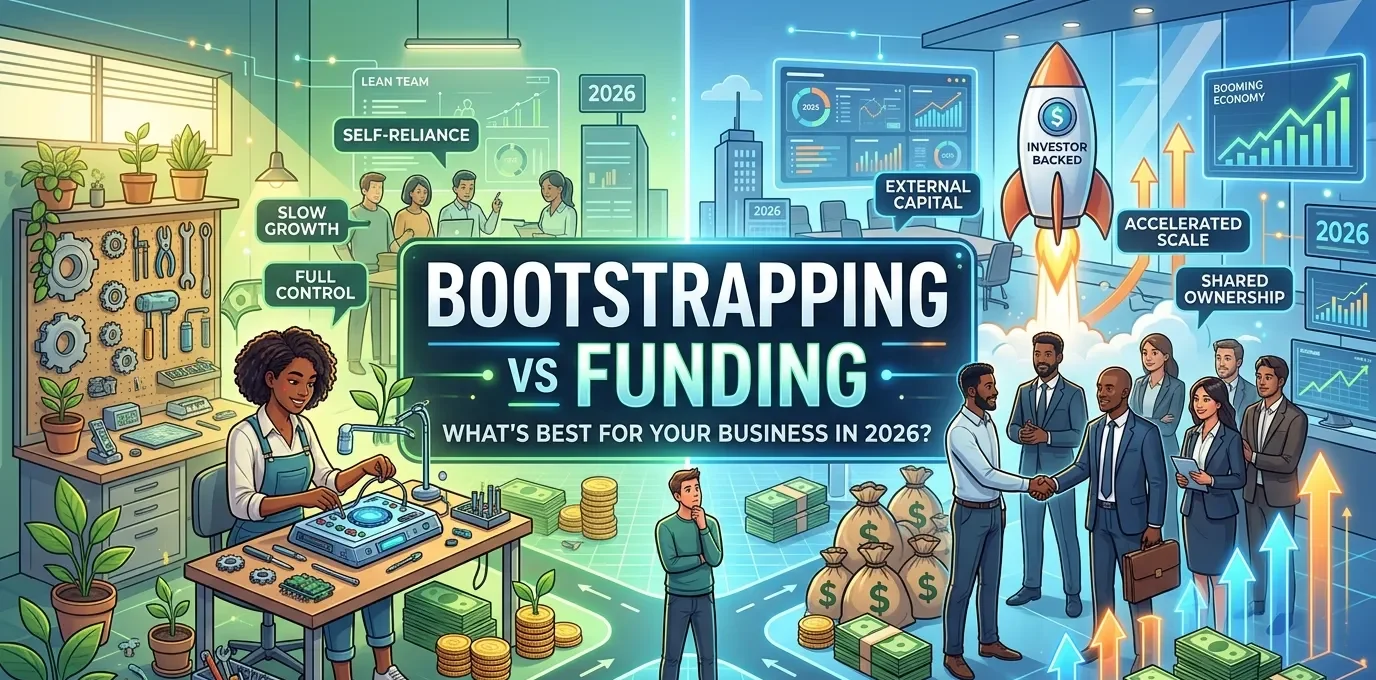
In terms of ownership, bootstrapping gives you full control while funding means shared ownership. Growth speed is slow and steady with bootstrapping but enables fast scaling with funding. Risk is personal financial risk with bootstrapping versus shared financial risk with funding. Decision making remains fully independent when bootstrapping but can be influenced by investors when funded. Finally, pressure is low with bootstrapping while funding comes with high investor expectations.
Choosing between them depends on your priorities.
Advantages of Bootstrapping
Full Control
You make all decisions without external interference.
No Debt or Equity Loss
You don’t owe money or shares to investors.
Financial Discipline
Limited resources force smarter spending.
Long-Term Independence
You build a business on your own terms.
Disadvantages of Bootstrapping
However, bootstrapping also has limitations:
- Slow growth
- Limited resources
- Higher personal financial risk
- Restricted scalability
Bootstrapping requires patience and careful planning.
Advantages of External Funding
Faster Expansion
You can scale operations quickly.
Access to Expertise
Investors often provide guidance and networks.
Better Resources
Funding allows investment in technology, marketing, and hiring.
Competitive Advantage
You can enter markets faster than competitors.
Disadvantages of External Funding
Funding also has challenges:
- Loss of ownership
- Pressure to deliver fast results
- Investor expectations
- Possible conflicts in decision-making
Not all funding leads to success.
When Should You Choose Bootstrapping?
Bootstrapping is ideal when:
- Your business requires low initial investment
- You want full control
- You prefer slow and stable growth
- You have strong financial discipline
Best suited for freelancing, service-based businesses, and small startups.
When Should You Choose Funding?
Funding is suitable when:
- Your business needs high capital
- You want rapid growth
- You operate in a competitive market
- You are building a scalable startup
Best suited for tech startups, e-commerce platforms, and innovation-driven businesses.
Hybrid Approach: The Smart Strategy
Many entrepreneurs combine both methods — start with bootstrapping to validate your idea, then raise funds to scale. This approach reduces risk, improves valuation, and builds investor confidence. Hybrid models are becoming increasingly popular in 2026.
Key Factors to Consider Before Choosing
Ask yourself these questions before deciding:
- How much capital do I need?
- What is my growth goal?
- Am I ready to share ownership?
- Can I manage financial risk?
Your answers will guide your decision.
The Future of Startup Funding
In 2026 and beyond, funding trends include:
- Rise of angel investors
- Crowdfunding platforms
- Startup incubators
- Government support programs
- Digital fundraising platforms
Entrepreneurs have more options than ever before.
Conclusion
There is no one-size-fits-all answer to bootstrapping vs funding. Both paths can lead to success if used correctly. Bootstrapping offers control and independence, while funding provides speed and scalability. In 2026, smart entrepreneurs choose the strategy that aligns with their vision, resources, and long-term goals.
It’s not about how you start — it’s about how you grow.
Subscribe Now For More articles.
