
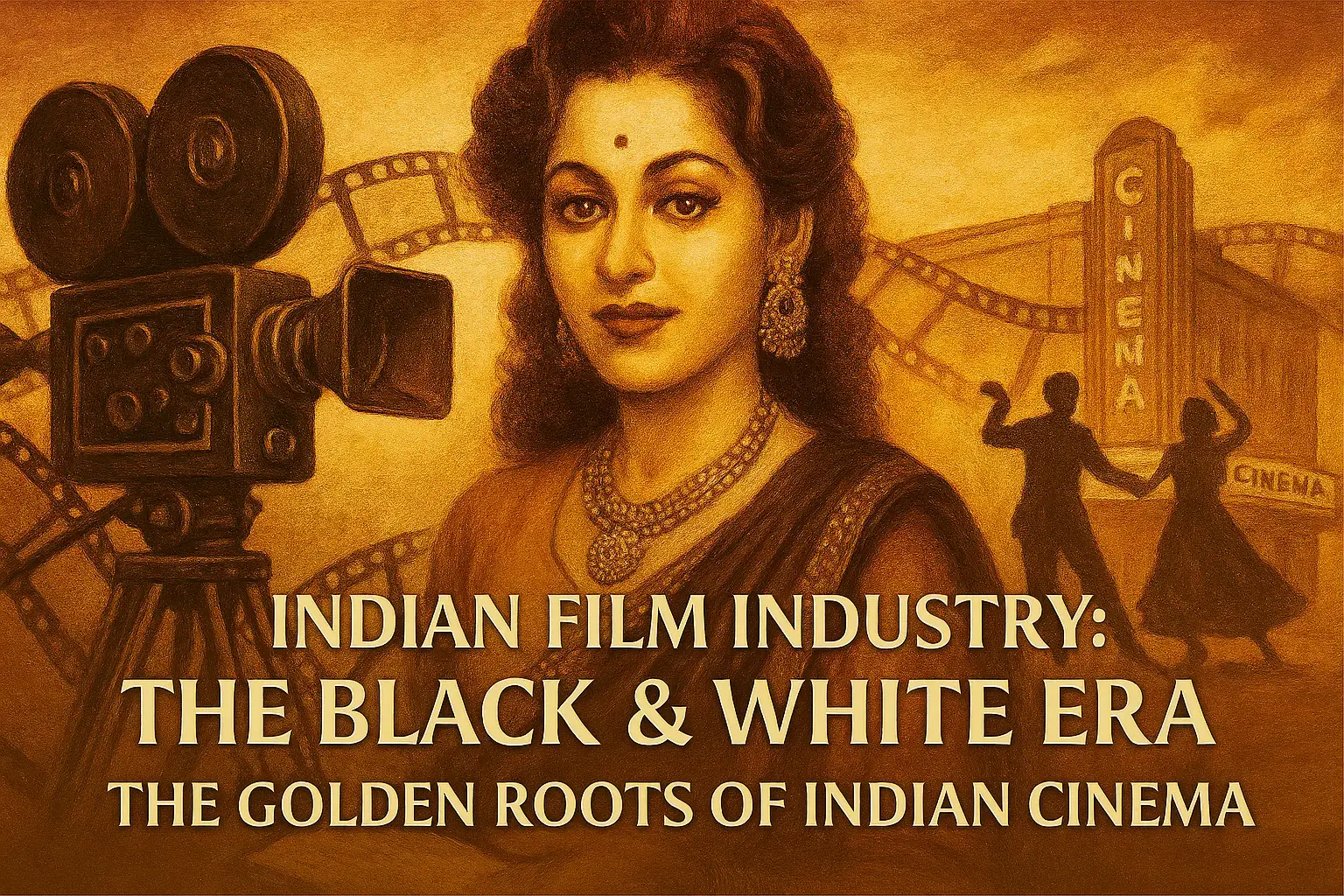
The Indian film industry’s black-and-white era is more than just a nostalgic memory — it is the foundation on which the world’s largest film making ecosystem stands today. Long before the arrival of color, digital cameras, and mega-budget blockbusters, filmmakers in India created timeless classics using limited technology but unlimited passion. This era, spanning from the 1910s to the early 1960s, is often called the Golden Age of Indian Cinema, and for good reason.
The Beginning: Silent Films and Pure Visual Storytelling (1913–1930)
The black-and-white era began with Dadasaheb Phalke’s landmark film Raja Harishchandra in 1913 — India’s first full-length feature film.
With no sound, filmmakers relied entirely on expressions, visuals, and strong dramatic storytelling.
Untold facts from this era:
Women didn’t act in films initially. Male actors played female roles until Durgabai Kamat broke the barrier in 1917.
The sets, costumes, and props were handmade because no film production industry existed yet.
Most films were inspired by mythology, epics, and folk tales, making cinema accessible to all.
Directors like Hiralal Sen, J.F. Madan, and Dadasaheb Torne built the pillars of Indian filmmaking during this period.
The Arrival of Sound: Alam Ara and a New Era (1931)
1931 changed everything.
India’s first talkie, Alam Ara, directed by Ardeshir Irani, introduced songs and dialogue to cinema.
This single film defined a new identity for Indian cinema:
Songs became the heartbeat of movies.
Actors with strong voices became stars.
Mythological stories expanded to romance, drama, and social films.
Sadly, Alam Ara is now lost, but its influence remains unmatched.
The Rise of Studios and Stars (1930s–1940s)
As cinema grew, big studios emerged across India:
Bombay Talkies
Prabhat Studios
New Theatres, Calcutta
Gemini Studios, Madras
These studios introduced professionalism, trained actors, and began shaping the Indian star system.
Iconic faces of early black-and-white films:
Devika Rani – the first lady of Indian cinema
Ashok Kumar – one of Bollywood’s earliest natural actors
K.L. Saigal – the first superstar singer-actor
New Theatres in Kolkata also gifted India its first waves of soulful music through Pankaj Mullick and R.C. Boral.
The Golden Age of Black-and-White Cinema (1940s–1960s)
The period after India’s independence is widely considered the greatest era in Indian cinema.
This era produced masterpieces that continue to inspire modern filmmakers.
Legendary Filmmakers:
Satyajit Ray – Brought global recognition with Pather Panchali.
Bimal Roy – Specialist in realism with films like Do Bigha Zamin.
Guru Dutt – Poet of cinema with classics like Pyaasa and Kaagaz Ke Phool.
Raj Kapoor – Showman who blended entertainment with social commentary.
The Iconic Black-and-White Stars:
Dilip Kumar – The tragedy king
Raj Kapoor – The lovable showman
Dev Anand – The evergreen romantic hero
Madhubala – The beauty of Indian cinema
Nargis – One of Bollywood’s finest dramatic actresses
Meena Kumari – The queen of emotions
These actors created timeless characters that still resonate today.
The Magical Music Era
Some of the most memorable melodies in Indian history were born during the black-and-white period.
Even with limited technology, composers created soulful tunes that still feel fresh.
Legendary music contributors:
Lata Mangeshkar and Asha Bhosle rose to fame
Kishore Kumar, Mukesh, and Mohammed Rafi set the benchmark for male playback singing
Composers like S.D. Burman, Naushad, Shankar–Jaikishan, and Madan Mohan redefined film music
Songs were recorded in one take—no retakes, no digital mixing. Yet they remain unmatched in purity.
Themes and Storytelling in the Black-and-White Era
This era gave Indian cinema its identity by exploring themes that reflected society:
Popular Themes:
Social inequality – Do Bigha Zamin
Romantic tragedies – Mughal-e-Azam, Barsaat
Patriotism – Shaheed, Mother India
Comedy and innocence – Chalti Ka Naam Gaadi
Human emotions and realism – Pather Panchali
Films weren’t just entertainment; they were mirrors of society.
Technical Beauty of Black-and-White Cinema
Even without color, filmmakers created cinematic magic through:
Dramatic lighting
Sharp contrasts
Close-up shots that highlighted emotions
Creative shadows
Symbolic imagery
Cinematographers like V.K. Murthy (Guru Dutt’s cameraman) transformed black-and-white into visual poetry.
His iconic beam-of-light shot in Kaagaz Ke Phool is still studied in film schools worldwide.
Global Recognition Begins
The black-and-white era put Indian cinema on the world map.
In 1956, Pather Panchali won major international awards, including Cannes and Venice.
Indian films began screening globally.
Critics worldwide praised Indian storytelling and realism.
This global respect was built long before Bollywood became a brand.
Transition to Color – The End of an Era
By the early 1960s, color films like Mughal-e-Azam, Junglee, and Sangam started dominating.
While black-and-white movies continued into the early ’70s, the golden age slowly faded.
Yet, the influence of the black-and-white era remains:
Modern filmmakers still reference its style.
Many remakes originate from this era’s stories.
Cinematic techniques developed then remain relevant today.
The era may have ended, but its legacy never will.Conclusion: The Eternal Charm of Black-and-White Indian Cinema
The black-and-white era of Indian cinema is not just history — it’s a heritage.
It is the era that taught India how to dream, how to tell stories, and how to portray human emotions with honesty and depth.
Without this era, Indian cinema would not be the giant it is today.
