
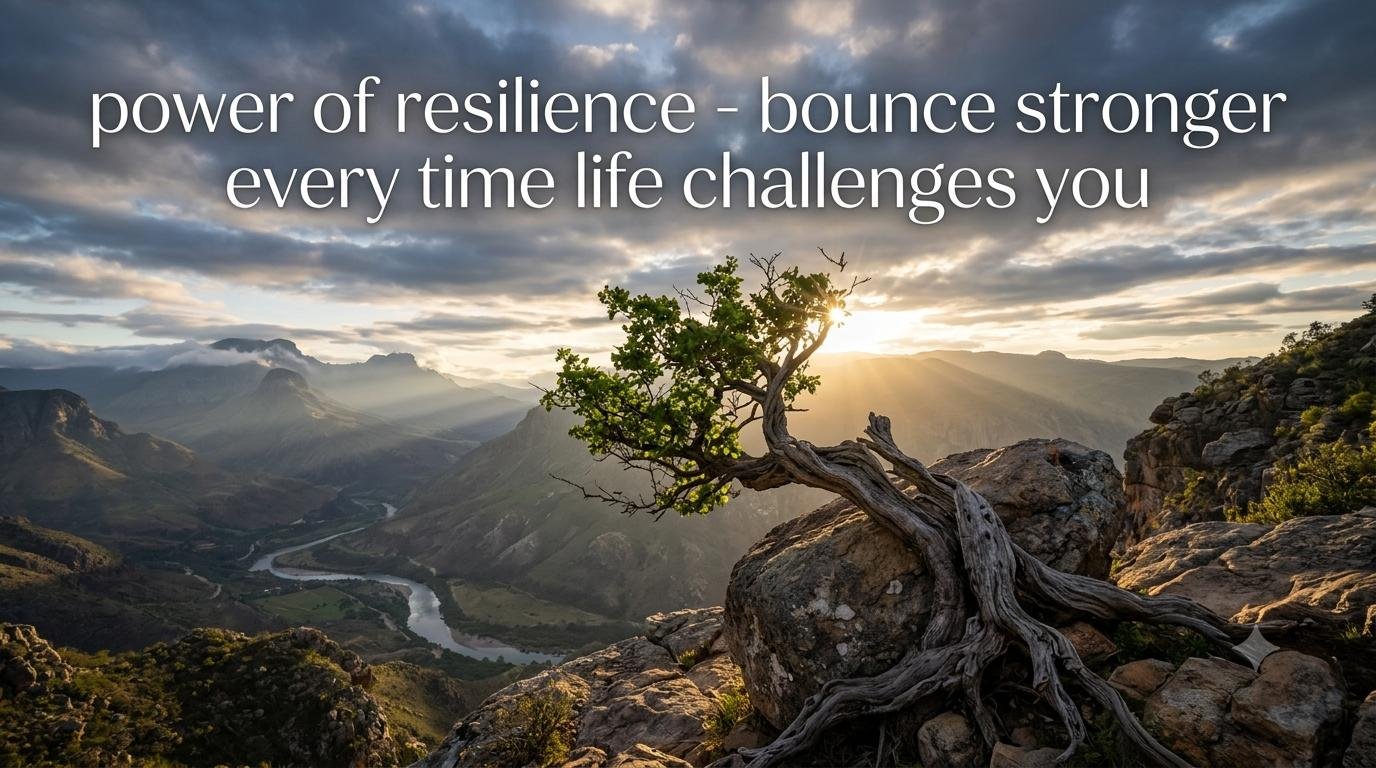
Falling Is Not the End of Your Journey
Life does not always follow the plan we create.
Sometimes a business fails despite months of work.
Sometimes a career opportunity disappears unexpectedly.
Sometimes personal challenges affect our confidence, relationships and peace of mind.
During these moments one question becomes important: Will you allow the setback to stop you? Will you find the strength to move forward?
This is where Power of Resilience matters.
Power of Resilience is the ability to face difficulties adapt to change recover from setbacks and continue moving towards goals.
Power of Resilience does not mean that you never feel sad, disappointed or afraid. Power of Resilience means that difficult experiences do not have to define your future.
A setback may change your journey. Power of Resilience does not have to decide your destination.
🌱 A Story About a Person Who Refused to Give Up
Imagine an entrepreneur who starts a business with great enthusiasm.
The initial response is encouraging. After a months customer numbers begin to decline. Expenses increase marketing efforts do not produce the expected results and the entrepreneur starts questioning the decision.
There are two responses.
The first response is to consider the experience as proof that the business idea was never good enough.
The second response is to understand what went wrong speak with customers review expenses improve the product and explore a business strategy.
The entrepreneur chooses the approach.
Progress is still slow. Success does not arrive overnight. Every challenge provides an opportunity to learn something
The entrepreneur gradually develops decision‑making skills and a clearer understanding of the market.
The important lesson is not that every business will eventually succeed. Power of Resilience helps people respond constructively learn from experience and make decisions about what comes
What Does Resilience Really Mean?
Power of Resilience is more than tolerating situations.
It involves qualities:
- Acceptance: Recognising the reality of a situation.
- Adaptability: Changing your approach when circumstances change.
- Emotional strength: Managing emotions without allowing them to control every decision.
- Problem‑solving: Looking for solutions of remaining stuck.
- Hope: Believing that improvement is possible even when progress is slow.
Power of Resilience does not require you to handle everything. Asking for support taking a break and seeking guidance when needed can also be signs of strength.
Five Reasons Resilience Is Important in Life
1. It Helps You Handle Failure
Failure can affect confidence. It can also reveal mistakes and areas that need improvement.
Of treating one attempt as the end examine what happened and identify what you can learn.
2. It Builds Confidence
When you successfully navigate situations you gain confidence in your ability to handle challenges.
You begin to understand that uncomfortable experiences can be managed one step at a time.
3. It Improves Decision‑Making
Stress can make people react impulsively.
Power of Resilience encourages you to pause understand the situation evaluate your choices and take action.
4. It Encourages Personal Growth
Challenges can reveal strengths, weaknesses and habits that you may not have noticed before.
They can encourage you to develop patience, communication, adaptability and practical skills.
5. It Helps You Stay Committed
Long‑term goals often involve delays.
Power of Resilience helps you review your strategy adjust your expectations and continue working when the original plan needs to change.
The Power of Resilience, in Your Career
Every professional experiences challenges.
A project may fail a promotion may be delayed a new technology may feel difficult to learn. Workplace expectations may change.
Resilient professionals do not think that one hard experience defines their worth.
They concentrate on getting better.
Develop these career habits:
- Treat feedback as a chance to learn.
- Improve your communication skills.
- Take responsibility for mistakes. Fix them.
- Adjust to changing workplace needs.
- Ask seasoned colleagues for help.
- Keep a balance between work and personal life.
For example when a software developer faces a production issue resilience means staying systematic looking into the problem working with the team and learning from the incident of feeling discouraged.
Professional growth is not about avoiding every problem. It is about becoming better equipped to deal with them.
The Power of Resilience in Business
Entrepreneurship involves uncertainty.
Customer preferences change competitors introduce products marketing plans sometimes fail and money pressure can lead to hard decisions.
A resilient entrepreneur knows that business success needs evaluation.
Useful practices include:
- Review business performance
- Listen to customer feedback.
- Keep financial plans.
- Try new strategies.
- Build reliable professional relationships.
- Learn from campaigns that do not succeed.
- Know when to change direction.
Resilience does not mean keeping the plan forever. Sometimes the best decision is to adjust, pause or move toward an opportunity.
The Power of Resilience in Social Media and Personal Branding
Content creators often see results.
One reel may get thousands of views while another gets attention. A new account may take months to grow an audience.
If creators judge their skill by each posts performance they may lose confidence fast.
Build resilience by:
- Create content with a purpose.
- Learn from audience feedback.
- Improve storytelling and presentation.
- Avoid comparisons.
- Keep a publishing schedule.
- Know that online popularity is not a measure of worth.
A strong personal brand grows through credibility, consistency and real value—not moments.
The Power of Resilience in Personal Relationships
Relationships can have misunderstandings, disagreements, disappointments and uncertain times.
Resilience helps people face these situations with patience and maturity.
It encourages people to communicate with respect, boundaries accept differences and learn from hard experiences.
However resilience does not mean accepting disrespect, manipulation or harmful behavior.
Sometimes moving forward means setting boundaries or leaving a situation.
True strength means knowing what deserves your effort and what you need to let go.
Seven Ways to Develop Resilience
1. Accept what you cannot control: Focus your energy on decisions and actions you can influence.
2. Change your perspective: Ask what a hard experience can teach you of just asking why it happened.
3. Break problems into steps: A small action can make a big problem feel easier.
4. Build relationships: Spend time with people who support growth and honest talk.
5. Take care of your health: Sleep well exercise eat right. Relax to handle stress.
6. Practice self-compassion: Do not judge yourself over one mistake or hard time.
7. Keep learning: Build skills that help you respond confidently to change.
The 7-Day Resilience Challenge
- Day 1: Identify one challenge you are facing now.
- Day 2: Separate the parts you can control from the parts you cannot.
- Day 3: Write down one lesson from a setback.
- Day 4: Take one action toward solving your challenge.
- Day 5: Speak with someone you trust and ask for a perspective.
- Day 6: Practice an activity that helps you manage stress.
- Day 7: Review your progress. Decide your practical step.
The purpose is not to eliminate every difficulty in one week. It is to build a response, to challenges.
Final Thought: Your Strength Is Revealed by How You Move
We cannot always choose what happens in life. I believe we can slowly build the skills and support systems that help us respond.
One failure should not erase years of effort. I feel that temporary disappointment must not convince us that the future has no possibilities.
Rest when needed. Learn when things go wrong. I think asking for help when needed is wise. Change strategy when circumstances demand it.
When ready take the step.
Remember: Resilience is not about never falling. It is, about finding a way to rise, learn and move forward with wisdom.
Your strongest chapter may begin after an experience.
Stay updated with the latest news and articles. Subscribe Now
