
What takes place when life does not proceed as planned?
Ever have the situation where you’ve put in a good deal of effort for something and then end up seeing it come to nothing?
It’s possible that you had prepared for a significant opportunity but weren’t chosen, or that your business idea failed, the relationship came to an end, or that your personal goal still remained unachieved even though you had made the necessary efforts.
At such times it is natural to feel disappointed, confused or even to doubt your own abilities.
But one hard time does not have to shape your whole story.
It isn’t all about avoiding difficulties; at times it is about learning to face them, to recover and then keep moving forward.
That capacity is known as resilience.
It doesn’t mean pretending all is well; rather, it means having the ability to recognize pain, adjust to difficulties, draw lessons from experience and then slowly restore your strength.
It is impossible for you to control every situation that comes your way.
If you have enough time and receive support along with some careful action, you may well be able to affect the way you respond.
Your setback might be included in your story, but it needn’t be the conclusion of your story.
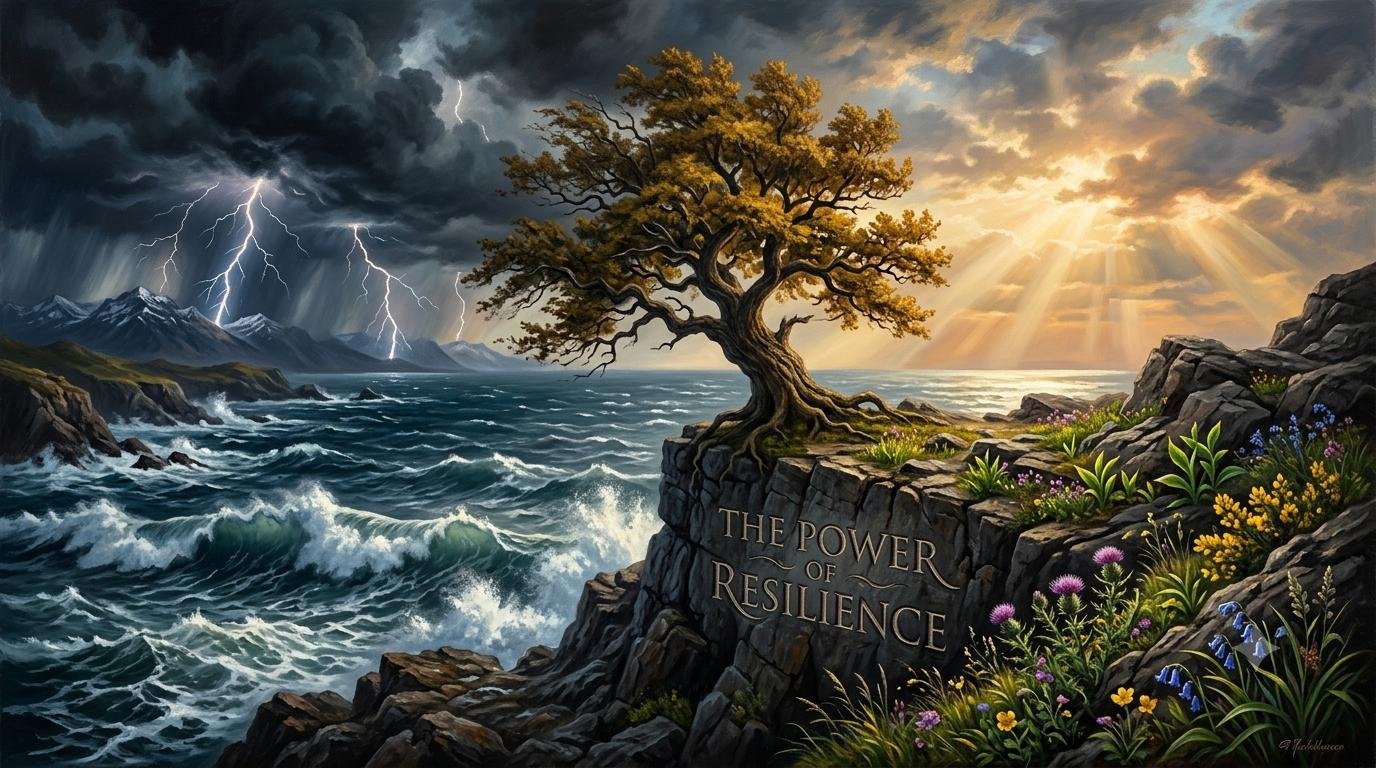
The Story of the Tree That Survived the Storm
Picture a tree standing in an open field.
For many years it has grown in warm sunlight and with light rainfall; its branches reach towards the sky and its roots spread slowly through the soil.
One evening a strong storm comes.
The wind grows stronger and starts to pour rain; some of the branches break and the tree bends from the pressure.
By the time morning comes, the field has a different appearance.
Certain plants have been uprooted and there are broken branches scattered over the ground.
The tree is hurt too.
Yet it remains standing.
During the next few weeks the weather gets better and new leaves start to show themselves; the branches that had been damaged are slowly replaced by new growth.
The tree does not end up in precisely the same state as the one it was in before the storm.
It keeps on growing from the point at which it currently is.
This story offers a simple lesson:
It has nothing to do with staying unaffected by the storms of life, rather it is about managing to grow even after having gone through them.
People too have to deal with storms—such as setbacks in their careers, financial difficulties, personal disappointments, and sudden changes.
We might need some time to get over it. We might have to ask for assistance from other people. We might have to alter our plans.
That does not mean that our future is over just because we have had a difficult experience.
What Resilience Really Means
Resilience is often mistaken for meaning that one should always be strong.
That isn’t realistic.
A person who is resilient may feel sad, frustrated, uncertain or afraid. They have the courage to take a break, to ask for help and to admit that they have been hurt.
Resilience does not mean the lack of emotion.
The capacity to react to tough experiences in a manner that promotes recovery and future advancement.
It may involve:
- Admitting that a setback has taken place.
Giving yourself some time to work through feeling disappointed.
- You can learn from your mistakes without damaging your self-worth.
Make the necessary adjustments to your plans if the circumstances change.
- Go for advice or assistance when you need it.
Take small steps to rebuild your life.
Resilience can at times consist in moving forward.
In other cases, it involves resting, reviewing the situation and deciding to go a different way.
Each of them may indicate strength.
Why Failure Doesn’t Have to Define You
Failure is often linked to personal worth by many people.
They think:
Since I failed the exam, it follows that I am not intelligent.
Since my business failed, I am not capable.
Since I missed this opportunity, I shall never be successful.
These conclusions go beyond what can be learned from one experience.
Failure gives you information about a specific attempt, decision, or situation. It does not measure your worth as a person.
A business might have difficulty due to market conditions, a lack of proper planning, financial strain or a combination of these factors.
A job application can fail due to the level of competition, the timing of the application, or because there is a mismatch between the position and the applicant’s experience.
An exam result could show that a different study strategy is necessary.
Instead of turning one outcome into a permanent identity, ask:
What does this experience have to teach me regarding my next move?
The question provides an opportunity for learning.
The Resilience Mindset: Change the Questions You Ask
The way you talk to yourself can affect the way you deal with challenges.
If you encounter a problem, then substitute negative questions with positive ones.
| Instead of asking… | Try asking… |
|—|—|
| Why does this always occur to me? | What is taking place and what should I do afterwards? |
Are you right to say that I am a complete failure?
Which part of this effort has not succeeded?
What if I fail once more?
How can I change my preparations?
| Why am I lagging behind all the others? | What sort of progress can I expect from myself at this time? |
| Has everything been ruined? | What alternatives do I still have? |
It by no means involves ignoring real problems or forcing yourself to think in a positive way.
What it involves is viewing the situation clearly without letting disappointment determine all of your decisions.
Resilience in Career and Business
The course of a professional career is seldom something that can be predicted with perfect clarity.
You could encounter rejection, changes in technology, difficult projects, unforeseen expenses or business decisions which fail to achieve the results you had hoped for.
Resilience enables you to respond in a thoughtful manner.
If you face career rejection
Check your resume, your preparation for the interview and the gaps in your skills. Ask for feedback when it’s appropriate and keep looking at other suitable opportunities.
If your business struggles
Carefully examine your financial situation, what your customers need, your pricing and your operations. Think about whether you should improve the present approach, get some advice, or alter your course.
If a project fails
Work out what caused the problem, record the lessons learned and put them into future work.
What is important is not to mindlessly repeat the same method.
Resilience involves both persistence and the willingness to adapt.
The correct action at times is to carry on.
The correct action at times is to alter the strategy.
At times the best thing to do is to give up on a method which is any longer fulfilling the role it was meant to.
Resilience in Personal Life
Personal difficulties can be particularly hard since they have an impact on the people and the relationships we care about.
We might feel uncertain about the future following a disagreement, a separation, a feeling of disappointment or a major change in our lives.
Resilience in personal life can begin with small, compassionate steps:
- Allow yourself to feel whatever you feel.
Instead, go and speak to someone you can trust rather than bearing all the troubles by yourself.
- Stick to your normal routines such as sleeping, eating and carrying out your daily duties.
- Establish boundaries in cases where a situation is repeatedly harmful.
- Do not make any important decisions based simply on a surge of emotion.
- If distress proves to be difficult to manage, then it is advisable to seek professional help.
Healing doesn’t have to be fast or foreseeable.
There is no need to compare your recovery to that of some other person’s.
You deserve patience and care for your experience.
Seven Powerful Lessons About Resilience
1. A setback is an event and not a part of who you are
An error occurred. That is not the same as saying that you are a failure.
Distinction should be made between the events and the person you are.
2. It is possible to start over without having to begin from scratch
You might have gained from your earlier attempts some knowledge, experience, connections, or a better understanding of the things that fail.
You can apply those lessons to the next stage of your life.
3. Asking for Help Is a Strength
Many people think that asking for help means they are weak or not good enough. In reality, reaching out for support shows courage and self-awareness. Everyone faces challenges at some point. Getting help can give you new ideas and solutions that you might not see on your own. It also helps you build stronger relationships with others. Remember, it is okay to ask for help when you need it.
It is not necessary for you to deal with every problem by yourself.
Help coming from reliable individuals, such as mentors or qualified professionals, may enable you to notice alternatives that you might have overlooked.
4. Adaptability Matters
Although a good plan may be useful, changes in the circumstances are possible.
Keep open to modifying your methods yet remain committed to the values and goals that are important to you.
5. The Value of Small Steps
If a challenge seems overwhelming then concentrate on one action that is manageable.
You do not need to figure out your whole future today.
6. Rest is part of the recovery process
Trying to constantly push yourself can cause an already difficult time to become even more difficult.
You can regain a sense of perspective by taking rest, reflecting and following healthy routines.
7. The things from your past do not include all the answers regarding your future
Although past experiences are important, they do not show us every opportunity or possibility that lies ahead.
Provide room for new information, different decisions, and unexpected changes.
How to Build Resilience in Everyday Life
Resilience can be built up by developing practical habits.
Step 1: Identify the challenge. Explain exactly what took place, without exaggerating or placing the blame entirely on yourself.
Step 2: Distinguish between facts and fears. Make a list of what you know, what you are assuming and what is still uncertain.
Step 3: Work out what you can control. Although you can’t influence another person’s decision or an unforeseen event, you can control your own preparation, response or the next action you take.
Step 4: Select a small step. This could involve making a phone call, altering a plan, finishing one task, asking for advice or allowing yourself some time to recover.
Step 5: Review and adjust. Observe what works, what doesn’t and what you could instead try.
Step 6: Acknowledge the progress you’ve made. Since recovery may be slow, you should praise yourself for taking constructive actions even if the main problem has not yet been solved.
A Message for Anyone Going Through a Difficult Time
If you are finding life difficult at the moment, it’s worth remembering that you don’t have to know all the answers right away.
There is no need to feign that you are not affected.
There is no need to demonstrate your strength through suffering in silence.
Take as long as you need. Get in touch with those who care about you. Concentrate on what you can deal with today.
Even though a difficult period may alter your plans it won’t wipe out all that you have learned or all the possibilities that still remain.
If the first thing you do to move forward fails, then you should reassess and attempt a different approach.
You can rebuild your life in a step at a time.
Final Thought: Rise Again, in Your Own Way
It won’t always go along the lines that you envisaged.
There could be surprising developments, difficult conclusions, and instances when your confidence seems to be smaller than it previously was.
This is what resilience teaches us: that it is possible to recover and grow, even if the journey ends up different from what we had expected.
It is not necessary for you to grow stronger in one day.
It is not necessary to turn each unpleasant experience into a success story.
You need only allow yourself the chance to respond, to gain knowledge, to ask for support and then to take the next important step.
The storm could have altered the tree.
The tale of the tree might have been followed by the storm.
Remember: You cannot always choose the challenges that enter
Keep in mind that while you can’t always select the challenges that come into your life, you can aim at choosing a response which will help you make progress.
Stay updated with the latest news and articles. Subscribe Now for more articles.
