
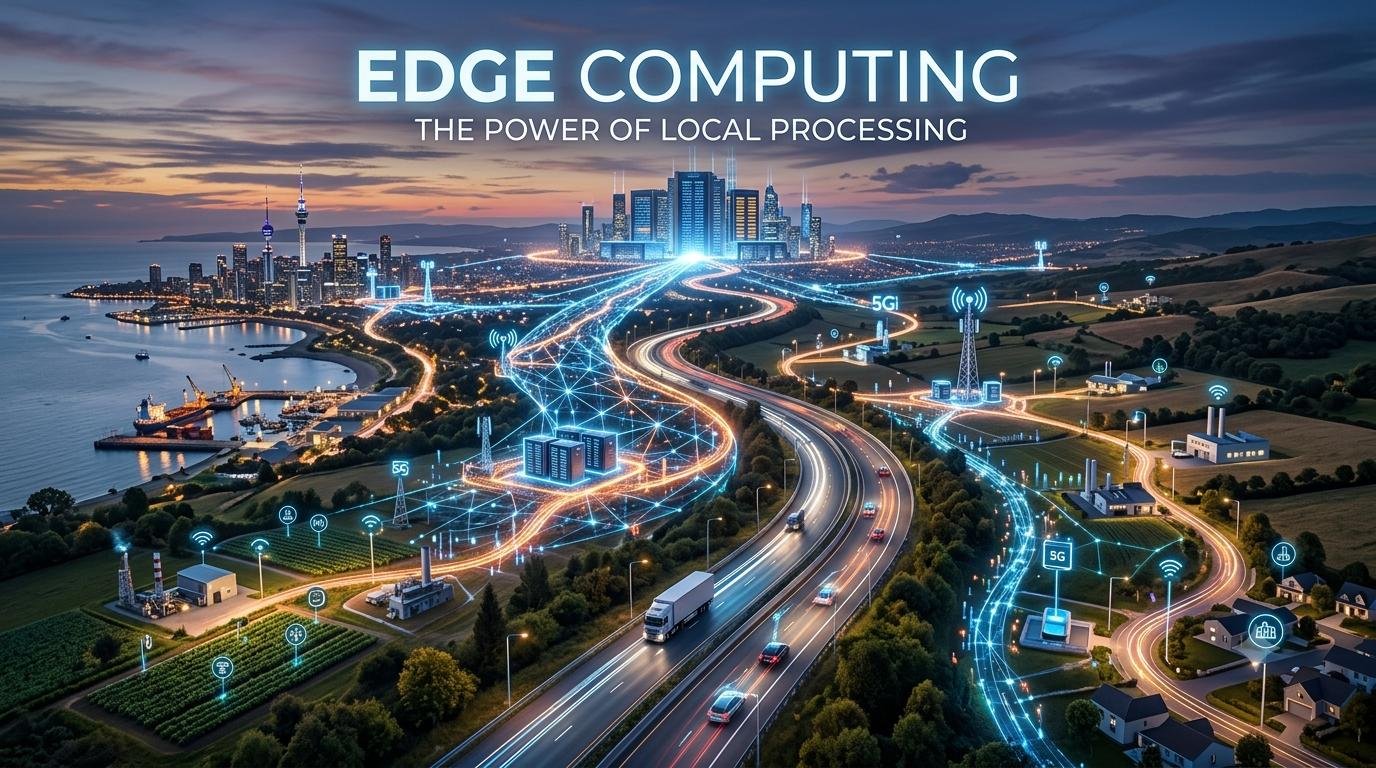
The rapid growth of connected devices, Artificial Intelligence, and the Internet of Things has created an enormous and growing demand for faster and more efficient data processing. Traditional cloud computing has transformed digital services across the world, but the increasing need for real-time responses has driven the rise of a complementary and increasingly essential technology: Edge Computing. Rather than sending all data to a distant cloud server for processing, edge computing analyses information closer to the source where it is generated — reducing delays, improving performance, strengthening security, and enabling the kinds of applications that require instant, local decision-making. From smart cities and autonomous vehicles to healthcare and industrial automation, edge computing is becoming one of the most important technologies shaping the digital future.
What Is Edge Computing?
Edge Computing is a computing model that processes and analyses data near the device or location where it is created, rather than relying entirely on centralised cloud data centres located far from the point of data generation. A practical example illustrates the difference clearly: instead of a smart security camera sending every video frame across the internet to a remote server for analysis, it can process important information locally and transmit only the most relevant results to the cloud. This approach saves significant network bandwidth, dramatically reduces response time, and improves the overall efficiency of the system — making it particularly well-suited to applications where even small delays in processing would compromise the quality or safety of the outcome.
How Edge Computing Works
Edge Computing combines local processing capability with cloud services in a way that optimises for both speed and scale. Smart devices equipped with sensors collect data continuously from their environment. Nearby edge devices or gateways then process that information locally, making real-time decisions without waiting for a round-trip to a distant server. Only the most important or aggregated data is then transmitted to cloud systems for long-term storage, deeper analysis, and coordination across larger networks. This architectural balance provides the speed of local processing where immediacy matters most, while retaining the scalability and analytical power of cloud infrastructure for tasks where latency is less critical.
Edge Computing in Autonomous Vehicles
Self-driving and connected vehicles generate truly enormous volumes of data every second from cameras, radar, lidar, and dozens of other sensors simultaneously. Applications that depend on this data — collision avoidance systems, real-time navigation, vehicle-to-vehicle communication, traffic monitoring, and driver assistance technologies — simply cannot afford the latency introduced by sending data to a remote cloud server and waiting for a response. Edge Computing enables vehicles to make the split-second decisions that safety demands without any dependency on cloud response times, making it a foundational technology for the safe deployment of autonomous transportation at scale.
Edge Computing in Healthcare
Healthcare applications demand reliable and fast access to critical information in environments where delays can have serious consequences. Edge Computing enables remote patient monitoring systems to process vital sign data locally and alert clinicians immediately when intervention is needed, supports smart medical equipment that can analyse patient data without network dependency, powers emergency response systems that must function reliably regardless of connectivity, enables wearable health devices to deliver real-time health insights, and supports AI-assisted diagnostic tools that process medical imaging and other data at the point of care. The World Health Organization increasingly recognises real-time digital health infrastructure as critical to improving healthcare access and quality globally, making edge computing’s role in this domain particularly significant.
Smart Manufacturing and Industry 4.0
Modern factories are increasingly deploying Edge Computing as a core component of Industry 4.0 transformation. Predictive maintenance systems that monitor equipment performance and detect early signs of failure before breakdowns occur, automated quality inspection using computer vision, industrial robotics that require real-time coordination, and continuous production monitoring all benefit from the low-latency processing that edge infrastructure provides. Manufacturers who deploy edge computing effectively reduce unplanned downtime, improve production quality, and increase operational efficiency — all simultaneously — making it one of the most high-value applications of the technology in any sector.
Edge Computing in Smart Cities
Smart cities depend on real-time information from thousands of connected devices across complex and geographically distributed urban environments. Edge Computing enables smart traffic signals that adapt dynamically to actual traffic conditions, intelligent street lighting that reduces energy consumption, public safety systems that process surveillance data locally, real-time environmental monitoring for air and noise quality, and optimised waste management systems that schedule collection based on actual need rather than fixed schedules. Smart Cities Council analysis consistently identifies edge computing as one of the enabling technologies most critical to delivering the efficiency and responsiveness that makes a smart city genuinely functional rather than merely aspirational.
Edge Computing and 5G Networks
The combination of Edge Computing and 5G wireless networks creates a particularly powerful and mutually reinforcing digital infrastructure. 5G provides ultra-low latency wireless connectivity and dramatically higher bandwidth, while edge computing ensures that data is processed close enough to the device that even the small remaining latency of 5G transmission does not compromise real-time performance. Together, these technologies support next-generation mobile applications, significantly better network performance at scale, enhanced IoT connectivity across billions of devices, and improved cloud services that can operate with much greater speed and reliability than either technology could deliver independently.
Artificial Intelligence Deployed at the Edge
Artificial intelligence is becoming significantly more capable and practical when deployed directly on edge devices rather than relying entirely on cloud-based inference. Facial recognition, voice assistant processing, smart surveillance analysis, industrial automation control, and retail analytics all benefit from AI processing that happens locally — enabling faster responses, reducing dependence on continuous cloud connectivity, and improving privacy by keeping sensitive data processing on-device wherever possible. AI research organisations are increasingly focusing on optimising models specifically for edge deployment, developing lighter and more efficient architectures that can deliver impressive performance on the constrained hardware that edge devices typically use.
Edge Computing in Retail and Customer Experience
Retail businesses are increasingly adopting edge technology to improve both operational efficiency and customer satisfaction. Smart checkout systems that process transactions locally without network dependency, real-time inventory monitoring that prevents stockouts and waste, personalised shopping experiences driven by on-site AI analysis of customer behaviour, digital payment processing that works reliably even during connectivity disruptions, and customer behaviour analysis that informs store layout and merchandising decisions are all practical retail applications of edge computing being deployed today. These innovations allow businesses to deliver faster, more responsive, and more personalised service in an increasingly competitive retail environment.
Security Advantages of Edge Computing
Processing sensitive data locally rather than transmitting it across networks to distant servers offers several meaningful security advantages. The exposure of personal and sensitive information to interception during transit is reduced significantly. Threat detection at the network edge can be faster and more targeted than centralised monitoring systems. Network resilience improves because local systems can continue operating even during cloud service disruptions. And privacy controls can be implemented more precisely and more comprehensively when data processing happens closer to the point of generation. These security benefits are a significant driver of edge computing adoption in sectors such as healthcare, finance, and government, where data sensitivity is particularly high.
Challenges Facing Edge Computing Adoption
Despite its considerable advantages, Edge Computing presents real challenges that organisations must address carefully to implement it successfully. High initial deployment costs for edge infrastructure can be a significant barrier, particularly for smaller organisations. Managing a large and geographically distributed fleet of edge devices is operationally more complex than managing centralised cloud infrastructure. Cybersecurity risks are different and in some ways more difficult to manage at the edge, where physical access to devices can be harder to control. Infrastructure maintenance requirements are ongoing and often require specialised expertise. And integrating edge solutions with existing legacy systems adds technical complexity that many organisations underestimate at the planning stage. Careful architectural planning and strong change management are essential for successful edge deployments.
The Future of Edge Computing
Edge Computing is expected to become a fundamental and pervasive component of digital infrastructure as connected device populations continue to grow and real-time performance requirements become more stringent across more industries. Emerging trends include AI-powered edge devices with increasingly sophisticated on-device intelligence, edge-enabled smart factories operating with much greater autonomy, autonomous transportation systems at scale, more capable remote healthcare solutions, the expansion of Industrial IoT across new sectors, and sustainable smart city infrastructure that manages energy and resources with unprecedented efficiency. World Economic Forum analysis projects that edge computing will become one of the defining infrastructure layers of the next phase of the digital economy, as the volume and velocity of data generated by the world’s connected devices continues to grow beyond what centralised cloud systems alone can efficiently process.
Conclusion: Computing Power Where It Matters Most
Edge Computing is fundamentally transforming how data is processed by moving computational power closer to where information is generated and where decisions need to be made. This shift enables faster and more reliable decision-making, improves system efficiency, reduces network delays and bandwidth consumption, and strengthens data security across a wide range of applications. From healthcare and manufacturing to transportation, retail, and smart cities, edge computing is powering the next generation of intelligent and responsive systems. As organisations continue to embrace AI, IoT, and 5G in increasing depth and at increasing scale, Edge Computing will play an ever more central role in creating the smarter, faster, and more connected world that these technologies together make possible.
Stay updated with the latest news and articles. Subscribe Now for more articles.
