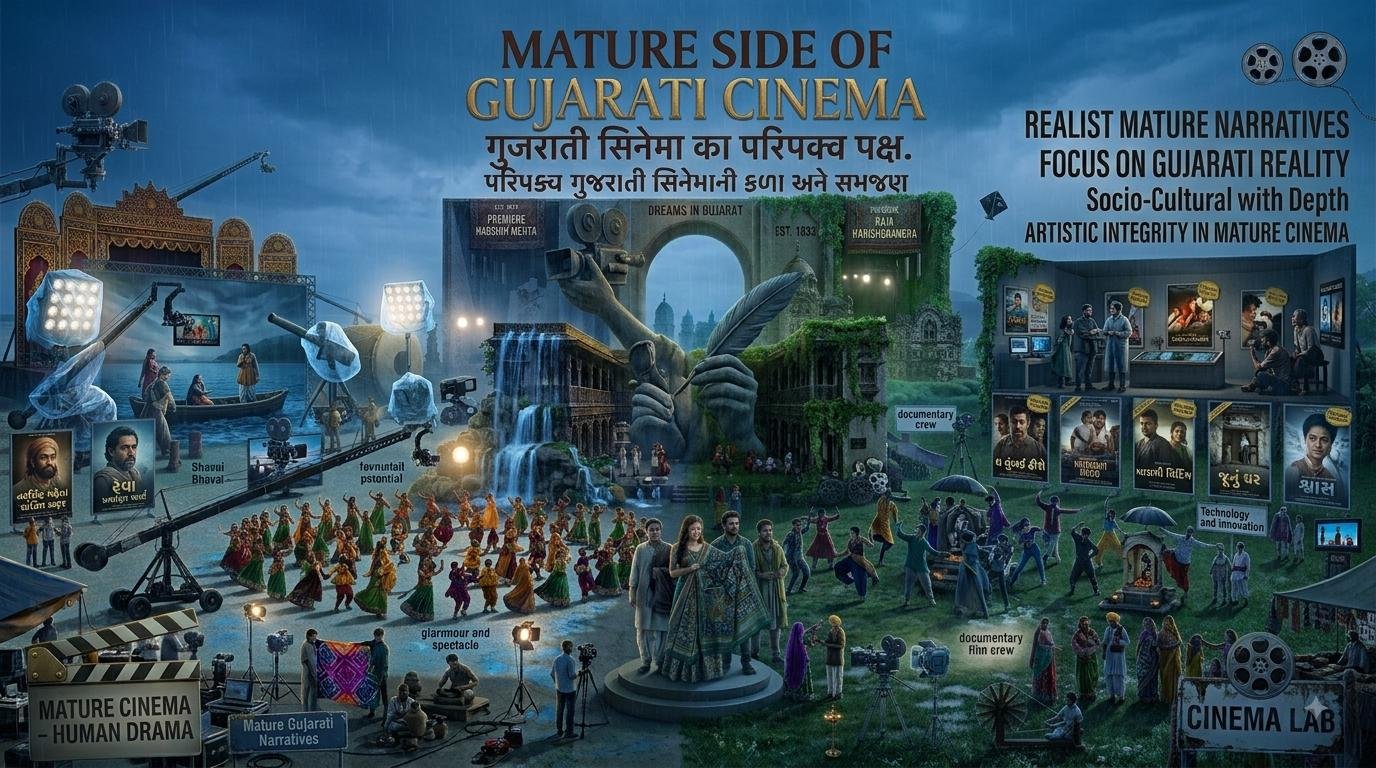
Gujarati cinema has traditionally been known for family entertainers, comedy, culture and relationship-driven stories. But beneath that familiar image is another side of Dhollywood—films that have dared to discuss difficult subjects such as sexual identity, gender inequality, crime, exploitation, violence, relationships and social pressure.
The term “adult Gujarati cinema” can be misleading. An adult-certified movie is not necessarily sexually explicit. A film may receive an A certificate because of violence, strong language or disturbing themes. This distinction is especially important when discussing the latest National Award-winning Gujarati film, Maaran.
🌈 Meghdhanushya: A Film That Challenged Social Taboos
Meghdhanushya – The Colour of Life (2013), directed by K. R. Devmani, became an important Gujarati film for addressing homosexuality and the social challenges faced by LGBTQ+ people.
At a time when such subjects were rarely discussed openly in mainstream Gujarati cinema, the film explored identity, family expectations, social acceptance and personal freedom.
Its significance wasn’t about sensationalism. It was about bringing a previously uncomfortable subject into public discussion.
Why Meghdhanushya Remains Important
LGBTQ+ representation
Family pressure
Social acceptance
Individual identity
Breaking traditional storytelling boundaries
It represents an important milestone in the evolution of mature Gujarati cinema.
🌈 Oy Vey! My Son Is Gay: Identity Meets Family
Another unconventional Gujarati-language project, Oy Vey! My Son Is Gay, explores the relationship between sexual identity and family expectations.
Stories like this demonstrate how Gujarati cinema can address questions that go beyond conventional romance or family comedy.
The central idea is simple but powerful: Can families accept an individual’s identity even when it doesn’t match their expectations?
❤️ Misri: Modern Relationships on Screen
Contemporary Gujarati cinema is also becoming more comfortable portraying modern relationships.
Misri, directed by Kushal Naik, follows a photographer whose casual romantic encounter develops into something emotionally deeper. The film was certified UA 13+, demonstrating that mature relationship themes don’t automatically make a movie an adult film.
This represents a changing Gujarati audience that is increasingly comfortable with stories involving:
Dating
Attraction
Emotional compatibility
Modern relationships
Personal choices
🏆 Maaran: The New Face of Mature Gujarati Cinema
A National Award-Winning Film That Confronts a Dark Social Reality
Among recent Gujarati films, Maaran stands out as one of the strongest examples of socially mature storytelling.
Directed by Abhishek Jain, the film features Yash Soni, Deeksha Joshi, Shruhad Goswami, Tarjani Bhadla, Abhinay Banker and other performers.
The film enters disturbing territory, exploring human trafficking, gender discrimination, patriarchy, exploitation and violence against women.
Its A certification reflects the intensity of its subject matter rather than simply indicating sexual content.
🔥 Why Maaran Is Different
The film doesn’t use a difficult subject merely as a marketing tool. It builds its narrative around the realities faced by vulnerable women.
It explores:
Human trafficking
Gender inequality
Patriarchal control
Violence
Exploitation
Psychological trauma
Women’s survival
That makes Maaran a significant example of mature social cinema in Gujarati filmmaking.
🏆 Maaran Takes Gujarati Cinema to the National Stage
The biggest milestone came with the 72nd National Film Awards, where Maaran was recognised as the Best Gujarati Film.
The achievement gave contemporary Gujarati cinema another major national moment and demonstrated that difficult, socially relevant stories can receive prestigious recognition.
Before its National Award recognition, the film had also earned recognition at the Chicago South Asian Film Festival.
For Dhollywood, this is important because it sends a powerful message:
> Gujarati cinema doesn’t have to remain limited to conventional subjects to succeed.
🎭 Yash Soni’s Darker Transformation
Maaran also gave Yash Soni an opportunity to move into a considerably darker dramatic space.
The film’s characters operate in a world far removed from conventional Gujarati family entertainment, requiring performances built around fear, vulnerability, conflict and psychological pressure.
This kind of role diversification can help Gujarati actors move beyond established screen images.
🔥 A Certificate Doesn’t Automatically Mean “Adult Film”
This is one of the most misunderstood aspects of Indian cinema.
An A certificate can relate to:
Violence
Strong language
Disturbing imagery
Crime
Mature themes
Sexual references
Other content unsuitable for children
Therefore:
A-rated ≠ erotic film
Mature subject ≠ explicit content
Maaran is a strong contemporary example of this difference.
🎥 The Good Road: Gujarati Cinema Takes an Uncomfortable Route
Another important example is The Good Road (2013), directed by Gyan Correa.
The film presented interconnected stories set along a Gujarat highway and explored disturbing realities rather than offering conventional entertainment.
Its selection as India’s official entry for the Academy Awards generated significant discussion and controversy over its depiction of Gujarat.
Regardless of differing opinions about the film, its journey proved that Gujarati cinema could tell serious, unconventional stories capable of attracting national attention.
📺 OTT Could Change the Future of Mature Gujarati Cinema
The rise of streaming platforms has dramatically changed the possibilities for regional filmmakers.
Theatrical Gujarati cinema often needs to appeal to broad family audiences. OTT can potentially provide space for more targeted storytelling.
Future Gujarati streaming projects could explore:
🔍 Crime Thrillers
Investigations, organised crime and real-life cases.
🧠 Psychological Stories
Trauma, obsession, manipulation and survival.
❤️ Modern Relationships
Dating, marriage, separation and complicated emotional relationships.
🌈 LGBTQ+ Stories
Identity, acceptance and family relationships.
👩 Women-Centric Cinema
Independence, workplace inequality and social expectations.
💻 Digital Relationships
Social media, online dating and technology’s influence on personal life.
This doesn’t mean Gujarati cinema needs to become more explicit.
It means filmmakers can become more honest and adventurous with their subjects.
🎬 Mature Cinema vs Sensational Cinema
This distinction could define the next generation of Dhollywood.
Mature Cinema
✔ Strong screenplay
✔ Meaningful characters
✔ Social relevance
✔ Authentic performances
✔ Responsible treatment of sensitive issues
✔ Emotional depth
Sensational Cinema
❌ Controversy without substance
❌ Shock value as the primary attraction
❌ Weak storytelling
❌ Exploitation of sensitive topics
Gujarati cinema has a huge opportunity to choose the first path.
🚀 What Should Gujarati Filmmakers Explore Next?
The industry has enormous potential in genres such as:
Crime | Horror | Psychological Thriller | Science Fiction | Biographical Drama | LGBTQ+ Stories | Women’s Stories | Mature Romance | Social Thriller | Urban Drama
Imagine a Gujarati film industry where audiences can choose between a family comedy on Friday, a psychological thriller on Saturday and a serious social drama on Sunday.
That’s how a regional industry develops a diverse cinematic ecosystem.
🌟 Why This Change Matters
Gujarati audiences today are exposed to cinema from across India and the world.
They watch:
Bollywood
Tamil cinema
Telugu cinema
Malayalam cinema
Marathi cinema
International films
OTT originals
This has raised audience expectations.
Young viewers increasingly want fresh stories, modern characters and new genres.
Gujarati cinema has the talent to deliver those stories while retaining its language and cultural identity.
🎯 Final Verdict
The evolution of adult and mature subjects in Gujarati cinema is not really about making films more explicit.
It is about making them more courageous.
From Meghdhanushya addressing LGBTQ+ identity to Misri reflecting contemporary relationships, and from The Good Road tackling uncomfortable realities to National Award-winning Maaran confronting trafficking, patriarchy and violence, Gujarati filmmakers are gradually expanding the boundaries of Dhollywood.
The biggest opportunity now is to create films that don’t simply ask:
“Will audiences watch this?”
but also:
“What conversation will this film start?”
That could be the next major evolution of Gujarati cinema.
Stay updated with the latest news and articles. Subscribe Now for more articles.
