
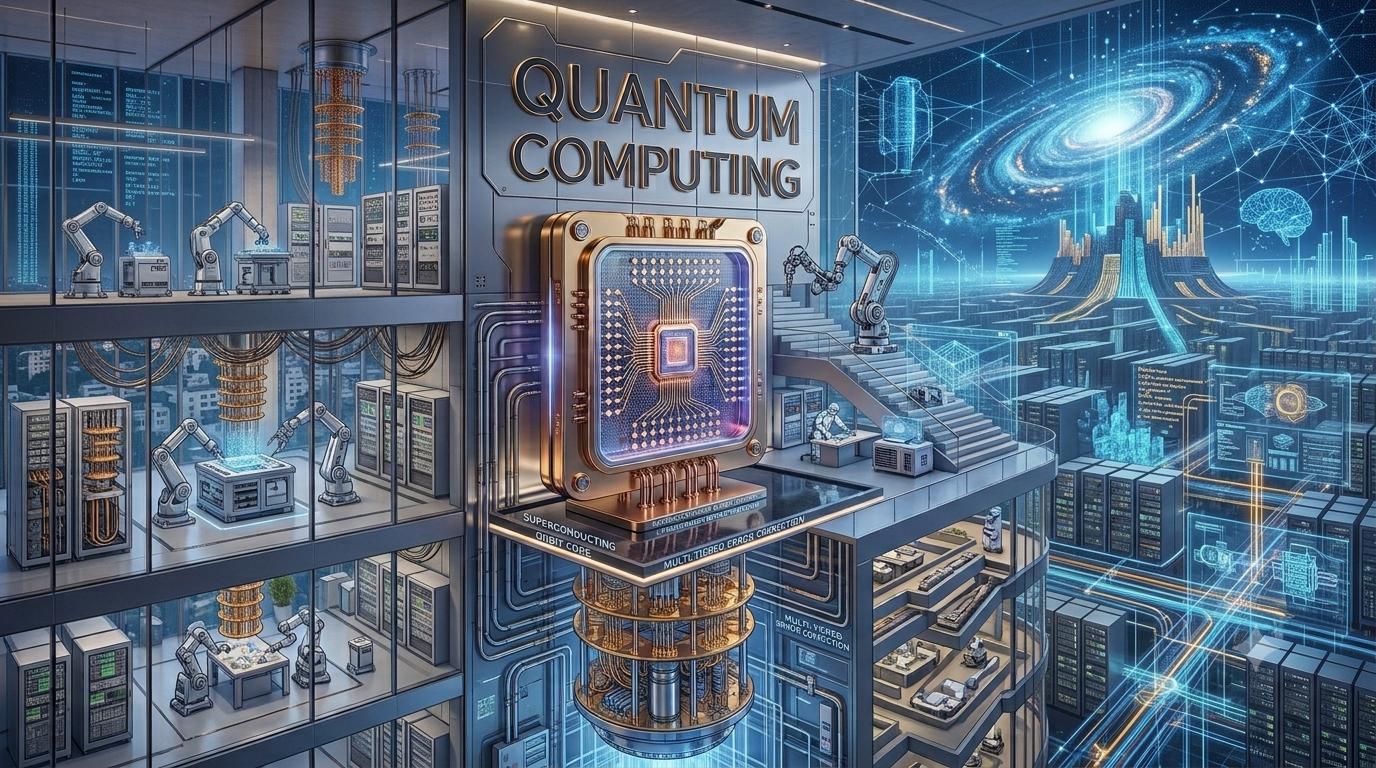
Quantum computing is widely considered one of the most revolutionary technologies of the 21st century. While today’s computers have become extraordinarily powerful by historical standards, certain classes of complex problems still take years — or even centuries in theoretical terms — to solve using traditional computing methods. Quantum computing offers an entirely new approach by using the principles of quantum physics to process information in fundamentally different ways from anything classical computers are capable of. From discovering life-saving medicines and strengthening cybersecurity to improving financial forecasting and accelerating scientific research, quantum computing has the potential to reshape industries across the world. Although the technology is still developing and widespread commercial deployment remains some years away, leading experts believe it could become one of the defining drivers of innovation over the coming decades.
What Is Quantum Computing?
Quantum computing is a form of computation that uses the principles of quantum mechanics to perform calculations that are impractical or impossible for classical computers. Unlike conventional computers that process information using bits — which must be either 0 or 1 at any given moment — quantum computers use quantum bits, commonly called qubits, which can represent multiple states simultaneously under specific quantum conditions. This property, known as superposition, allows quantum computers to explore many possible solutions to certain types of problems at the same time rather than sequentially. Combined with other quantum phenomena such as entanglement and interference, this enables quantum computers to tackle specific categories of calculation with an efficiency that classical machines simply cannot approach. Key capabilities include extremely powerful processing for suitable problem types, advanced mathematical operations, high-speed optimisation, the ability to model complex scientific systems, and the potential to solve problems that lie beyond the practical reach of classical computing.
How Quantum Computing Works
Quantum computers rely on the behaviour of particles at extremely small scales — the domain where quantum mechanical effects dominate rather than the classical physics that governs everyday objects. Information is stored and manipulated in qubits, which quantum operations process to explore multiple possible computational outcomes simultaneously. Specialised quantum algorithms — designed specifically to take advantage of quantum mechanical properties — then analyse these complex calculations and produce results for the problems they are built to address. It is important to understand that quantum computers are designed to complement classical computers for specific problem types rather than to replace them entirely. Most practical applications will likely involve hybrid systems in which quantum and classical processors work together, each handling the tasks they are best suited for.
Quantum Computing in Healthcare
Healthcare is one of the sectors most likely to benefit significantly from quantum computing as the technology matures. The ability to model molecular interactions at a quantum level could dramatically accelerate drug discovery by simulating how candidate molecules interact with biological targets in ways that classical computers cannot do efficiently. Protein structure analysis — a field whose complexity is illustrated by the remarkable progress of AI tools like AlphaFold — could be further advanced. Personalised medicine research, disease modelling, and medical data optimisation all represent areas where quantum computation could reduce the time and cost currently required to move from research insight to clinical application. The World Health Organization consistently identifies faster and more affordable drug development as one of the most urgent priorities in global health, making quantum computing’s potential contribution to this field particularly significant.
Quantum Computing and the Future of Cybersecurity
Quantum computing will influence digital security in both powerfully positive and genuinely challenging ways. On the challenging side, sufficiently powerful quantum computers could in principle break many of the encryption methods that currently protect sensitive digital communications and data — a concern that governments and security organisations are already taking seriously. On the positive side, quantum mechanics also enables the development of quantum-resistant encryption and fundamentally more secure communication systems that leverage quantum properties to detect any interception attempt. The US National Institute of Standards and Technology has been actively developing post-quantum cryptographic standards specifically to ensure that critical infrastructure and sensitive data remain protected as quantum computing capabilities advance.
Climate Science and Environmental Research
Quantum computing may significantly improve the accuracy and speed of environmental modelling — an area where the complexity of the systems involved has always strained the limits of classical computational capacity. Possible applications include improved climate prediction modelling, enhanced weather forecasting, optimisation of carbon capture processes, acceleration of renewable energy materials research, and the creation of environmental simulations with far greater fidelity to the complexity of real Earth systems. Better and more granular models could support more informed and more effective climate strategies, giving policymakers and scientists tools that are genuinely adequate to the scale and urgency of the environmental challenges they are working to address.
Quantum Computing in Financial Services
Banks, investment firms, and financial institutions are actively exploring quantum technology for complex analytical applications that strain or exceed classical computing capabilities. Portfolio optimisation across large numbers of assets, more sophisticated risk management models, faster and more accurate fraud detection, realistic market simulations, and advanced investment analysis are all areas where quantum algorithms could deliver meaningful improvements in decision quality and processing speed. Financial systems are characterised by the simultaneous interaction of enormous numbers of variables, making them exactly the kind of problem domain where quantum approaches have the greatest potential to outperform classical methods.
Transportation and Logistics Optimisation
Transportation networks generate massive amounts of data every day and are defined by optimisation challenges of extraordinary complexity — finding the most efficient routes, managing supply chains across thousands of nodes, coordinating fleets of vehicles, and reducing waste across enormous logistics networks. Quantum optimisation algorithms could deliver meaningful improvements in traffic management, supply chain efficiency, route planning, and fleet coordination in ways that classical approaches — which often have to use approximations because exact solutions are computationally prohibitive — cannot achieve. Even modest improvements in efficiency across these systems would translate into significant cost savings and environmental benefits at scale.
Manufacturing and Industrial Innovation
Manufacturers are studying quantum computing for its potential in product design, materials discovery, and production planning. The ability to simulate complex material properties at the quantum level could accelerate the discovery of new materials with properties — strength, conductivity, thermal resistance, and others — specifically optimised for particular applications. Production process optimisation, advanced manufacturing simulations, and quality improvement modelling all represent areas where quantum computing could help companies innovate faster and manufacture more efficiently than classical simulation tools currently allow.
Artificial Intelligence and Quantum Computing
Artificial intelligence and quantum computing are increasingly viewed as technologies that could powerfully complement each other rather than develop in isolation. Quantum computing could accelerate machine learning research by enabling faster training of complex models, improve data analysis capabilities for very large and complex datasets, enhance pattern recognition across domains where classical approaches are already stretched, and support scientific discovery by enabling the simulation of systems that are currently beyond reach. Google’s quantum AI research team is among several leading organisations actively investigating how quantum computing can be used to advance AI development in ways that neither technology could achieve independently.
Challenges Facing Quantum Computing Development
Despite its remarkable potential, quantum computing faces significant and genuinely difficult challenges on the path to widespread practical deployment. Development costs remain extremely high, limiting research to well-resourced organisations. The technical complexity of building and operating quantum hardware is formidable. Maintaining qubit stability — keeping qubits in their quantum states long enough to perform useful calculations — is one of the most demanding engineering problems in the field, since quantum states are extraordinarily sensitive to environmental interference. Error correction in quantum computation is an active and critical research area. And commercial availability of practical quantum systems capable of outperforming classical computers on real-world problems remains limited. Significant further research and engineering advances are required before quantum computing delivers on its most ambitious promises.
The Future of Quantum Computing
Quantum computing is expected to become increasingly practical and commercially accessible over the coming years, driven by sustained investment from governments, universities, and leading technology companies including IBM, Google, Microsoft, and a rapidly growing ecosystem of specialised quantum computing startups. Emerging trends include more powerful quantum processors with greater qubit counts and lower error rates, hybrid classical-quantum computing architectures that combine the strengths of both approaches, quantum computing delivered as a cloud service making the technology accessible without requiring organisations to own and operate quantum hardware directly, and quantum-safe cybersecurity solutions becoming standard infrastructure. World Economic Forum analysis projects that quantum computing will deliver its first commercially significant advantages in specific domains — particularly chemistry, materials science, and optimisation — within this decade.
Conclusion: One of the Defining Technologies of the Digital Age
Quantum computing represents one of the most exciting and consequential frontiers in modern technology. By harnessing the counterintuitive principles of quantum mechanics, it has the genuine potential to solve highly complex problems in healthcare, finance, manufacturing, climate science, cybersecurity, and many other fields that currently lie beyond the practical reach of classical computation. Although widespread commercial use is still developing and the most transformative applications remain some years away, the pace of research and investment is accelerating consistently. As this technology matures, it may well become one of the truly defining innovations of the digital age — changing not just what computers can do, but what humanity as a whole is capable of understanding and achieving.
Stay updated with the latest news and articles. Subscribe Now for more articles.
