
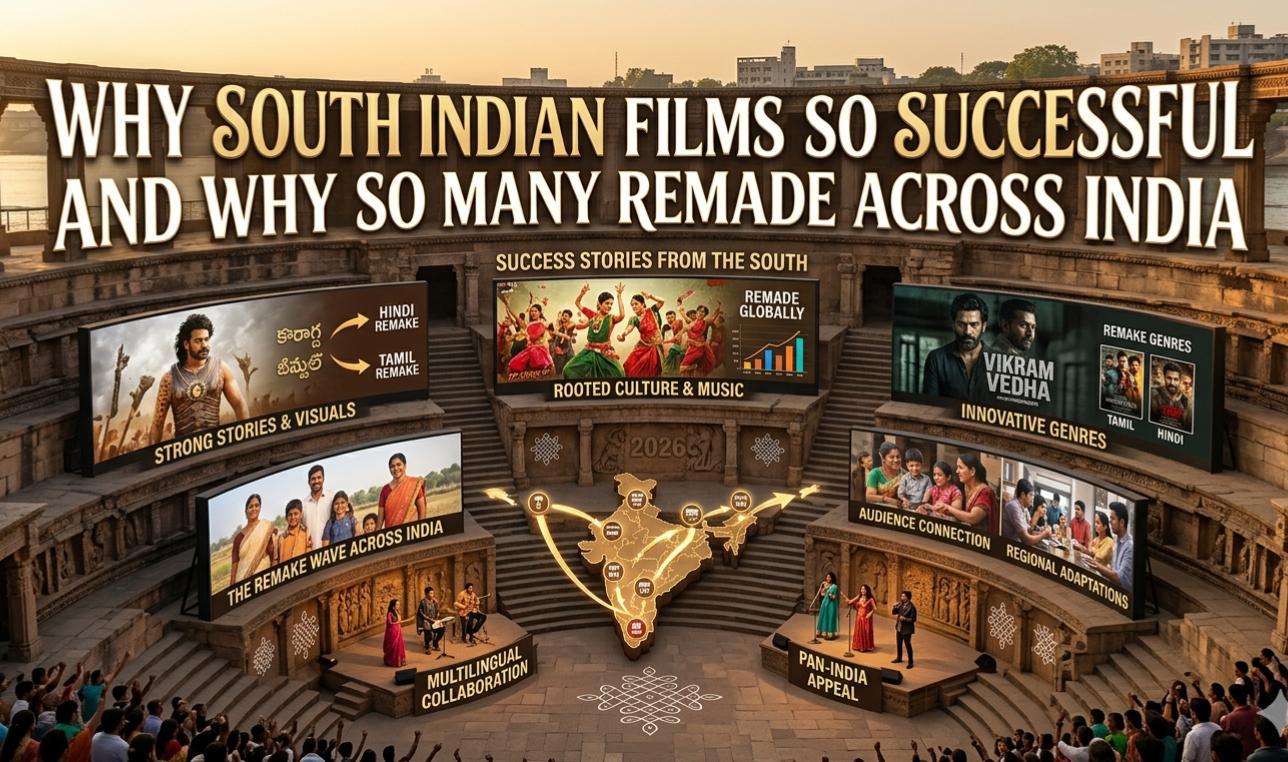
Over the last two decades, South Indian cinema has become the biggest source of remakes in Indian film history. Whether it is Bollywood, Bengali, Odia, or other regional industries, many of the most successful remakes have originated from Telugu, Tamil, Malayalam, or Kannada cinema. But why does this happen? The answer goes far beyond action scenes and larger-than-life heroes — it lies in a deeper culture of storytelling, audience understanding, and creative ambition that South Indian filmmaking has built over decades.
A Strong Story Development Culture
One of the biggest strengths of South Indian cinema is its deep focus on storytelling. Many South filmmakers spend years developing scripts before production even begins, treating the screenplay as the true foundation of a film’s eventual success. Films like Drishyam, Pokiri, Vikramarkudu, and Manichitrathazhu succeeded first and foremost because of powerful storytelling — their commercial success followed naturally once the narrative foundation was strong enough to carry it.
An Exceptional Understanding of Mass Audiences
South cinema has mastered the delicate balance between emotion, family drama, action, comedy, music, and heroism within a single film. A South Indian commercial release often provides genuinely complete entertainment for every age group within a family, making it a true mass-audience product rather than a niche offering. This completeness is precisely what makes these stories easier to adapt successfully into multiple languages — the emotional and entertainment formula translates because it was built to appeal broadly from the very beginning.
Regional Roots, Universal Emotions
The best South Indian films are deeply connected to local culture while being built on genuinely universal themes. The fierce protection of family in Drishyam, the powerful mother-son emotional bonds found in many Telugu blockbusters, and the exploration of love against social barriers in films like Sairat all demonstrate the same underlying principle — emotions travel across languages far more easily than dialogue ever could. A story rooted in authentic local detail but built around a universal human experience has a natural advantage when it comes to crossing linguistic and cultural boundaries.
A Strong Writer-Director System
Many South Indian film industries place significant importance on the role of the writer within the filmmaking process. Filmmakers such as S.S. Rajamouli, Mani Ratnam, Lokesh Kanagaraj, and Sukumar are known first and foremost for their storytelling vision rather than for any single technical specialty. In this system, the script often remains the true hero of the production — a philosophy that consistently produces stronger, more durable stories than approaches where star power or spectacle are allowed to overshadow narrative quality.
How Telugu Cinema Became a Remake Factory
Historically, Telugu cinema has produced some of the most remade films in Indian cinema history. Pokiri became Wanted and several other regional versions. Vikramarkudu became Rowdy Rathore and multiple other adaptations. Arjun Reddy became the widely discussed Kabir Singh. Ala Vaikunthapurramuloo became Shehzada. Telugu producers have traditionally targeted broad mass entertainment with wide appeal, creating commercially proven formulas that producers in other industries could adapt with relatively lower risk and a higher likelihood of replicating the original’s success.
Why Malayalam Cinema Excels in Content-Driven Storytelling
If Telugu cinema dominates mass-entertainment remakes, Malayalam cinema dominates the category of story-driven remakes. Drishyam, Manichitrathazhu, and Bodyguard all originated as Malayalam films before becoming successful adaptations across multiple languages. Malayalam filmmakers consistently focus on realistic characters and tightly constructed screenplays rather than relying primarily on scale or spectacle. As a result, their stories adapt unusually well across industries, because the core narrative strength does not depend on a particular star, language, or cultural context to land emotionally with audiences.
South Industries Take More Creative Risks
South Indian filmmakers frequently experiment with mythology, fantasy, historical dramas, science fiction, and rural action dramas in ways that other Indian film industries have historically approached more cautiously. Films such as Baahubali: The Beginning, Baahubali 2: The Conclusion, Pushpa: The Rise, and Kantara demonstrate vividly how distinctly regional stories, told with genuine creative ambition and conviction, can become full-blown national sensations. This willingness to take creative risks on unconventional genres and large-scale ambition has repeatedly paid off in ways that more conservative, formula-driven filmmaking rarely achieves.
An Exceptionally Strong Fan Culture
South India has one of the world’s strongest movie-going cultures, with fans celebrating major film releases almost like festivals — complete with elaborate promotional events, first-day-first-show traditions, and passionate community engagement. This level of support allows filmmakers to attempt bigger and more ambitious ideas, recover their investments faster through strong opening performances, and build long-running franchises with confidence. The strong theatrical culture across South Indian states keeps the broader industry financially healthy in a way that supports continued creative risk-taking.
Why Bollywood Historically Preferred Proven Stories
For many years, Bollywood producers preferred remaking already-successful South Indian films rather than taking on the financial risk of untested original scripts. This pragmatic approach led to blockbusters such as Wanted, Rowdy Rathore, Kabir Singh, and Bhool Bhulaiyaa. A proven South Indian hit significantly reduced the commercial risk for Hindi-language producers, since audience response, pacing, and emotional beats had already been validated in the original market before a single rupee was spent on the remake.
The Pan-India Revolution That Changed Everything
The extraordinary success of Baahubali: The Beginning, KGF: Chapter 1, Pushpa: The Rise, and RRR changed Indian cinema fundamentally and permanently. Today, instead of remaking South Indian films into separate regional versions, many producers now release a single film directly in multiple languages simultaneously, recognising that strong stories no longer need to be reshot and reinterpreted to reach a national audience. This shift is precisely why traditional remakes have become noticeably less common than they were a decade ago — the pan-India release model has, in many ways, made the old remake system increasingly unnecessary.
The Real Reason Behind South Cinema’s Success
South Indian films are not successful simply because they feature bigger action scenes or larger budgets. Their biggest strengths are strong scripts, emotional storytelling, a genuine understanding of mass audiences, writer-driven filmmaking culture, deep cultural authenticity, and passionate theatrical fan support working together. When a story works emotionally at its core, language becomes a secondary consideration — and this is the fundamental insight that explains why South Indian cinema has produced so many of India’s most successful cross-language remakes.
Final Verdict: Storytelling Built South Cinema’s Legacy
The reason so many Indian remakes come from South cinema is ultimately simple — South Indian film industries spent decades methodically building strong storytelling ecosystems. Whether it is Telugu mass entertainers, Malayalam content-driven dramas, Tamil social stories, or Kannada cultural epics, South cinema consistently creates stories that connect with audiences across the whole of India. That is why so many of India’s biggest remake blockbusters began as South Indian originals — and why South cinema continues to shape and influence the future direction of Indian entertainment as a whole.
Stay updated with the latest news and articles. Subscribe Now for more articles.
