
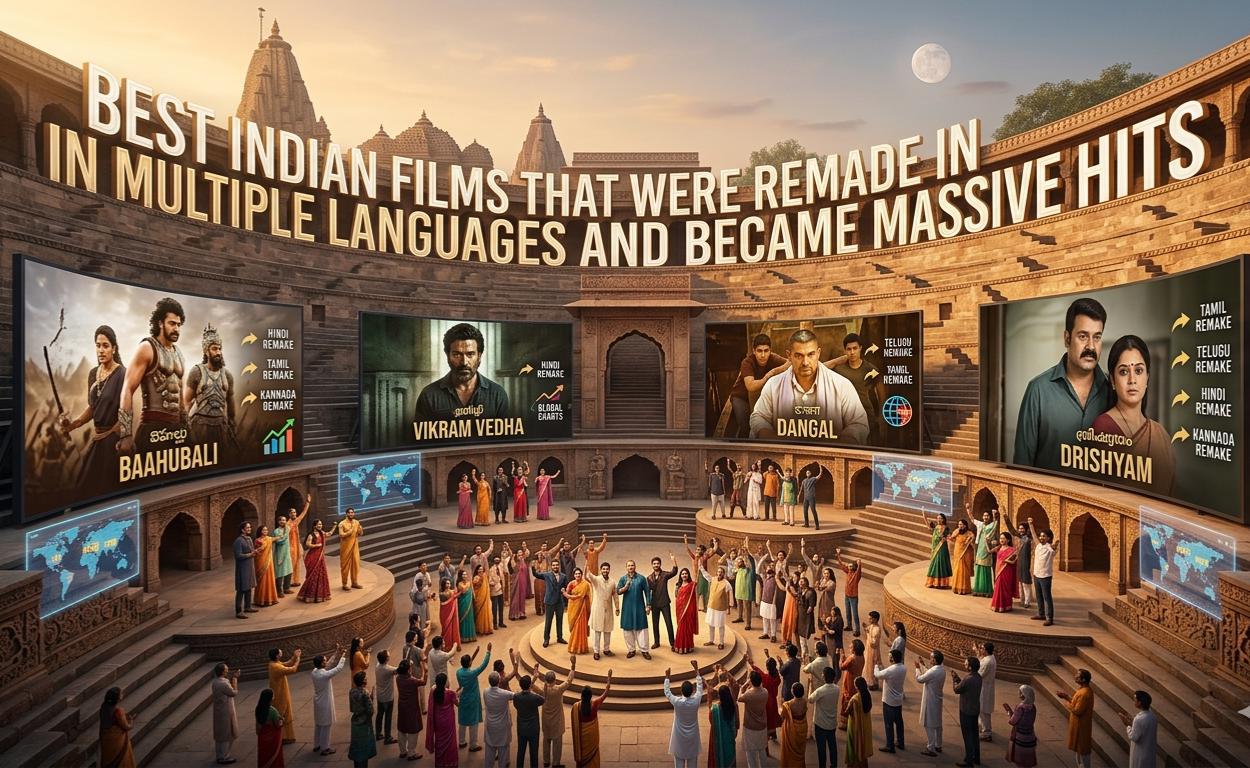
Indian cinema has a unique and fascinating tradition where successful films are remade across different regional languages, allowing powerful stories to reach audiences who might never have discovered the original. However, only a handful of films become such enormous successes that producers from multiple industries remake them repeatedly — across three, four, or even five languages — each time finding a new audience that embraces the story as its own. Here is a look at some of the most influential Indian films that became blockbuster remakes across the country, again and again.
Drishyam — The King of Indian Remakes
Originally starring Mohanlal in the Malayalam version, Drishyam is widely regarded as the most successful remake franchise in Indian cinema history. The film was remade in Hindi, Tamil, Telugu, and Kannada, with each version finding massive commercial success and critical appreciation. Even a Chinese adaptation was inspired by the concept. The reason for its extraordinary cross-language appeal is simple — it combines a brilliantly constructed thriller with deeply universal family emotions that resonate with audiences regardless of language or cultural background. Drishyam is the modern benchmark against which all Indian remake success stories are measured.
Vikramarkudu — From Rajamouli to Bollywood Blockbuster
Originally directed by S.S. Rajamouli, Vikramarkudu was a high-energy action entertainer that quickly attracted the attention of producers across India. It was remade as Rowdy Rathore in Hindi — one of Bollywood’s biggest action blockbusters of its era — and subsequently in Tamil, Kannada, and Bengali as well. The film demonstrated how a well-crafted mass-entertainment formula, in the hands of the right director, could translate into box office gold across virtually every major Indian film market.
Manichitrathazhu — The Psychological Thriller That Launched Multiple Franchises
Manichitrathazhu is considered one of India’s greatest psychological thrillers, and its influence on Indian cinema is almost unparalleled in the remake space. It was adapted as Chandramukhi in Tamil, which itself became a massive hit, and as Bhool Bhulaiyaa in Hindi, which spawned its own successful franchise. Telugu and Kannada adaptations followed as well. The original Malayalam film’s genius lay in its unique blending of supernatural horror, psychological drama, and comedy — a combination that proved irresistible to audiences and filmmakers across the country for decades.
Ramudu Bheemudu — The Classic That Defined the Dual-Role Genre
Ramudu Bheemudu is the classic dual-role entertainer that set the template for an entire genre of Indian cinema. It was remade as the legendary Ram Aur Shyam in Hindi and adapted in Tamil and Malayalam as well. The film’s influence stretched far beyond its direct remakes — it inspired dozens of double-role films across Indian cinema for generations. Its enduring appeal demonstrated how a well-executed concept, built around a charismatic star performance, could sustain storytelling energy across multiple languages and multiple decades.
Pokiri — Reviving Action Cinema Across Industries
Originally starring Mahesh Babu in one of his most iconic roles, Pokiri was an action blockbuster that reinvigorated the mass-entertainer genre across South Indian cinema. It was remade as Wanted in Hindi — a film that relaunched Salman Khan’s career as a full-scale action hero — and subsequently in Tamil, Kannada, and Bengali. Each version performed strongly at the box office, demonstrating that Pokiri’s core formula of slick action, sharp dialogue, and an irresistible lead performance had universal commercial appeal across India’s diverse film-going markets.
Sairat — Proving Regional Stories Can Become National Phenomena
Sairat was one of the biggest regional box office hits in Indian cinema history, a Marathi film that broke all expectations when it became a massive cultural phenomenon far beyond Maharashtra. Its Hindi remake Dhadak brought the story to a national audience, and Kannada, Punjabi, and Bengali adaptations followed. Sairat’s extraordinary reach proved that a story rooted in authentic regional reality — one that speaks honestly about caste, love, and social pressure — can transcend its original context and move audiences across the entire country when the storytelling is genuine enough.
Alaipayuthey — Redefining Urban Romance for a Generation
Directed by the legendary Mani Ratnam, Alaipayuthey was a milestone in how Indian cinema portrayed modern urban relationships — honest, complicated, and deeply emotionally resonant. Its Hindi remake Saathiya brought that sensibility to a new audience and redefined the urban romance genre for a generation of Bollywood viewers. The film’s lasting influence can be felt in the way Indian romantic cinema depicts the realities of young love and marriage, moving beyond fantasy toward something more truthful and more affecting.
Bodyguard — Pan-Indian Commercial Success
Bodyguard is one of the clearest examples of a commercial entertainment formula finding success across virtually every major Indian film market. Remade in Hindi, Tamil, Telugu, and Kannada, the film combined action, humour, and emotion in a crowd-pleasing package that connected with mass audiences regardless of regional differences in taste and culture. Its pan-Indian success reinforced the idea that certain entertainment formulas carry an almost universal appeal when executed with the right star power and production quality behind them.
Katha Parayumbol — The Power of Emotional Storytelling
Katha Parayumbol, the Malayalam original, was a deeply moving film about the relationship between an ordinary person and a film star — a story about human connection across social divides. It was remade as Kuselan in Tamil and Billu in Hindi, with a Telugu adaptation also following. Each version demonstrated how a story rooted in genuine emotional truth can find an audience in any language, and the film’s legacy reinforces the principle that heartfelt storytelling — more than genre, spectacle, or formula — is ultimately what makes a film worth remaking.
The Most Remade Indian Films of All Time
When judged by the combination of total number of remakes, box office performance across languages, and lasting cultural impact, a clear hierarchy emerges among India’s most remade films. Manichitrathazhu stands as one of the most remade psychological thrillers in Indian cinema history, having launched multiple successful franchises across several decades. Drishyam is the modern remake champion, having achieved blockbuster status in every language it has been adapted into. Ramudu Bheemudu remains the classic pioneer whose influence on the dual-role genre is still felt today. Pokiri established itself as a remake machine that revived action cinema across multiple industries simultaneously. And Vikramarkudu achieved the rare distinction of succeeding commercially in almost every major language market it entered.
Final Verdict: Great Stories Know No Language Barrier
When considering the full combination of remake volume, box office success, and cultural impact, the three greatest winners in Indian cinema’s remake tradition are Drishyam, Manichitrathazhu, and Pokiri. Each of these films proved — in different genres and different eras — that a truly great story can transcend language barriers and become a blockbuster across India’s enormously diverse film-going audience. The tradition of remaking successful films is not simply a commercial strategy; it is a testament to the power of stories that capture something universal about human experience. And in Indian cinema’s extraordinary diversity of languages and cultures, that universality is one of the most remarkable things a film can achieve.
Stay updated with the latest news and articles. Subscribe Now for more articles.
