
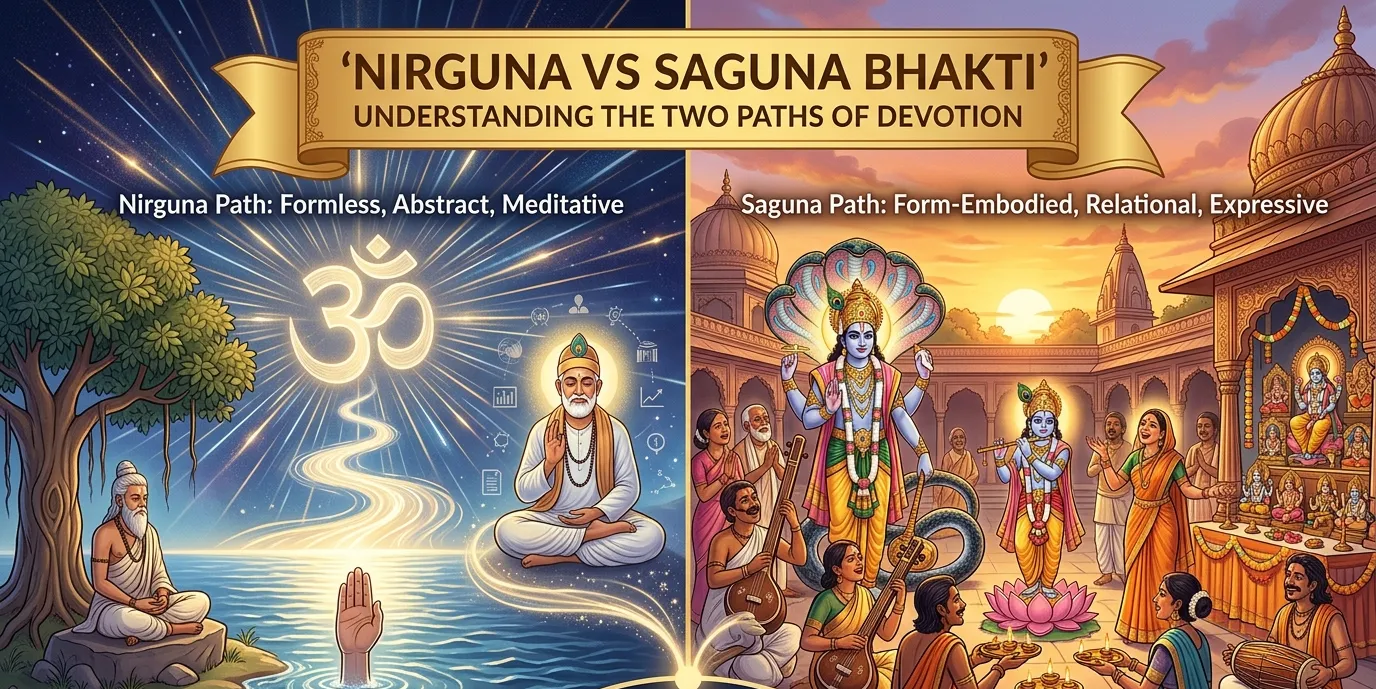
In the vast spiritual tradition of India, devotion to God takes many forms. Two of the most important and widely followed paths are Nirguna Bhakti and Saguna Bhakti.
Nirguna vs Saguna Bhakti approaches may seem different, but both lead to the same ultimate truth — connection with the Divine. Let’s explore their meaning, differences, and significance in a simple and modern way.
What Is Nirguna Bhakti?
Nirguna Bhakti means devotion to a formless, attribute-less God. “Nir” means without and “Guna” means qualities or attributes. So Nirguna Bhakti is worship of a God who has no shape, no form, no image, and exists beyond human understanding.
Key features of Nirguna Bhakti include:
- God is invisible and infinite
- No idol worship
- Focus on meditation and inner realization
- Emphasis on truth, simplicity, and equality
- Rejects rituals and external practices
Famous Nirguna saints include Kabir, Dadu Dayal, and Guru Nanak. These saints taught that God lives within us, not just in temples or idols.
What Is Saguna Bhakti?
Saguna Bhakti means devotion to God with form and qualities. “Sa” means with and “Guna” means qualities. In this path, God is worshipped in physical forms, such as idols, images, or incarnations.
Key features of Saguna Bhakti include:
- God has a form (like Rama, Krishna, Shiva)
- Idol worship and rituals are accepted
- Emotional connection through love and devotion
- Bhajans, kirtans, and temple worship
- Personal relationship with God
Famous Saguna saints include Mirabai, Tulsidas, and Surdas. These saints expressed their devotion through love, songs, and stories.
Key Differences Between Nirguna and Saguna Bhakti
While both paths lead to the Divine, they differ in approach. In terms of the nature of God, Nirguna sees God as formless while Saguna worships God with form. In terms of worship style, Nirguna focuses on meditation and inner realization while Saguna embraces idol worship and rituals. The overall approach of Nirguna is philosophical, whereas Saguna is emotional. Nirguna emphasizes self-realization, while Saguna cultivates a personal relationship with God. Finally, rituals are not important in Nirguna Bhakti but are central to Saguna Bhakti.
Are They Opposite?
No. Nirguna and Saguna Bhakti are not enemies — they are two different paths to the same destination. Think of it like this: Nirguna is like air — invisible but everywhere. Saguna is like water — visible and touchable. Both are essential and powerful.
Which Path Is Better?
There is no “better” path. It depends on the individual.
- If you prefer meditation and inner silence → Nirguna Bhakti
- If you feel emotional connection with God’s form → Saguna Bhakti
Both paths lead to peace, devotion, and spiritual growth.
Relevance in Modern Life
In today’s world, people follow both paths. Some meditate and focus inward following the Nirguna way, while others visit temples and sing bhajans following the Saguna tradition. Both help reduce stress, bring peace, and strengthen faith.
Conclusion
Nirguna and Saguna Bhakti are two beautiful expressions of devotion. One focuses on the invisible truth, while the other celebrates the visible form of God. In the end, both paths teach the same message:
God is one — only the ways to reach Him are different.
Subscribe Now For More articles.

1 comment
I wish to share a poem that deals with a Nirguna Bhakti meditation. It was inspired by the desire to worship anywhere anytime.
https://www.poemist.com/david-carberry/easy-meditation
Just an old white guy from Canada