
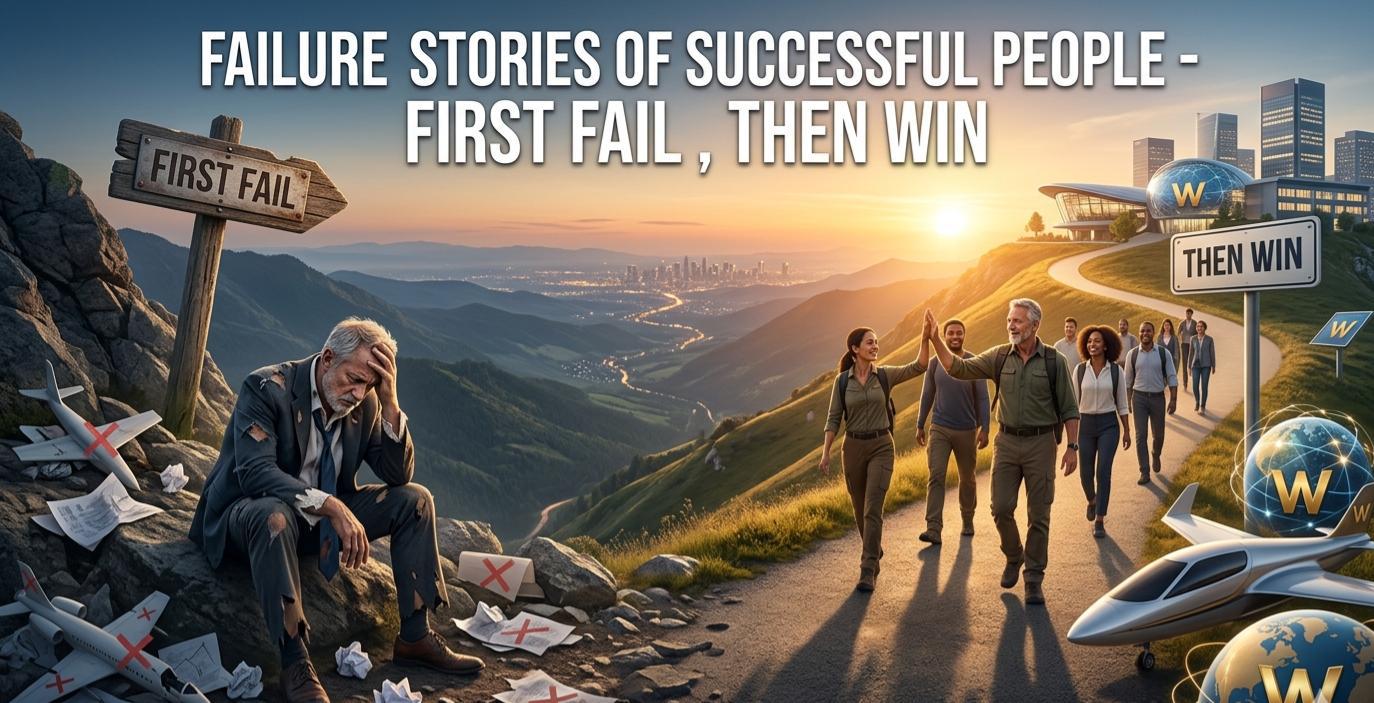
In a world that celebrates success, people often overlook the struggles that come before it. We see achievements, awards, wealth, and recognition — but we rarely see the failures, disappointments, and setbacks that happened behind the scenes. The truth is simple: almost every successful person has failed before succeeding. Failure is not the opposite of success. In many cases, it is an essential part of the journey. The people we admire today were once rejected, criticised, doubted, and defeated. What made them different was not that they avoided failure — it was that they refused to quit.
Why Failure Is a Necessary Part of Growth
Most people fear failure because they see it as an ending. Successful people see it differently. They understand that failure provides valuable lessons, builds resilience, improves decision-making, develops patience, and creates the kind of mental strength that comfortable success never could. Every setback contains information that can help you grow, and research on learning from failure consistently shows that those who reflect on their setbacks and extract lessons from them outperform those who either avoid failure or are defeated by it. Failure is often life’s most effective — and most honest — teacher.
The Real Shape of the Journey to Success
Success rarely happens in a straight line. Most genuine journeys follow a pattern that looks more like this: dream, effort, failure, learning, improvement, and eventually success — with that cycle often repeating several times before the destination is reached. People who quit after their first failure never discover their true potential. Those who continue despite setbacks, adjusting their approach each time, eventually achieve results that seemed impossible at the start. The journey is the education, and failure is one of its most demanding but most rewarding courses.
Thomas Edison: Turning Thousands of Failures into One Great Invention
Thomas Edison is remembered as one of history’s most prolific inventors, credited with helping develop the electric light bulb and holding over a thousand patents. But before achieving those breakthroughs, he experienced thousands of unsuccessful experiments. When asked about his failures, he famously reframed them — explaining that he had simply found many ways that did not work, and that each one brought him closer to the way that did. His mindset transformed obstacles into learning opportunities and made persistence itself into a form of genius.
Michael Jordan: Cut from the Team, Driven to Greatness
Today, Michael Jordan is considered one of the greatest basketball players in the history of the sport. But early in his life, he was cut from his high school basketball team — a rejection that could have ended his ambitions before they properly began. Instead of giving up, he practised harder than ever, channelling the pain of that disappointment into fuel for relentless improvement. That early setback became one of the defining stories in sport — proof that rejection, handled with the right mindset, can become the very foundation of extraordinary achievement.
J.K. Rowling: Rejected by Publishers, Read by Millions
Before becoming one of the world’s most successful authors, J.K. Rowling faced serious financial struggles and an extended string of publishing rejections. Numerous publishers turned down her manuscript, and there were periods when her personal circumstances were deeply difficult. Yet she continued believing in her story. Eventually, a small publisher took a chance, and what followed became a global phenomenon that transformed children’s literature and inspired millions of readers around the world. Her journey from rejection to record-breaking success remains one of the most powerful illustrations of what persistence in the face of repeated failure can achieve.
Colonel Sanders: Rejected Hundreds of Times Before Building a Global Brand
Colonel Sanders faced repeated rejection while travelling the country trying to find restaurants willing to adopt his chicken recipe. Hundreds of businesses turned him away. Most people in that situation would have concluded that the idea simply was not good enough and moved on. Instead, he kept trying until someone gave him a chance. His persistence eventually built what became one of the most recognisable food brands in the world. The story of KFC’s founding is, at its core, a story about the extraordinary things that become possible when a person simply refuses to stop.
What Successful People Understand About Failure That Others Do Not
Successful individuals do not interpret failure as proof that they are incapable. Instead, when something does not work, they ask themselves what they can learn from the experience, what they should improve, and how they can do better the next time. This shift in framing — from failure as verdict to failure as feedback — is one of the most important mindset differences between those who eventually succeed and those who give up prematurely. Resilience research consistently identifies this kind of constructive interpretation of setbacks as a defining characteristic of high achievers across every field.
Why Most People Quit Too Soon
Many people abandon their goals not because failure proves their dreams were wrong, but because the emotional experience of failing is harder than they anticipated. Results take longer than expected, fear of criticism increases with each attempt, confidence erodes under repeated setbacks, and comparison with others who appear to be succeeding more easily creates discouragement. The challenge is never failure itself — it is how a person chooses to respond to failure. Those who learn to sit with discomfort, extract lessons, and return to the effort are the ones who eventually break through.
The Qualities That Failure Builds and Success Alone Cannot Teach
Success feels rewarding, but failure creates genuine growth in ways that easy achievement simply cannot replicate. Through failure, people develop patience — the understanding that good things often require more time than expected. They build resilience, the ability to recover from setbacks and return stronger than before. They cultivate adaptability, learning how to change strategies when a current approach is not working. They gain humility, recognising that there is always more to learn and that no one succeeds alone. And they discover determination — the quiet, enduring commitment to keep going despite obstacles. These qualities, forged through difficulty, are the true foundation of lasting success.
Why Social Media Creates a False Picture of Success
Today, social media consistently shows only victories. People post their achievements, awards, and success stories — but rarely share the rejections, mistakes, and failures that preceded them. This creates a powerful and deeply misleading illusion that successful people never struggled, that their journey was smooth, and that difficulty is somehow exceptional rather than universal. The reality is very different. Every major success story includes years of challenges, setbacks, and moments of serious doubt that most people never see. Comparing your behind-the-scenes reality to someone else’s highlight reel is one of the most common and most damaging mistakes a person can make.
How to Handle Failure Positively and Keep Moving Forward
Handling failure well begins with accepting it as a natural and inevitable part of growth rather than treating it as a personal weakness or a permanent verdict. From there, the most valuable question to ask is what lesson this experience is offering — because every failure, however painful, contains information that a success in the same area would not have provided. Avoiding self-doubt is critical: one failure does not define a future. Staying consistent across multiple attempts is where most people separate from the crowd, and maintaining a focus on improvement — rather than simply on results — ensures that each setback makes the next attempt stronger and better informed.
Why This Lesson Matters Especially in India Today
Many students, entrepreneurs, and creators in India face enormous pressure to succeed quickly — from family expectations, competitive academic environments, and a culture that often struggles to make room for failure as a legitimate part of the journey. But long-term success consistently requires patience. Whether you are preparing for competitive exams, building a startup, growing a digital audience, or creating something entirely new, failure is not a sign to stop. It is often a sign that you are attempting something meaningful and difficult enough to be worth doing. India’s most successful entrepreneurs almost universally have significant failure in their histories — and they are better for it.
Final Thought: The Greatest Success Stories Begin with Failure
Every successful person has a chapter they do not always talk about — a chapter filled with rejections, mistakes, losses, and moments of serious doubt. But those difficult moments were not detours from success. They were the path to it. Failure is not falling down. Failure is refusing to get back up. The road to success is rarely perfect, and the people who achieve greatness are not those who never fail — they are the ones who keep moving forward after every setback, learning a little more each time, until eventually the effort compounds into something extraordinary. Because sometimes, the greatest success stories begin exactly where most people would have stopped.
Stay updated with the latest news and articles. Subscribe Now for more articles.
