
In a fast-moving world filled with pressure, competition, and constant comparison, many people wake up every day feeling lost. They ask themselves a quiet but powerful question:
“Why am I doing this?”
The Japanese concept of Ikigai offers a meaningful answer.
More than a trend or motivational word, Ikigai is a way of life — a philosophy that helps people find purpose, balance, and long-term happiness. It is not about chasing success at any cost, but about living with intention and joy.
What Is Ikigai?
The word Ikigai comes from two Japanese words:
- Iki – life
- Gai – value or worth
Together, Ikigai means “reason for being” or “what makes life worth living.”
Ikigai is the deep inner feeling that gives you a reason to wake up every morning. It is not always loud or dramatic. Often, it is quiet, steady, and deeply personal.
In Japan, people believe that everyone has an Ikigai — the challenge is discovering it.
Why Ikigai Matters in Modern Life
In today’s world, many people run after money, titles, and social validation, yet still feel empty inside. Ikigai addresses this emptiness by helping individuals align their lives with meaning.
Ikigai helps you:
- Find clarity in confusion
- Balance passion and responsibility
- Reduce stress and burnout
- Build long-term happiness
- Live with purpose, not pressure
Unlike short-term motivation, Ikigai creates sustainable fulfillment.
The Four Pillars of Ikigai
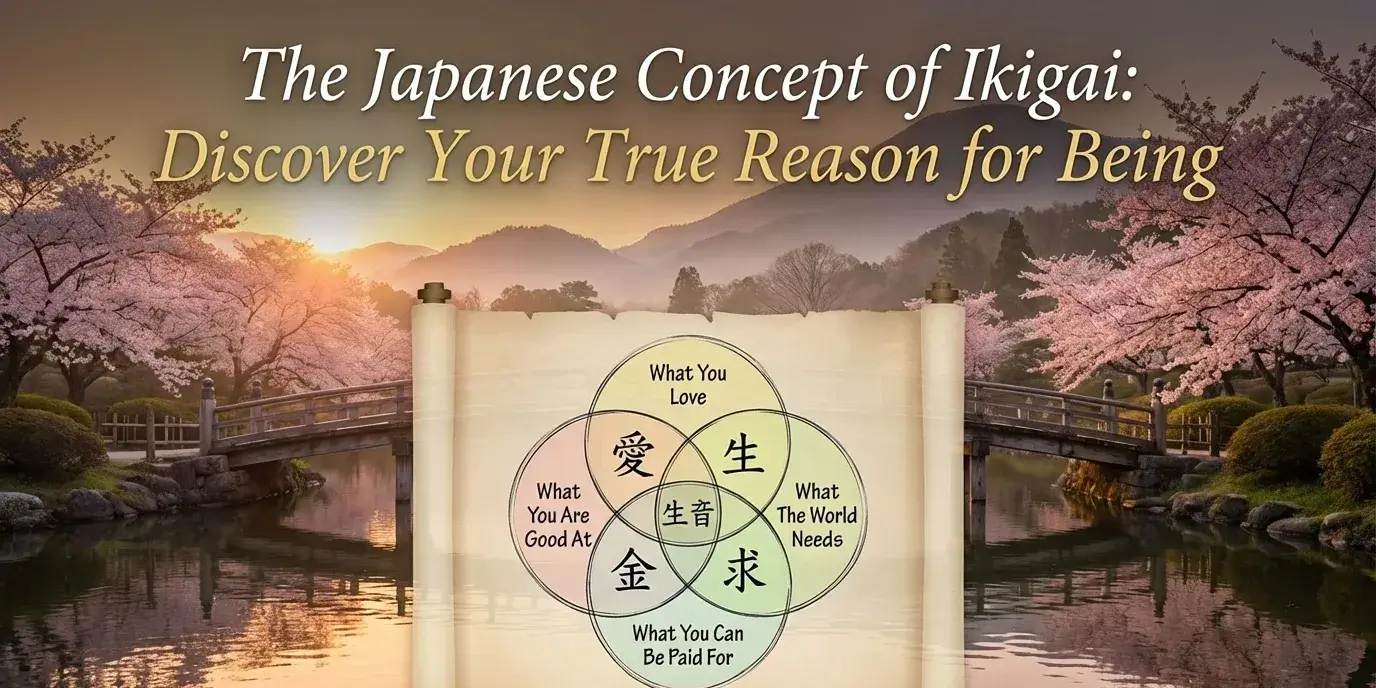
Ikigai is often explained through four overlapping elements.
Your Ikigai lies at the center, where all four meet.
1. What You Love
Your passions and interests — the activities that make you feel alive.
When you do these things, time feels effortless.
2. What You Are Good At
Your skills, strengths, and natural abilities.
Some are innate, others are developed through practice and dedication.
3. What the World Needs
Ikigai is not selfish. It connects personal joy with contribution.
Your actions should add value to others.
4. What You Can Be Paid For
While Ikigai is not only about money, financial stability supports balance.
Sustainable purpose often includes livelihood.
When these four elements align, life feels meaningful and complete.
Ikigai Is Not About Perfection
Many people misunderstand Ikigai as finding one perfect job or calling.
In reality, Ikigai is flexible and evolving.
In Japanese culture, Ikigai can be:
- A profession
- A hobby
- A family role
- A daily routine
- A simple habit like gardening or teaching
Ikigai does not demand fame or wealth.
It values consistency, dedication, and joy in small moments.
Ikigai and Longevity: A Japanese Secret
Japan is home to some of the longest-living people in the world.
In places like Okinawa, elders live active, meaningful lives well into old age.
One common belief among them is Ikigai.
They don’t retire from life. They continue to:
- Teach
- Create
- Help others
- Stay socially connected
- Maintain a sense of usefulness
This ongoing sense of purpose keeps both the body and mind healthy.
A Simple Ikigai Story
Imagine an elderly Japanese man who wakes up early every morning to tend his small garden.
He doesn’t earn money from it.
He doesn’t seek praise.
Yet he smiles while watering plants, sharing vegetables with neighbors, and teaching children how to grow food.
That garden is his Ikigai.
Purpose doesn’t have to be grand — it only has to be meaningful to you.
How to Discover Your Ikigai
Finding Ikigai is not a one-day activity.
It is a journey of self-reflection and honesty.
Ask yourself:
- What activities make me forget time?
- What problems do people often ask me to help with?
- What gives me deep satisfaction, even if no one notices?
- What would I continue doing even without recognition?
Write your answers down.
Patterns will appear — that’s where Ikigai begins.
Ikigai in Daily Life
You don’t need to change your entire life overnight.
Ikigai grows slowly and naturally.
Start with small steps:
- Dedicate time to what matters
- Improve skills you care about
- Help others using your strengths
- Create routines that bring peace
- Reduce activities that drain energy
Ikigai is built through daily commitment, not sudden transformation.
Why Ikigai Works So Well for Mental Health
Ikigai creates emotional stability by shifting focus from external pressure to internal satisfaction.
It helps with:
- Anxiety
- Stress
- Burnout
- Low motivation
- Mid-life confusion
When life has meaning, challenges feel lighter and more manageable.
Why This Topic Performs Well on Google Discover
Google Discover favors content that improves quality of life, connects emotionally, remains evergreen, encourages reflection, and offers real value.
Ikigai meets all these requirements, making it highly Discover-friendly.
Life Lessons from Ikigai
1. Happiness Is a By-Product of Purpose
Chasing happiness directly often fails. Purpose brings happiness naturally.
2. Small Joys Matter
Ikigai often hides in everyday moments.
3. Comparison Kills Meaning
Ikigai is personal. What fulfills others may not fulfill you.
4. Growth Comes from Consistency
Doing meaningful work daily creates a fulfilling life.
5. Purpose Evolves
Your Ikigai can change — and that’s healthy.
Final Thought: Live With Meaning, Not Rush
Ikigai teaches us that life is not a race to the finish line.
It is a journey meant to be lived with care, intention, and contribution.
You don’t need to find your purpose immediately.
You only need to start listening to yourself.
When your actions align with your values, passions, and contribution, you will discover your Ikigai.
And once you do, every day will feel worth living.
Subscribe Now Us For More articles.

22 comments
I wanted to thank you for this good read!! I definitely enjoyed every bit of it. I have got you bookmarked to look at new things you
It’s amazing in support of me to have a web site, which is helpful for my knowledge. thanks admin
This is a topic that is close to my heart… Cheers! Exactly where are your contact details though?
I will right away grasp your rss feed as I can’t find your email subscription hyperlink or e-newsletter service. Do you have any? Please let me recognise so that I may subscribe. Thanks.
Greetings! Very useful advice within this article! It’s the little changes that will make the biggest changes. Many thanks for sharing!
Ahaa, its nice dialogue on the topic of this paragraph here at this website, I have read all that, so at this time me also commenting at this place.
I’m not sure where you’re getting your information, but good topic. I needs to spend some time learning much more or understanding more. Thanks for great information I was looking for this information for my mission.
Ahaa, its good dialogue concerning this piece of writing at this place at this website, I have read all that, so now me also commenting here.
I will right away seize your rss feed as I can’t in finding your email subscription hyperlink or e-newsletter service. Do you’ve any? Kindly let me recognise in order that I could subscribe. Thanks.
I visited many blogs but the audio feature for audio songs present at this web site is actually superb.
I enjoy what you guys are usually up too. Such clever work and coverage! Keep up the excellent works guys I’ve added you guys to our blogroll.
I enjoy what you guys tend to be up too. Such clever work and coverage! Keep up the awesome works guys I’ve incorporated you guys to my own blogroll.
This is a topic that’s close to my heart… Thank you! Where are your contact details though?
It’s very trouble-free to find out any topic on web as compared to textbooks, as I found this paragraph at this web site.
I will right away take hold of your rss as I can not to find your e-mail subscription link or e-newsletter service. Do you’ve any? Kindly permit me realize so that I may just subscribe. Thanks.
There is certainly a lot to learn about this topic. I really like all the points you have made.
Ahaa, its pleasant discussion regarding this post at this place at this website, I have read all that, so now me also commenting at this place.
Ahaa, its pleasant dialogue concerning this piece of writing at this place at this web site, I have read all that, so at this time me also commenting at this place.
Hello, i feel that i saw you visited my blog so i came to return the choose?.I’m trying to in finding things to enhance my website!I suppose its adequate to make use of a few of your ideas!!
Hi, I wish for to subscribe for this weblog to get
newedst updates, so where can i do it please help.
Playing at a casino for real money can add extra excitement to online entertainment.
A lot of players appreciate easy money management, transparent conditions, aand
a wide variety of games. With a well-organized platform, the overall process stays simple.
That helps build a positive aand pleasant atmosphere.
Elegir una plataforma con retiradas inmediatas puede hacer qque
laa experiencia sea mucho más cómoda. Para quienes valoran la
rapidez, recibir fondos sin largas esperas mejora
la satisfacción general. Además, los sistemas financieros
modernos ayudan a mantener todo bajo control.
Al combinar procrsos transparentes con una interfaz cómoda, todo resulta más positivo.