
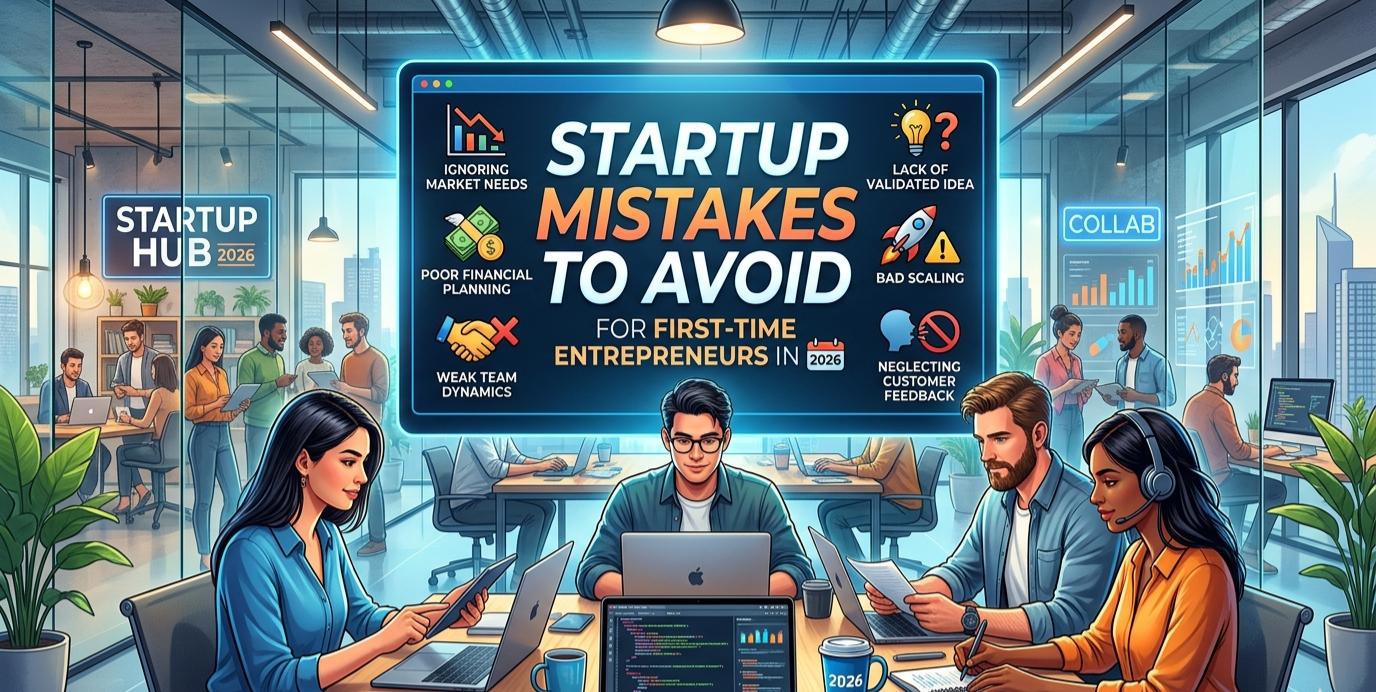
Starting a business is exciting, but it also comes with risks and challenges. Many first-time entrepreneurs enter the market with passion and big ideas, yet a large number of startups fail within the first few years.
The reason is not always lack of effort — it’s often due to avoidable mistakes. In 2026, where competition is intense and markets evolve rapidly, avoiding these mistakes can significantly increase your chances of success.
This article highlights the most common startup mistakes and how to avoid them.
Why Most Startups Fail?
Startups fail not because of bad ideas, but because of poor execution.
Common reasons include:
Lack of market demand
Poor financial management
Weak business strategy
Ineffective marketing
Team-related issues
Understanding these factors helps entrepreneurs prepare better.
Mistake 1: Starting Without Market Research
Many entrepreneurs fall in love with their idea without validating it.
Problems:
No real demand
Wrong target audience
Misaligned product-market fit
Solution:
Conduct surveys
Analyze competitors
Understand customer pain points
A validated idea has a higher chance of success.
Mistake 2: Poor Financial Planning
Running out of money is one of the biggest reasons startups fail.
Common issues:
Underestimating expenses
No budgeting
Poor cash flow management
Solution:
Create a financial plan
Track every expense
Maintain an emergency fund
Financial discipline is critical in the early stages.

Mistake 3: Lack of Clear Business Strategy
Without a strategy, businesses operate blindly.
Mistakes include:
No clear goals
Weak value proposition
Unclear revenue model
Solution:
Define your business model
Set measurable goals
Plan growth strategies
A clear roadmap ensures direction.
Mistake 4: Ignoring Marketing
Even great products fail without visibility.
Common problems:
No marketing plan
Inconsistent promotion
Ignoring digital channels
Solution:
Invest in digital marketing
Build online presence
Focus on branding and content
Marketing drives awareness and sales.
Even great products fail without visibility.
Common problems:
No marketing plan
Inconsistent promotion
Ignoring digital channels
Solution:
Invest in digital marketing
Build online presence
Focus on branding and content
Marketing drives awareness and sales.
Mistake 5: Hiring the Wrong People
A weak team can destroy a strong idea.
Mistakes:
Hiring too quickly
Ignoring cultural fit
Lack of skills
Solution:
Hire carefully
Focus on attitude and adaptability
Build a strong team culture
The right people drive growth.
Mistake 6: Trying to Do Everything Alone
Many founders try to control every aspect of the business.
Problems:
Burnout
Slow growth
Poor decision-making
Solution:
Delegate tasks
Build a support system
Focus on core activities
Smart delegation improves efficiency.
Mistake 7: Ignoring Customer Feedback
Customers are the backbone of any business.
Mistakes:
Not collecting feedback
Ignoring complaints
Not improving products
Solution:
Listen to customers
Act on feedback
Continuously improve
Customer-focused businesses succeed.
Mistake 8: Lack of Adaptability
Markets change quickly.
Mistakes:
Sticking to outdated strategies
Ignoring trends
Resisting innovation
Solution:
Stay flexible
Monitor industry trends
Adapt quickly
Adaptability is key in 2026.
Mistake 9: Scaling Too Fast
Growth is exciting, but rapid expansion without preparation can lead to failure.
Problems:
Operational chaos
Financial pressure
Reduced quality
Solution:
Scale gradually
Build systems first
Ensure stability before expansion
Controlled growth is sustainable.
Mistake 10: Ignoring Legal and Compliance Issues
Legal problems can damage your business.
Mistakes:
Not registering properly
Ignoring taxes
Weak contracts
Solution:
Follow legal requirements
Maintain documentation
Seek professional advice
Compliance protects your business.
Future of Startups in 2026
Startups that succeed will:
- Be customer-centric
- Use technology effectively
- Focus on sustainability
- Adapt quickly to changes
- Build strong teams
- Entrepreneurs who learn from mistakes grow faster.
Conclusion
Mistakes are part of the entrepreneurial journey, but avoidable mistakes can cost time, money, and opportunities. First-time entrepreneurs must focus on planning, execution, and continuous learning.
In 2026, success belongs to those who are prepared, adaptable, and willing to improve.
Learn fast. Adapt faster. Grow smarter.
Subscribe Now For More articles.
