
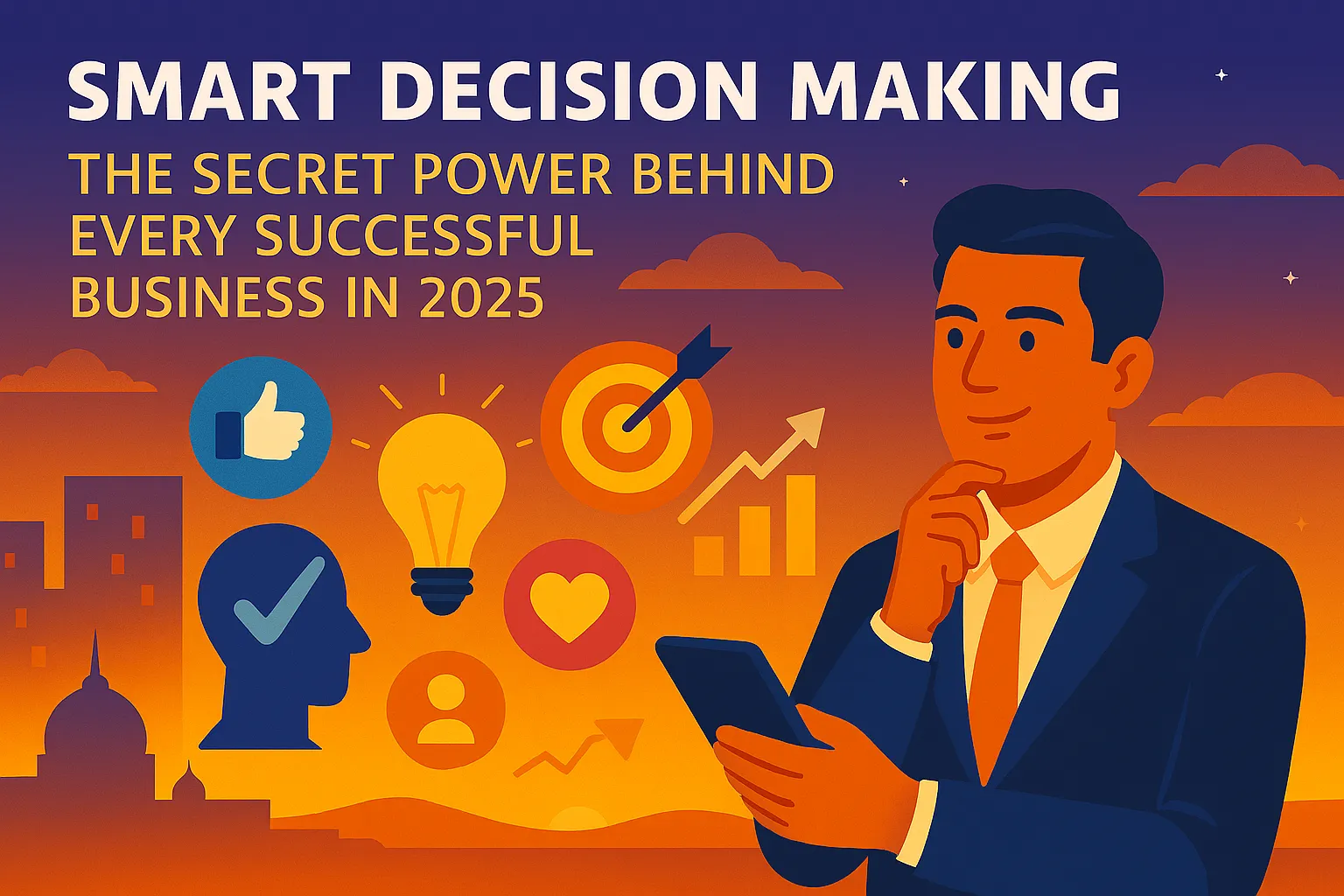
In the fast-changing world of business, leaders often talk about marketing, sales, strategy, innovation, and technology. But there is one element that silently decides whether a business will rise or fall — smart decision making. In 2025, where markets shift overnight and consumer behavior changes instantly, smart decision making has become the most powerful skill for entrepreneurs and corporate leaders.
Why Smart Decision Making Matters More Than Ever
The digital age has changed the speed of business. Decisions that earlier took days or weeks now need to be made in minutes. Competitors move fast. Trends change instantly. Customers switch brands quickly. A wrong decision can cost months of progress.
Smart decision making ensures that:
- You reduce risks
- You increase profit potential
- You identify opportunities early
- You avoid emotional decision traps
- You manage time and resources wisely
- You lead your team with clarity
Great decisions are not about luck — they are a combination of analysis, intuition, experience, and strategy.
- Data: The New Fuel for Business Decisions
Businesses that rely on assumptions fail. Businesses that rely on data scale.
Today, even small businesses have access to tools that provide insights about customers, markets, and trends. Platforms like Google Analytics, CRM dashboards, and social media metrics help business owners understand:
- Who their ideal customers are
- What customers search for
- Which products sell the most
- What marketing channels bring the highest ROI
- How users behave online
- By using data, leaders can:
- Launch better products
- Improve marketing strategies
- Allocate budgets correctly
- Predict customer needs
Data doesn’t replace intuition — it supports it.
- Emotion-Free Decision Making: The CEO Mindset
Many business failures happen because decisions are made emotionally. Fear, ego, overconfidence, or impatience can destroy months of hard work. The smartest leaders follow a simple rule:
“Facts first, feelings later.”
Examples of emotional mistakes:
- Hiring someone because they are a friend
- Keeping a failing product due to attachment
- Overspending on branding for prestige
- Rejecting new ideas due to ego
- Rushing decisions under pressure
A strong business decision is:
- Logical
- Evidence-based
- Long-term focused
- Aligned with goals
Good CEOs remove emotion and focus on the outcome.
- Scenario Planning: Think 3 Steps Ahead
Smart decision-makers never think of one outcome — they plan multiple outcomes.
This technique is called scenario planning, where leaders consider:
- Best-case scenario
- Worst-case scenario
- Most likely scenario
- For example, launching a new product includes:
- What if it sells extremely well?
- What if the market rejects it?
- What if sales are moderate?
This approach allows businesses to prepare backup strategies, reduce risk, and react faster when situations change.
- Decision Speed: Move Fast, But Not Blindly
Slow decision-makers lose opportunities. Fast decision-makers win markets. But the key is balance:
✔ Fast decisions when stakes are low
✔ Careful decisions when stakes are high
According to many business experts, 70% clarity is enough to take action. Waiting for 100% clarity means losing the opportunity to a faster competitor.
- Intuition: The Hidden Strength of Experienced Leaders
Not every decision can be data-driven. Sometimes markets change too fast. Sometimes new ideas have no past data. That’s where intuition helps.
Business intuition is not magic — it is the result of:
- Experience
- Observation
- Pattern recognition
- Customer understanding
Many legendary entrepreneurs have built their biggest successes on guts combined with analysis.
- Ask Better Questions to Make Better Decisions
Powerful decision-makers focus on the right questions rather than the quickest answers.
Questions that improve decisions:
- What problem am I trying to solve?
- What are the top three risks?
- How will this decision impact the next 12 months?
- Is this aligned with my business goals?
- What happens if I don’t take this decision?
Better questions lead to smarter decisions.
- Reduce Decision Fatigue: The Silent Business Killer
Making too many decisions every day can exhaust even the strongest leaders. This leads to poor judgment, stress, and burnout.
Ways to reduce decision fatigue:
- Automate repetitive decisions
- Delegate low-impact decisions to team members
- Use templates and frameworks
- Schedule important decisions during high-energy hours
A fresh mind makes better choices.
- Team-Based Decision Making: Use Collective Intelligence
Smart leaders don’t make every decision alone. They build teams that contribute ideas, opinions, and expert knowledge.
Benefits of collaborative decisions:
- More diverse viewpoints
- Higher creativity
- Lower chances of mistakes
- Stronger team alignment
- Faster execution
A leader’s job is not to have all answers — but to guide the decision-making process.
- Long-Term Thinking: See Beyond Today
Short-term decisions may bring quick results, but long-term decisions build legacy businesses. Long-term thinking includes:
- Building customer loyalty
- Investing in skill development
- Creating strong systems
- Expanding market reach
- Innovating consistently
Every great company is built on long-term decisions made early.
Conclusion: Smart Decision Making Build Smart Businesses
In 2025, business success is not just about working hard — it’s about choosing wisely. Decision-making is the backbone of every strategy, every plan, and every outcome. Entrepreneurs who master this skill enjoy:
✔ Faster growth
✔ Higher profits
✔ Stronger leadership
✔ Reduced stress
✔ Better problem-solving
Smart decision making is not a one-time skill — it is a habit. A daily practice. A business culture. And the true secret behind every successful business story.
Subscribe Now Us For More articles.

7 comments
Alright, alright, alright. 639jili’s got some sweet promotions goin’ on right now. Just snagged a bonus, feeling lucky! Give ’em a whirl: 639jili
X777gamelogin was pretty straightforward. Was able to get in quickly, and the interface is clean. Not too many frills, but that’s okay! Check out x777gamelogin and you might be surprised!
Checking out 777xpgamepk.com now. This site better have some goodies to offer, or it’s a hard pass. 777xpgamepk
The 666winapplogin is super convenient! I can play on my phone wherever I am. The login is smooth and the app is well-designed. Thumbs up from me! 666winapplogin
Getting into 92gologin is super easy and the games are decent. No complaints here! You can login via 92gologin.
291lodi is pretty cool. Easy to use and has a bunch of games to choose from. Definitely worth checking out if you’re trying your luck. Visit them at 291lodi
Yo, just stumbled on pito777slot.info and gotta say, the selection is kinda sweet. If you’re huntin’ for a new place to spin those reels, give pito777slot a looksie.