
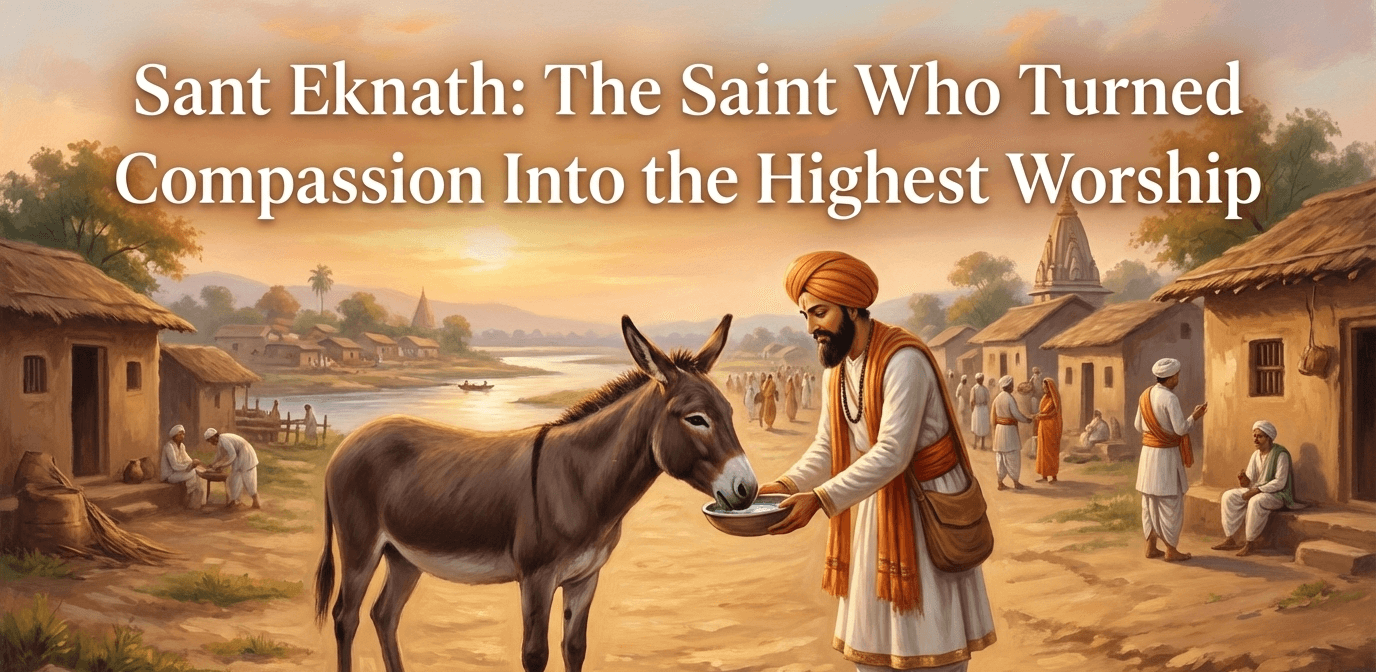
Sant Eknath is remembered as one of the greatest humanist saints of the Indian Bhakti movement. Where many saints taught devotion through words, Sant Eknath lived devotion through behavior, tolerance, and compassion. His life was a living lesson that true spirituality begins with humanity.
At a time when caste discrimination, ritual pride, and social cruelty were common, Sant Eknath stood firm with love, humility, and fearless truth. His story is deeply relevant even today, making it ideal for readers seeking spiritual inspiration with social meaning.
Birth and Family Background
Sant Eknath was born around 1533 CE in Paithan, Maharashtra, a sacred town on the banks of the Godavari River. He belonged to a learned Brahmin family deeply rooted in spiritual traditions.
However, Eknath lost his parents at a very young age. This early loss shaped his inner strength and compassion for suffering humanity.
From childhood, Eknath showed deep interest in devotion, service, and self-discipline. Instead of pride in knowledge, he showed humility — a rare quality even among scholars.
Guru Janardan Swami: The Spiritual Foundation
Sant Eknath became a disciple of Janardan Swami, a respected scholar, yogi, and devotee of Lord Dattatreya.
Under his guru’s guidance, Eknath mastered:
- Vedanta philosophy
- Yoga and discipline
- Devotion and surrender
- Service to society
His guru taught him a powerful truth:
“Knowledge without compassion is incomplete.”
This teaching became the core of Eknath’s life.
A Saint Who Lived Among People
Unlike saints who withdrew from society, Sant Eknath lived among ordinary people. He believed that spirituality must be practiced in daily life, not in isolation.
He performed household duties, served guests, helped the poor, and treated everyone equally — regardless of caste, status, or religion.
For him:
- Feeding the hungry was worship
- Serving the weak was prayer
- Tolerance was devotion
The Famous Story of Ultimate Tolerance
One of the most famous incidents of Sant Eknath’s life reflects his divine patience.
It is said that a man deliberately insulted and even spat on Sant Eknath repeatedly. Instead of anger, Eknath calmly went to the river to cleanse himself — again and again.
When asked why he tolerated such humiliation, Sant Eknath replied:
“If my anger hurts another soul, my devotion is incomplete.”
This incident turned hatred into repentance and became a timeless lesson on non-violence and compassion.
Breaking the Walls of Caste
Sant Eknath strongly opposed caste discrimination. He believed that God does not live in birth-based hierarchy.
He:
- Shared meals with people of all castes
- Allowed everyone to participate in spiritual gatherings
- Declared that devotion is superior to ritual purity
His actions were revolutionary in a rigid society.
Sant Eknath as a Literary Giant
Sant Eknath was not only a saint but also a brilliant writer who made spiritual knowledge accessible to common people.
Major contributions:
- Eknathi Bhagwat – a Marathi interpretation of the Bhagavata Purana
- Bhavartha Ramayana – a devotional retelling of Ramayana
- Abhangas and Bharuds (devotional songs)
Through simple Marathi language, he brought deep spiritual philosophy to the masses.
Humor and Wisdom: The Bharuds
Sant Eknath used humor, satire, and folk storytelling in his Bharuds to expose hypocrisy and ego.
Instead of harsh criticism, he used wit to make people reflect.
This made his teachings:
- Memorable
- Engaging
- Non-threatening
- Deeply effective
Sant Eknath and the Warkari Tradition
Sant Eknath was a pillar of the Warkari movement, devoted to Lord Vitthal of Pandharpur.
He strengthened the tradition started by:
- Sant Dnyaneshwar
- Sant Namdev
Later saints like Sant Tukaram were deeply influenced by Eknath’s life and teachings.
Teachings of Sant Eknath
Sant Eknath’s teachings remain timeless.
Core teachings:
- Compassion is the highest form of devotion
- Ego destroys spirituality
- Serve humanity to serve God
- Tolerance is spiritual strength
- Knowledge must walk with humility
- God lives in every being
He believed that a saint is one who reduces suffering around him.
Final Years and Samadhi
Sant Eknath spent his final years in Paithan, continuing his service and teaching until the end.
He left his physical body around 1599 CE, but his presence lives on through his writings, stories, and ideals.
His samadhi remains a sacred site for devotees.
Why Sant Eknath Is More Relevant Than Ever
In today’s world of anger, division, and intolerance, Sant Eknath’s message feels urgently necessary.
He teaches us:
- Respond with patience, not anger
- Choose humanity over pride
- Live spirituality, don’t display it
- Turn suffering into service
His life proves that kindness is the truest religion.
Conclusion
Sant Eknath was not a saint who escaped society — he healed it. His devotion was not loud, dramatic, or rigid; it was gentle, fearless, and deeply human.
His life shares a powerful message:
“If your devotion does not make you kind, it is incomplete.”
Sant Eknath remains a guiding light for anyone seeking spirituality with compassion.
Subscribe Now For More articles.
