
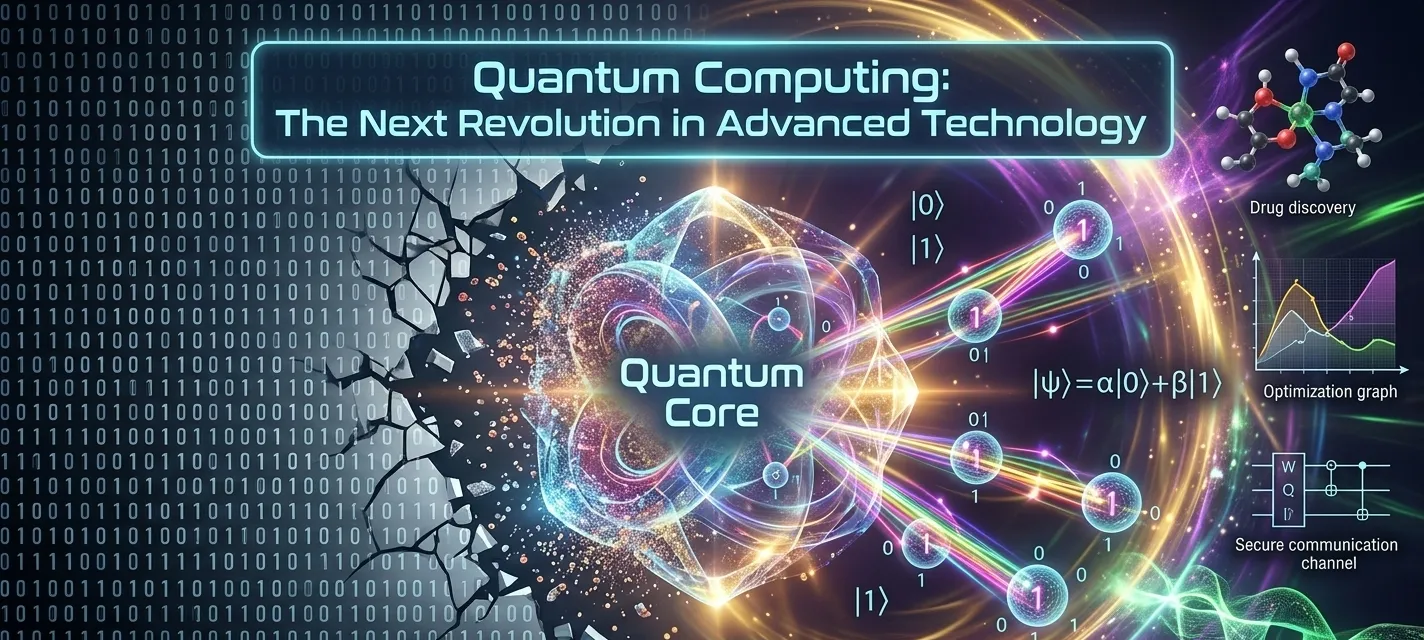
Quantum computing is emerging as one of the most powerful and transformative technologies of the future. While traditional computers have changed the world over the past decades, quantum computers promise to solve problems that are currently impossible for classical machines.
From drug discovery and climate modeling to cyber security and financial forecasting, quantum computing has the potential to revolutionize industries and scientific research. Although still in its early stages, this technology is progressing rapidly and attracting global attention.
What Is Quantum Computing?
Quantum computing is a type of computing that uses the principles of quantum mechanics — the science that explains how particles behave at atomic and subatomic levels.
Unlike traditional computers that use bits (0 or 1), quantum computers use qubits. A qubit can exist as 0, 1, or both simultaneously due to a property called superposition.
Key quantum concepts include:
- Superposition – A qubit can represent multiple states at once
- Entanglement – Qubits can be interconnected and influence each other instantly
- Quantum interference – Used to amplify correct solutions and reduce errors
These principles allow quantum computers to process massive amounts of information simultaneously.
How Quantum Computers Differ from Classical Computers
Traditional computers process information step by step. Even the fastest supercomputers have limits when solving extremely complex problems.
Quantum computers:
- Perform parallel computations
- Solve complex mathematical problems faster
- Analyze vast datasets more efficiently
- Break certain encryption systems
This makes quantum computing a game-changer for high-level problem solving.
Quantum Computing in Healthcare
One of the most promising applications of quantum computing is in medicine.
Healthcare benefits include:
- Faster drug discovery
- Simulation of molecular interactions
- Personalized medicine development
- Advanced disease modeling
Quantum systems can analyze biological data at unprecedented speed, potentially accelerating medical breakthroughs.
Climate Change and Environmental Research
Climate modeling requires enormous computing power.
Quantum advantages include:
- Accurate climate simulations
- Carbon capture optimization
- Energy-efficient material research
Quantum computing can help scientists develop better solutions for global environmental challenges.
Quantum Computing and Cyber Security
Quantum technology has a dual impact on cyber security.
Opportunities include:
- Quantum encryption for highly secure communication
- Advanced threat detection
Challenges include:
- The ability to break current encryption methods
This is why researchers are developing post-quantum cryptography to secure future data systems.
Quantum Computing in Finance
Financial institutions are exploring quantum computing for complex calculations.
Applications in finance include:
- Risk analysis
- Fraud detection
- Investment portfolio optimization
- Market trend prediction
Quantum algorithms can analyze massive datasets in seconds.
Space Exploration and Scientific Research
Quantum computing supports advanced simulations used in space missions and scientific experiments.
Key uses include:
- Material research for spacecraft
- Astrophysics simulations
- High-energy physics experiments
It enhances precision and reduces research time.
Industrial and Manufacturing Impact
Industries are exploring quantum solutions for efficiency and innovation.
Industrial applications include:
- Supply chain optimization
- Smart manufacturing
- Advanced robotics development
- Chemical engineering improvements
Quantum-powered insights can increase productivity and reduce costs.
Challenges in Quantum Computing
Despite its promise, quantum computing faces major obstacles:
- Extremely high development cost
- Need for ultra-cold operating temperatures
- Error-prone qubits
- Limited commercial availability
Scientists are continuously working to make quantum systems stable and scalable.
Global Investment in Quantum Technology
Countries and technology companies are heavily investing in quantum research to gain technological leadership.
Key focus areas include:
- Building stable quantum processors
- Developing quantum software
- Creating secure quantum networks
The global race for quantum supremacy is accelerating innovation.
Future of Quantum Computing
Quantum computing is expected to grow significantly in the coming decades.
Future trends include:
- Hybrid classical-quantum systems
- Commercial quantum cloud services
- Breakthroughs in materials science
- Integration with artificial intelligence
As hardware improves, real-world applications will expand.
Conclusion
Quantum computing represents the next frontier in digital transformation. While still in its developmental stage, its potential impact on healthcare, finance, climate research, cyber security, and space exploration is enormous.
This technology could solve problems beyond the reach of traditional computers. As research progresses, quantum computing will move from laboratories to real-world applications — shaping the future of innovation.
Subscribe Now For More articles.
