
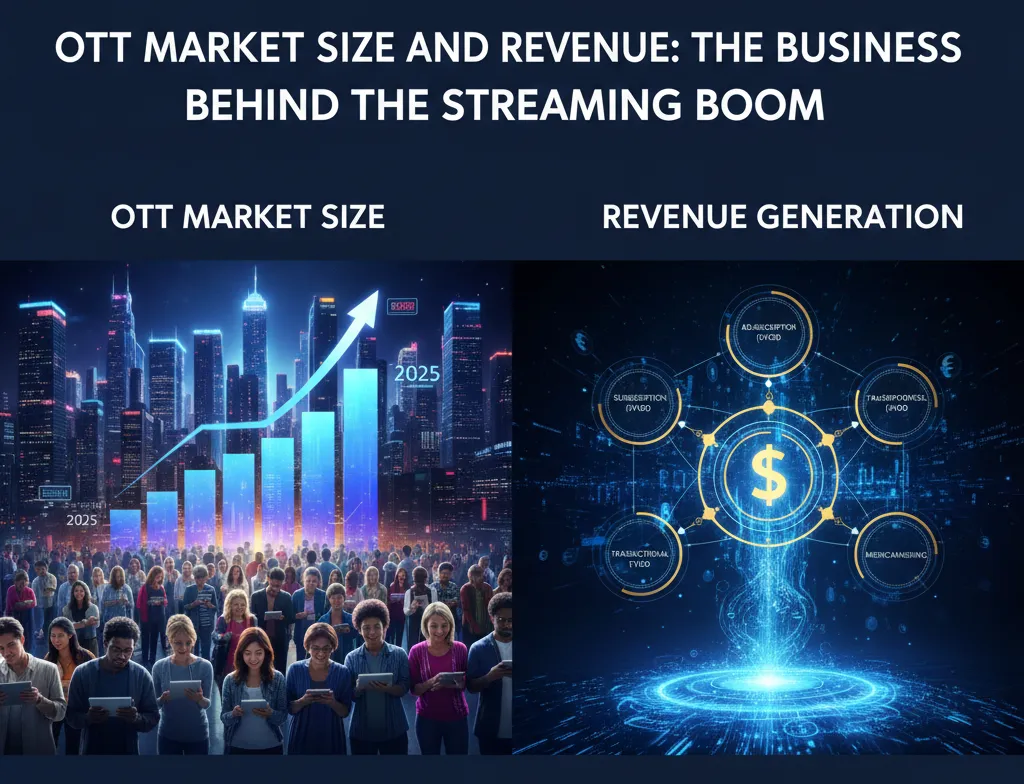
The entertainment industry is witnessing one of its biggest transformations in history, and at the center of this change is the OTT (Over-The-Top) streaming market. What started as a digital alternative to television has now become a multi-billion-dollar global business.
OTT platforms are no longer just content providers — they are powerful revenue engines shaping the future of media consumption.
This article explains the OTT market size, revenue growth, Indian and global trends, and why OTT is one of the fastest-growing industries in the world.
What Is the OTT Market?
The OTT market includes all platforms that deliver video and audio content directly via the internet, without relying on cable or satellite television.
OTT content includes:
- Movie and web-series streaming
- Live sports streaming
- Original digital content
- Ad-supported video platforms
Major OTT platforms:
Netflix, Amazon Prime Video, Disney+ Hotstar, JioCinema, Sony LIV, Zee5, Apple TV+, and several regional OTT platforms.
Global OTT Market Size: A Billion-Dollar Industry
The global OTT market has grown at an extraordinary pace over the last decade.
Key global market highlights:
- Global OTT market revenue exceeds $55 billion annually
- Industry projections suggest it may cross $180 billion by the end of the decade
- Average annual growth rate remains above 20%
North America currently leads in revenue, but the Asia-Pacific region — especially India — is emerging as the primary growth engine of the OTT industry.
OTT Market in India: One of the Fastest-Growing in the World
India has become a critical battleground for OTT platforms due to its massive population, affordable internet access, and multilingual content demand.
Current OTT market size in India:
- Valued at ₹17,000–₹18,000 crore
- Expected to double within five years
- Could become one of the top five OTT markets globally by the end of the decade
Why the Indian OTT market is growing rapidly:
- Low-cost mobile data
- Affordable smartphones
- Strong demand for regional language content
- Young, digital-first audience
- Growth of smart TVs and connected devices
OTT platforms now offer content in Hindi, Tamil, Telugu, Malayalam, Marathi, Gujarati, Bengali, and other regional languages, expanding reach beyond metro cities.
OTT Revenue Models Explained
OTT platforms generate revenue through multiple business models.
1. Subscription Revenue (SVOD)
Users pay monthly or yearly fees for premium content. This is the largest global revenue contributor.
2. Advertising Revenue (AVOD)
Free content supported by ads. This model is growing rapidly in price-sensitive markets like India.
3. Hybrid Revenue Models
A combination of subscriptions and advertisements to balance affordability and profitability.
4. Transactional Revenue
Users pay for individual movies, sports events, or premium releases.
In India, ad-supported OTT platforms are gaining strong traction, helping services reach mass audiences.
OTT User Growth and Market Expansion
OTT viewership continues to expand across multiple devices:
- Smartphones
- Smart TVs
- Tablets
- Laptops
Connected TV usage has grown sharply, signaling a shift from mobile-only viewing to large-screen home entertainment. This shift has increased advertising value and premium subscription demand.
OTT platforms now compete not only with television but also with cinema, social media, and gaming platforms.
OTT vs Traditional Media: Revenue Shift
OTT has disrupted traditional media revenue models.
Key differences:
- Revenue Growth: High (OTT) vs Slow (Traditional TV)
- Viewer Control: Full vs Limited
- Advertising Targeting: Advanced vs Broad
- Content Variety: Unlimited vs Fixed
Brands are increasingly shifting advertising budgets from television to OTT platforms due to better targeting and higher engagement.
Key Factors Driving OTT Revenue Growth
Digital Lifestyle Shift
Audiences prefer on-demand content over fixed broadcast schedules.
Regional Content Explosion
Local and regional stories are driving subscriptions and long-term engagement.
Sports Streaming
Live sports rights have become major revenue generators for OTT platforms.
Data-Driven Content Strategy
OTT platforms use viewer data to create content with guaranteed audience interest.
Global Reach
A single OTT release can reach audiences across continents instantly.
Challenges in the OTT Business
Despite rapid growth, OTT platforms face several challenges:
- Rising content production costs
- Intense competition
- Subscriber fatigue
- Pressure to maintain profitability
Sustainable growth depends on content quality, smart pricing strategies, and strong brand loyalty.
Future of the OTT Market and Revenue
The future of the OTT industry looks strong and stable.
Key future trends:
- Increased focus on regional and local storytelling
- Growth of ad-supported OTT platforms
- Integration of AI and personalized recommendations
- Expansion into live events and interactive content
OTT is no longer an experiment — it has become a core pillar of the global entertainment economy.
Conclusion
The OTT market size and revenue growth clearly show that streaming platforms are redefining entertainment economics. With billions of viewers worldwide and rapidly increasing revenue, OTT has become one of the most powerful industries of the digital age.
India stands at the center of this transformation, offering unmatched growth potential. As technology advances and viewing habits evolve, OTT platforms will continue to dominate the future of entertainment.
Subscribe Now For More articles.

3 comments
Heard about 92supergame from a friend and decided to check it out. Pretty decent! Lots of games to choose from, and the site is easy to navigate. Check it out: 92supergame
Acespuer is a new one for me, but I’m digging it so far. Smooth gameplay and some cool graphics. Check it out if you’re bored: acespuer
Been trying to get my gcash arionplay login to work and finally got it! Smooth sailing now. If you’re having trouble, just double check your info. Here’s the link: gcash arionplay login