
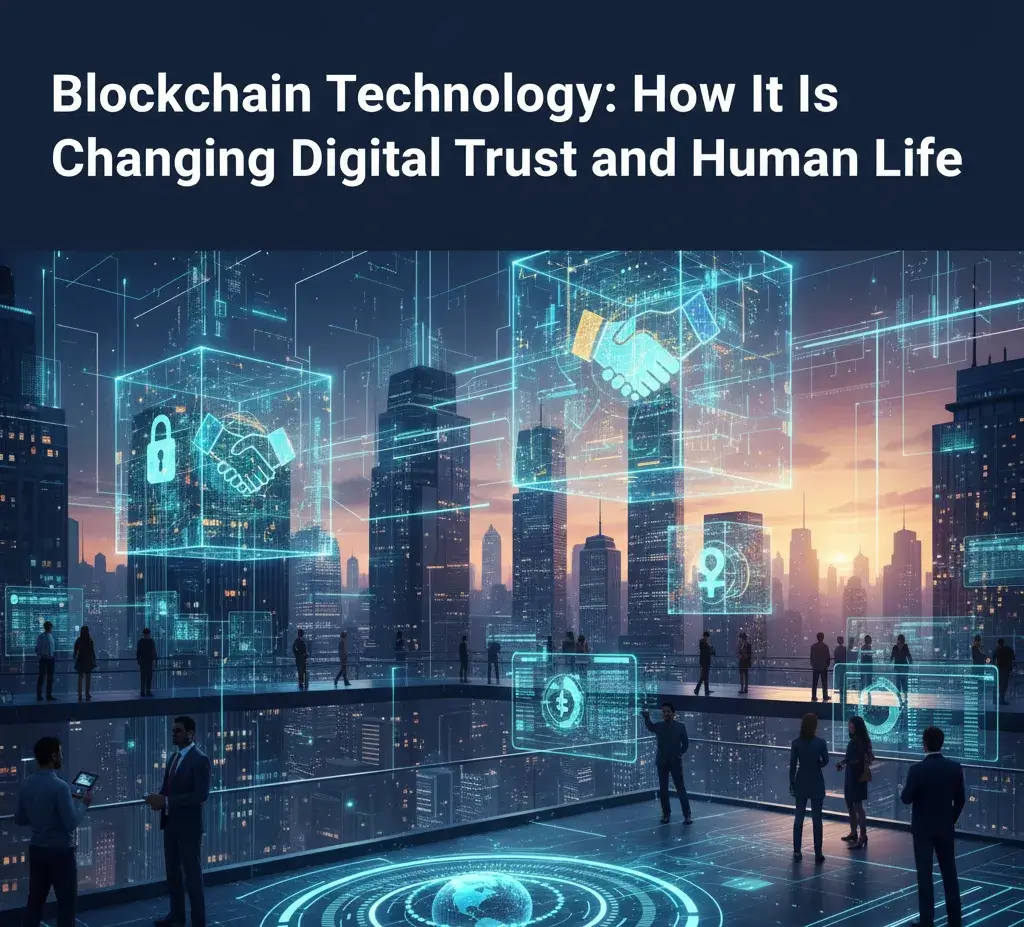
Blockchain technology is no longer limited to cryptocurrencies. It has evolved into one of the most powerful digital innovations of modern times, transforming how data is stored, shared, and secured.
From finance and healthcare to governance and supply chains, blockchain is creating a new era of transparency, trust, and decentralization.
In 2025 and beyond, blockchain technology is playing a critical role in making digital systems more secure, efficient, and human-centric.
What Is Blockchain Technology?
Blockchain is a decentralized digital ledger that records transactions across multiple computers in a secure and transparent way. Instead of storing data on a single server, blockchain distributes information across a network, making it extremely difficult to alter or hack.
Key Characteristics of Blockchain
- Decentralized structure with no single authority
- Transparent and publicly verifiable records
- Highly secure and tamper-resistant design
- Immutable data that cannot be changed
This structure builds digital trust without relying on intermediaries.
1. Blockchain in Digital Payments and Finance
Blockchain has transformed the financial world by enabling faster, safer, and borderless transactions.
How It Helps
- Instant international payments
- Lower transaction fees
- Reduced dependency on banks and intermediaries
- Transparent transaction records
Cryptocurrencies, digital wallets, and decentralized finance (DeFi) platforms are making financial systems more inclusive and accessible.
2. Blockchain in Healthcare: Secure Medical Records
Healthcare systems handle highly sensitive data, and blockchain offers a powerful solution.
Benefits in Healthcare
- Secure and encrypted patient records
- Easy data sharing between hospitals
- Protection against data tampering
- Improved transparency in clinical trials
Patients gain greater control over their medical data, while doctors receive accurate and reliable information.
3. Blockchain in Supply Chain Management
Supply chains are becoming smarter and more transparent with blockchain technology.
Real-World Impact
- Tracking product origin and authenticity
- Preventing counterfeit goods
- Improving inventory management
- Increasing trust between suppliers and customers
From food safety to luxury goods, blockchain ensures transparency from production to delivery.
4. Blockchain in Governance and Voting
Governments around the world are exploring blockchain to improve transparency and reduce corruption.
Key Applications
- Secure digital voting systems
- Transparent public records
- Land registration and ownership tracking
- Digital identity verification
Blockchain-based governance helps build trust between citizens and authorities.
5. Blockchain in Education and Certification
Educational institutions are adopting blockchain to verify academic credentials.
Why It Matters
- Tamper-proof certificates
- Easy verification for employers
- Secure academic records
- Global recognition of skills
This reduces fake degrees and strengthens trust in education systems.
6. Smart Contracts: Automated Trust
Smart contracts are self-executing programs built on blockchain technology.
How They Work
- Automatically execute when conditions are met
- Eliminate middlemen
- Reduce fraud and processing delays
- Ensure transparency and accuracy
Smart contracts are widely used in real estate, insurance, finance, and legal services.
7. Blockchain for Cybersecurity and Data Protection
With rising cyber threats, blockchain provides enhanced digital security.
Security Advantages
- No central point of failure
- Encrypted and distributed data storage
- Protection against unauthorized access
- Strong identity management
Blockchain makes hacking extremely difficult and improves overall digital safety.
8. Blockchain and Web3: The Future Internet
Blockchain is the foundation of Web3, a decentralized version of the internet.
Web3 Benefits
- User-controlled data ownership
- Decentralized applications (dApps)
- Reduced dependency on centralized platforms
- Greater privacy and digital freedom
Web3 aims to give power back to users instead of large centralized corporations.
9. Blockchain in Business and Enterprises
Businesses are adopting blockchain to improve efficiency and accountability.
Business Use Cases
- Secure transactions
- Transparent accounting systems
- Fraud prevention
- Digital identity management
Blockchain reduces paperwork, speeds up operations, and strengthens trust in business processes.
10. How Blockchain Makes Human Life Easier
Blockchain improves everyday life by:
- Building trust without intermediaries
- Enhancing transparency and accountability
- Strengthening digital security
- Saving time and operational costs
- Empowering users with data ownership
- Enabling global access to services
Blockchain is not just a technology — it is a system that promotes fairness and trust.
Future of Blockchain Technology
The future of blockchain looks promising with developments such as:
- Integration with artificial intelligence and IoT
- Growth of decentralized finance (DeFi)
- Expansion of digital identity solutions
- Blockchain-based smart cities
- Increased government adoption
As scalability and energy efficiency improve, blockchain will become even more mainstream.
Conclusion
Blockchain technology is redefining how the digital world operates. By offering security, transparency, and decentralization, it solves many of the biggest challenges of modern digital systems.
From finance and healthcare to governance and education, blockchain is empowering individuals and organizations alike. As adoption continues to grow, blockchain will play a vital role in creating a more secure, transparent, and trustworthy digital future.
Subscribe Now Us For More articles.

37 comments
I like it whenever people get together and share thoughts. Great website, continue the good work!
I am sure this article has touched all the internet viewers, its really really pleasant piece of writing on building up new webpage.
I enjoy what you guys are up too. This type of clever work and exposure! Keep up the superb works guys I’ve incorporated you guys to my blogroll.
I will immediately snatch your rss as I can not find your e-mail subscription hyperlink or e-newsletter service. Do you have any? Kindly let me realize so that I could subscribe. Thanks.
I will right away seize your rss feed as I can not in finding your e-mail subscription hyperlink or newsletter service. Do you’ve any? Kindly let me recognize in order that I may just subscribe. Thanks.
I found the information layout very user‑friendly, which made exploring the product surprisingly comfortable. The overview of cialis 20mg side effects was presented in a calm, neutral tone that helped me feel well‑oriented. Everything came together nicely and left me satisfied with the clarity and transparency.
There’s definately a lot to learn about this subject. I really like all the points you have made.
There’s certainly a lot to find out about this topic. I really like all the points you made.
Good day! Do you know if they make any plugins to protect against hackers? I’m kinda paranoid about losing everything I’ve worked hard on. Any recommendations?
It’s very simple to find out any topic on web as compared to textbooks, as I found this piece of writing at this site.
If you are going for best contents like myself, only pay a quick visit this site all the time because it gives feature contents, thanks
I’ll right away seize your rss as I can’t to find your e-mail subscription link or newsletter service. Do you’ve any? Please permit me realize in order that I may just subscribe. Thanks.
It’s very easy to find out any matter on net as compared to textbooks, as I found this piece of writing at this website.
Ahaa, its nice discussion regarding this article here at this webpage, I have read all that, so now me also commenting here.
It’s very trouble-free to find out any matter on web as compared to textbooks, as I found this post at this site.
This is a topic that is near to my heart… Many thanks! Where are your contact details though?
Howdy! I just want to give you a big thumbs up for the great information you have got right here on this post. I am coming back to your website for more soon.
I every time spent my half an hour to read this web site’s content daily along with a mug of coffee.
There is definately a lot to know about this subject. I love all the points you’ve made.
I am sure this post has touched all the internet people, its really really pleasant piece of writing on building up new blog.
I will immediately take hold of your rss as I can’t in finding your email subscription link or e-newsletter service. Do you’ve any? Kindly permit me understand in order that I could subscribe. Thanks.
I am sure this paragraph has touched all the internet users, its really really good article on building up new website.
I am sure this article has touched all the internet users, its really really nice paragraph on building up new weblog.
I am sure this piece of writing has touched all the internet visitors, its really really fastidious article on building up new webpage.
I will immediately clutch your rss feed as I can’t to find your email subscription hyperlink or newsletter service. Do you have any? Please permit me realize so that I may subscribe. Thanks.
Thank you for the good writeup. It in fact was a amusement account it. Look advanced to far added agreeable from you! However, how could we communicate?
This piece of writing will assist the internet visitors for creating new webpage or even a weblog from start to end.
This is my first time visit at here and i am really pleassant to read all at alone place.
I am sure this article has touched all the internet visitors, its really really good piece of writing on building up new blog.
I am sure this paragraph has touched all the internet users, its really really good post on building up new blog.
Its great as your other articles :D, appreciate it for putting up.
Hola! I’ve been reading your weblog for some time now and finally got the bravery to go ahead and give you a shout out from Huffman Tx! Just wanted to mention keep up the fantastic job!
Ahaa, its good conversation concerning this post here at this web site, I have read all that, so at this time me also commenting here.
I am sure this piece of writing has touched all the internet visitors, its really really fastidious post on building up new blog.
Good way of telling, and pleasant piece of writing to obtain facts on the topic of my presentation subject, which i am going to present in institution of higher education.
I wanted to thank you for this very good read!! I absolutely loved every little bit of it. I’ve got you bookmarked to look at new things you
Way cool! Some extremely valid points! I appreciate you writing this write-up and the rest of the site is extremely good.