
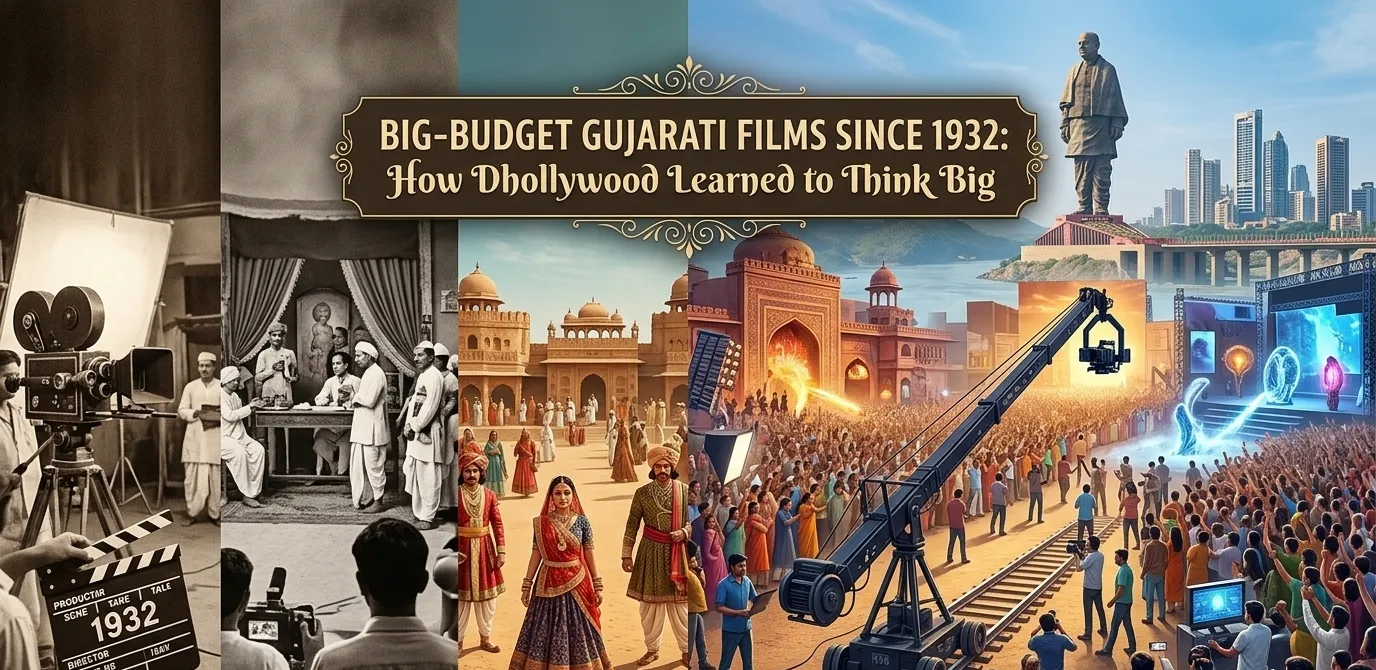
Gujarati cinema has come a long way since its early days in the 1930s. From modestly funded devotional dramas to today’s technically polished theatrical releases, the industry—often called Dhollywood—has gradually expanded its production budgets and ambitions. While Gujarati films traditionally operated with smaller investments compared to Bollywood or South Indian industries, several landmark projects over the decades pushed financial boundaries and reshaped audience expectations.
This article explores the evolution of big-budget Gujarati films from 1932 to 2026, highlighting how each era contributed to the industry’s growth.
The Beginning: Early Gujarati Cinema (1930s–1950s)
The first Gujarati talkie, Narsinh Mehta, directed by Nanubhai Vakil, marked the birth of the Gujarati film industry. During this period, budgets were extremely limited because the industry relied heavily on stage artists, basic sets, and simple production techniques.
Most films were made with very modest investments, but they succeeded in building a cultural foundation. Stories centered on mythology, saints, and folklore, appealing strongly to Gujarati audiences.
Despite limited resources, films such as Gunsundari gained popularity and demonstrated that Gujarati stories could attract strong box office response.
The early era proved one important lesson: content and cultural connection mattered more than large budgets.
The Growth Phase: 1960s–1970s
The Gujarati film industry began to grow during the 1960s and 1970s. Improved film technology, better studio facilities, and the influence of theatre artists helped increase production values.
A landmark film of this period was Jesal Toral starring Upendra Trivedi. The film became a massive commercial success and demonstrated the potential of investing more in costumes, music, and storytelling.
Another influential project was Kanku, which received international recognition and was even submitted for the Academy Awards.
Although budgets were still small compared with Hindi cinema, producers slowly started increasing spending to improve sets, songs, and cinematography.
The Commercial Boom: 1980s
The 1980s were a turning point when Gujarati films began experimenting with bigger commercial productions. The biggest star of this period was Naresh Kanodia, whose films attracted massive rural audiences. Many films featuring him had higher budgets than earlier productions due to elaborate folk music sequences and action-driven storytelling.
One of the most talked-about films of this era was Meru Malan. Its grand presentation and music made it one of the notable big-budget Gujarati films of the decade.
These films proved that Gujarati audiences were ready for larger-than-life entertainment rooted in local culture.
Decline and Struggle: 1990s–Early 2000s
The 1990s brought a challenging period for Gujarati cinema. Television expansion and the dominance of Bollywood significantly reduced theatre audiences for regional films.
As a result, most films during this era were made on very low budgets. Producers avoided high investments because of uncertain box office returns.
However, this phase also encouraged filmmakers to experiment with new storytelling methods and prepare for a future revival.
The Revival Era: 2015 Onwards
Gujarati cinema witnessed a remarkable revival after 2015. Improved writing, multiplex releases, and NRI audiences helped the industry regain momentum.
One of the films that symbolized this revival was Chhello Divas. The youth-centric comedy became a major hit and proved that Gujarati films could attract urban audiences. Soon after, films began to receive larger budgets for production quality and marketing.
The New Generation of Big-Budget Gujarati Films
Love Ni Bhavai
This romantic drama raised the bar with stylish cinematography and modern storytelling.
Hellaro
A landmark film that won the National Film Award for Best Feature Film. The movie featured large dance sequences and strong production design.
Chaal Jeevi Laiye
One of the highest-grossing Gujarati films ever. Its international shooting locations and emotional storyline reflected increased budgets and ambition.
Vash
A psychological thriller that showcased modern filmmaking techniques and became a major success, later inspiring the Hindi remake Shaitaan.
These films demonstrate how Gujarati producers are now willing to invest more in visual quality, storytelling, and marketing.
What Defines a “Big Budget” in Gujarati Cinema?
Unlike Bollywood, where budgets can reach hundreds of crores, Gujarati cinema typically operates with smaller but steadily increasing investments.
Historically, budgets have grown across eras:
- Early era films: very low budgets
- 1970s–80s big productions: moderate budgets
- Modern revival films: significantly higher investments
Today, a big Gujarati film may include:
- High-quality cinematography
- International shooting locations
- Advanced sound design
- Extensive digital marketing campaigns
This shift shows how the industry is evolving to meet modern audience expectations.
The Role of Technology and Multiplex Culture
The rise of multiplex theatres across Gujarat and major Indian cities played a crucial role in encouraging higher-budget films. Multiplex audiences prefer:
- Better visual quality
- Urban storytelling
- Contemporary music
- Professional production values
As a result, producers started investing more in filmmaking to compete with Hindi and South Indian films.
Future of Big-Budget Gujarati Cinema
The future looks promising for Gujarati cinema. With OTT platforms expanding the reach of regional films, producers now have additional revenue streams beyond theatrical releases. New filmmakers are also experimenting with genres like:
- Thrillers
- Biographical dramas
- Historical stories
- Social issue films
This creative expansion will likely encourage even larger budgets in the coming years.
Conclusion
From the humble beginnings of Narsinh Mehta to modern successes like Vash, Gujarati cinema has steadily evolved in scale and ambition. While the industry may not yet match the massive budgets of Bollywood or South Indian cinema, it has developed its own identity — focused on strong storytelling, cultural roots, and steadily improving production values.
The journey of big-budget Gujarati films reflects the resilience of the industry and its determination to grow. As technology, storytelling, and global reach continue to expand, the coming decades could see Gujarati cinema achieving even greater milestones.
Subscribe Now For More articles.
