
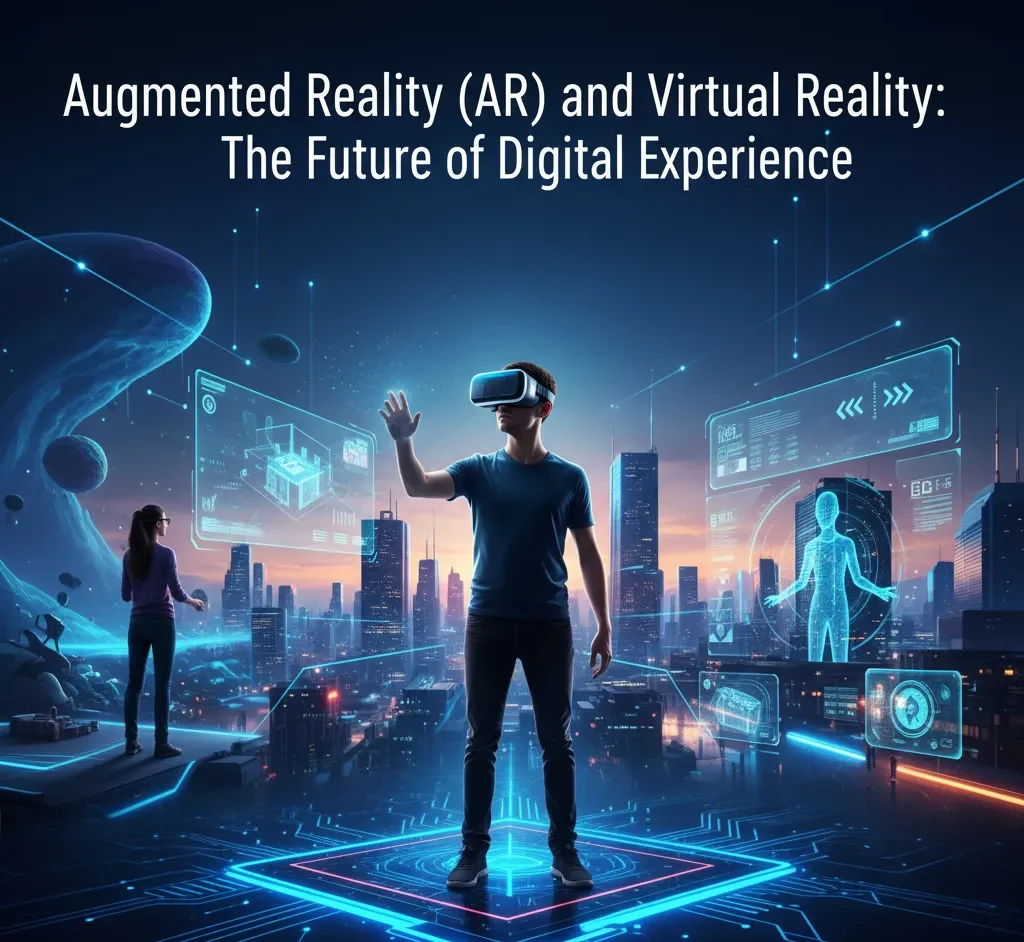
Technology is evolving faster than ever, and two of the most exciting innovations shaping the future are Augmented Reality (AR) and Virtual Reality (VR). These immersive technologies are changing how people learn, work, shop, play, and interact with the digital world.
From gaming and healthcare to education and real estate, AR and VR are creating experiences that were once only possible in science fiction. Today, they are becoming an essential part of modern digital life.
What Is Augmented Reality (AR)?
Augmented Reality (AR) enhances the real world by adding digital elements such as images, animations, sounds, or information on top of what we see in real life.
Common examples of AR include:
- Instagram and Snapchat filters
- Google Lens
- Pokémon GO
- Virtual try-on apps for clothes and glasses
- AR navigation on smartphones
AR does not replace reality. It enhances the real world by blending digital content with the physical environment.
What Is Virtual Reality (VR)?
Virtual Reality (VR) creates a completely immersive digital environment where users interact using VR headsets and controllers.
Examples of VR include:
- VR gaming experiences
- Virtual classrooms
- Medical training simulations
- Virtual tourism
- Real estate walkthroughs
Unlike AR, VR places users inside a fully digital world, separating them from the physical environment.
Difference Between AR and VR
Augmented Reality (AR)
- Combines real world with digital elements
- Works on smartphones and AR glasses
- Enhances surroundings instead of replacing them
- Used for shopping, filters, navigation, and learning
Virtual Reality (VR)
- Fully virtual environment
- Requires VR headsets
- Completely immersive experience
- Used for gaming, training, simulations, and virtual tours
Both technologies serve different purposes but work together to create powerful immersive experiences.
AR and VR in Gaming and Entertainment
Gaming is one of the biggest industries transformed by AR and VR.
AR and VR improve gaming by offering:
- Real-life interaction with digital objects
- 360-degree immersive environments
- Motion-based gameplay
- Enhanced realism
Games like Pokémon GO, Beat Saber, and VR racing games demonstrate how entertainment has evolved beyond traditional screens.
AR and VR in Healthcare
Healthcare is one of the biggest beneficiaries of immersive technology.
Key healthcare applications include:
- VR-based surgery training
- AR-assisted medical procedures
- Mental health therapy using VR
- Pain management through immersive environments
- Patient education and diagnosis
Doctors can practice complex procedures without risk, and patients benefit from advanced visualization and treatment methods.
AR and VR in Education
Education is becoming more interactive and engaging through AR and VR.
Benefits in learning include:
- Virtual classrooms
- 3D visualization of complex concepts
- Interactive science experiments
- Historical tours in VR
- Skill-based professional training
Students understand concepts faster because learning becomes visual, practical, and experiential.
AR and VR in Shopping and E-Commerce
Online shopping has transformed with AR and VR technology.
Smart shopping features include:
- Virtual try-on for clothes, glasses, and makeup
- 3D product previews
- Virtual showrooms
- Real-time product customization
Customers can see how products look before buying, reducing returns and increasing satisfaction.
AR and VR in Business and Industry
Businesses are adopting AR and VR to improve productivity and efficiency.
Business applications include:
- Employee training simulations
- Virtual meetings and remote offices
- Product design and prototyping
- Industrial safety training
Companies save time and costs while improving performance, collaboration, and safety.
AR and VR in Real Estate and Architecture
Property buying and planning have become smarter with immersive technology.
Key benefits include:
- Virtual house walkthroughs
- Interior design visualization
- Architectural planning
- Remote property inspection
Buyers can explore properties from anywhere without physically visiting them.
AR and VR in the Automotive Industry
Automotive companies use AR and VR for:
- Vehicle design and testing
- Virtual car showrooms
- Driver training simulations
- Head-up displays (HUDs)
This improves safety, efficiency, and customer experience.
AR, VR, and the Metaverse
AR and VR are the foundation of the Metaverse, a digital universe where people interact using avatars.
Metaverse applications include:
- Virtual offices
- Digital events and concerts
- Online education
- Virtual shopping malls
- Social networking
The metaverse is expected to redefine how humans connect and collaborate digitally.
Advantages of AR and VR
AR and VR offer many powerful benefits:
- Enhanced learning experiences
- Better user engagement
- Increased productivity
- Cost-effective training
- Improved decision-making
- High entertainment value
- Real-time visualization
These technologies bridge the gap between imagination and reality.
Challenges of AR and VR
Despite their advantages, AR and VR face some challenges:
- High device costs
- Motion sickness in VR
- Limited content availability
- High hardware requirements
- Privacy and data concerns
Rapid innovation and technological advancement are addressing these challenges steadily.
Future of AR and VR
The future of AR and VR is extremely promising.
Upcoming trends include:
- Lightweight AR glasses
- AI-powered virtual environments
- Integration with 5G technology
- Expansion of the metaverse
- Use in education, healthcare, and smart cities
Experts predict AR and VR will become as common as smartphones within the next decade.
Conclusion
Augmented Reality and Virtual Reality are reshaping the digital world by making experiences more immersive, interactive, and engaging. From education and healthcare to gaming and business, these technologies are transforming how humans learn, work, and interact.
As AR and VR continue to evolve, they will play a critical role in building a smarter, more connected, and digitally advanced future.
Subscribe Now For More articles.
