
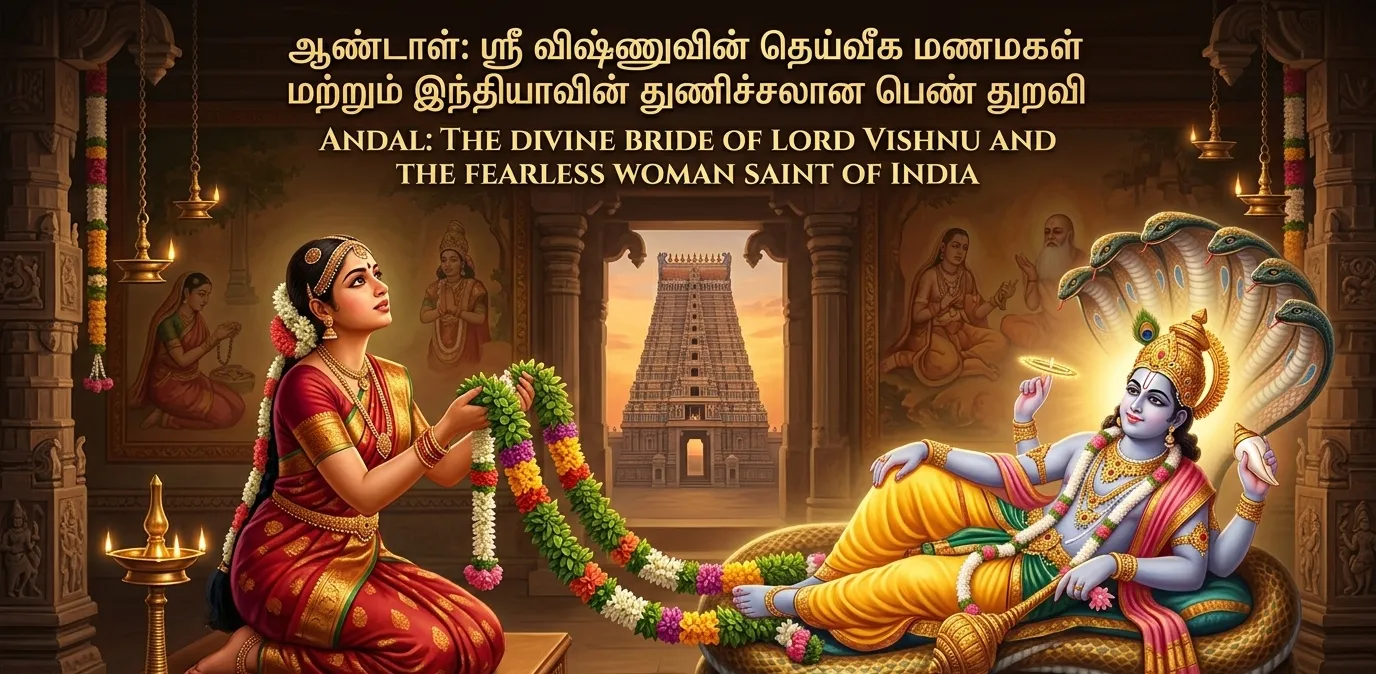
Among India’s great women saints, one name shines with unmatched devotion and poetic brilliance — Andal. She was not just a saint but a symbol of pure love, surrender, and spiritual courage.
Born in Tamil Nadu over a thousand years ago, Andal’s life story is one of divine romance, unshakable faith, and poetic devotion toward Lord Vishnu. Even today, millions recite her hymns during the holy month of Margazhi. Her message continues to inspire women and devotees across India.
The Miraculous Birth of Andal
Andal was found as a baby under a sacred Tulsi plant in the temple garden of Periyalvar, a devoted saint of Srivilliputhur.
Periyalvar considered her a divine blessing and raised her with love and devotion. He named her Kodhai, but the world would later know her as Andal.
From childhood, she was deeply attached to Lord Vishnu and would spend hours listening to devotional stories.
The Garland Story: A Bold Act of Love
One day, young Andal did something extraordinary.
Her father used to make flower garlands daily for Lord Vishnu’s idol. Before the garland was offered to the deity, Andal secretly wore it first to see how she looked as the bride of God.
When Periyalvar discovered this, he was upset. According to tradition, only untouched garlands should be offered to God.
But that night, Lord Vishnu appeared in his dream and expressed that he preferred the garland worn by Andal.
From that day, Andal became known as the beloved bride of Vishnu. This story symbolizes that true devotion is greater than ritual purity.
Andal’s Divine Love for Lord Ranganatha
Andal’s devotion was not ordinary worship — it was bridal mysticism. She considered herself the eternal bride of Lord Ranganatha, the presiding deity of Srirangam.
She expressed her longing and surrender through powerful devotional poetry.
Tiruppavai: A Timeless Spiritual Treasure
Andal composed 30 devotional hymns known as Tiruppavai.
These verses:
- Emphasize surrender to God
- Encourage collective prayer
- Promote spiritual discipline
- Celebrate divine love
During the month of Margazhi, devotees across South India chant Tiruppavai daily. Her poetry is simple yet deeply philosophical.
A Woman Saint Ahead of Her Time
In a society where women’s voices were limited, Andal boldly expressed:
- Her desire to marry God
- Her spiritual independence
- Her deep personal connection with the divine
She became the only female Alvar saint among the twelve Alvars of the Bhakti movement. Her life proves that spiritual power has no gender.
The Divine Union
As Andal grew older, she declared that she would marry no mortal man — only Lord Ranganatha.
According to tradition, she was taken to Srirangam Temple for her divine wedding. It is believed that she merged into the idol of Lord Ranganatha, achieving eternal union. This mystical ending symbolizes the soul merging with the Supreme.
Teachings of Andal
Her life teaches powerful spiritual lessons:
- Pure devotion transcends rules
- Love for God is the highest form of bhakti
- Women can lead spiritual movements
- Surrender brings divine grace
- Faith transforms destiny
Andal’s Relevance in Modern Times
Today, Andal is:
- A symbol of women empowerment in spirituality
- A cultural icon in Tamil Nadu
- An inspiration for poets and devotees
- A reminder that devotion is personal and fearless
Her temple in Srivilliputhur remains one of the most visited pilgrimage sites in South India.
Conclusion
Andal’s story is not just about devotion — it is about courage, identity, and divine love. She showed the world that faith can be bold, poetic, and transformative.
Her hymns still echo in temples, her story still inspires women, and her love for Lord Vishnu remains eternal. Andal is not just remembered — she is celebrated as the divine bride of God.
Subscribe Now For More articles.
