
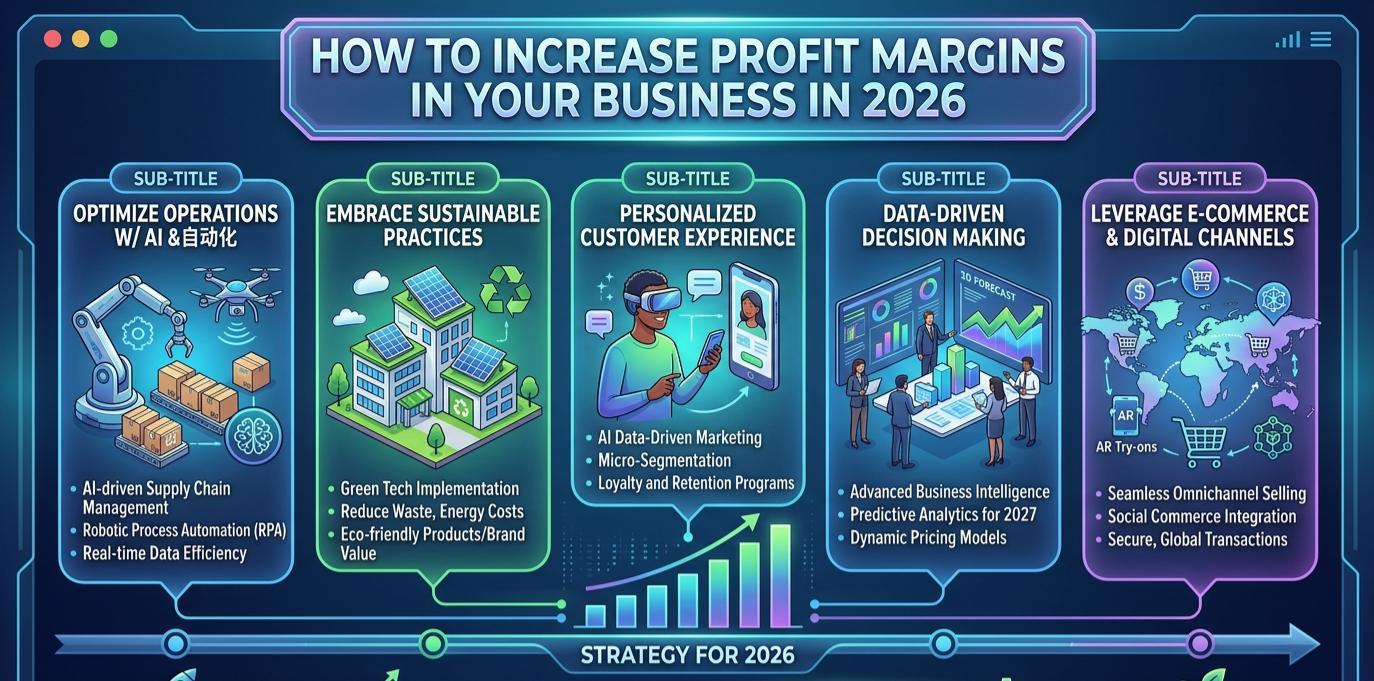
Revenue growth is important, but profit is what truly determines the long-term success of a business. Many businesses generate high sales but still struggle financially because their profit margins are too low. In 2026, increasing profit margins is becoming one of the top priorities for entrepreneurs due to rising competition, operational costs, and changing market conditions. This guide explains practical and effective strategies businesses can use to improve profitability without sacrificing quality or customer satisfaction.
What Are Profit Margins and Why Do They Matter?
A profit margin is the percentage of revenue left after covering all expenses, calculated simply as profit divided by revenue, multiplied by 100. Higher profit margins mean better financial health, greater business stability, more growth opportunities, and stronger resistance to market challenges. In 2026, modern businesses face rising operational expenses, increasing competition, higher customer expectations, and rapid market changes. Strong margins provide the flexibility and security needed to survive economic uncertainty, reinvest in growth, increase cash flow, and build long-term sustainability. Profitability is not just a financial metric — it is the foundation of everything a business can do next.
Strategy 1: Analyse Your Costs Carefully
The first step to improving profit margins is developing a thorough understanding of where money is being spent. This means reviewing fixed costs, variable costs, marketing expenses, and operational inefficiencies with honest scrutiny. Many businesses carry unnecessary expenses that have accumulated over time without being questioned. Identifying and eliminating this wasteful spending — even in small amounts — can have a meaningful cumulative impact on profitability. A rigorous cost audit conducted regularly is one of the simplest and most powerful tools available to any business owner.
Strategy 2: Improve Your Pricing Strategy
Many businesses significantly underprice their products or services, leaving substantial profit on the table without realising it. Transitioning to value-based pricing — where price reflects the genuine value delivered to the customer rather than simply the cost of production — can dramatically improve margins. Premium pricing works well for unique or differentiated offerings where trust, quality, and experience justify a higher price point. Dynamic pricing models, which adjust prices based on demand, timing, or customer segment, are also increasingly viable thanks to modern technology. Customers consistently demonstrate a willingness to pay more when they perceive strong value and trust in a brand.
Strategy 3: Focus on Your Highest-Profit Products and Services
Not all products or services generate equal profits, and treating them as if they do is a common and costly mistake. By analysing best-selling products, highest-margin services, and customer demand patterns, businesses can identify which offerings deserve the most marketing attention and resources. Promoting and scaling the products that deliver the strongest profitability — while reducing focus on low-margin offerings — allows a business to generate more profit from the same or even less overall effort. This kind of portfolio discipline is a hallmark of financially sophisticated businesses.
Strategy 4: Increase Customer Retention
Retaining existing customers is significantly more profitable than continuously acquiring new ones. Harvard Business Review research has shown that increasing customer retention rates by even a small percentage can increase profits substantially. Loyal customers generate lower marketing costs, higher repeat purchases, and greater lifetime value — all of which directly strengthen margins. Building genuine relationships with existing customers through excellent service, personalised communication, and loyalty programmes is one of the highest-return investments a business can make.
Strategy 5: Grow Revenue Through Upselling and Cross-Selling
Increasing revenue from existing customers through upselling and cross-selling is one of the most cost-effective ways to improve profitability. Offering premium upgrades, product bundles, or complementary services to customers who are already engaged with a brand requires far less effort than winning entirely new business. This strategy improves the average transaction value and strengthens the customer relationship simultaneously. When done with genuine relevance — recommending products that truly serve the customer’s needs — upselling and cross-selling feel helpful rather than pushy and build long-term loyalty alongside short-term revenue.
Strategy 6: Automate Business Processes to Reduce Costs
Automation is one of the most powerful tools available for improving profit margins in 2026. By automating customer support, billing systems, marketing campaigns, and inventory tracking, businesses can reduce labour costs significantly while simultaneously improving consistency and speed. McKinsey research on automation consistently shows that businesses which invest in process automation achieve measurable improvements in operational efficiency and profitability. The upfront investment in automation technology is typically recovered quickly through ongoing cost savings and productivity gains.
Strategy 7: Optimise Your Supply Chain and Operations
Operational efficiency directly impacts profit margins, and the supply chain is one of the most significant areas of opportunity for most businesses. Improving supplier negotiations, tightening inventory management, streamlining logistics planning, and refining production workflows all contribute to reducing waste and lowering costs without compromising quality. Even modest improvements across multiple operational touchpoints can add up to meaningful margin gains. Businesses that treat operational excellence as a strategic priority consistently outperform competitors who focus only on the revenue side of the equation.
Strategy 8: Strengthen Your Digital Presence for Lower-Cost Growth
Digital channels typically provide customer acquisition at significantly lower cost than traditional advertising, making a strong digital presence one of the most effective ways to improve profitability over time. Investing in SEO strategies, content marketing, social media growth, and email marketing builds organic reach that compounds in value over time without proportionally increasing costs. Unlike paid advertising, which stops generating results the moment spending stops, organic digital marketing creates lasting assets that continue to attract customers and generate revenue long after the initial investment.
Strategy 9: Improve Customer Experience to Drive Loyalty and Referrals
Satisfied customers spend more, stay longer, and refer others — all of which directly improve profit margins. Focusing on service quality, fast and helpful support, personalised experiences, and a smooth purchasing process creates customers who become genuine advocates for a business. The most profitable customer acquisition channel for most businesses is word-of-mouth referral, which is entirely driven by the quality of the customer experience. Investing in experience improvement is not a cost — it is one of the highest-return strategies available for sustainable profitability.
Strategy 10: Monitor Financial Performance Regularly
Data-driven decision-making is the backbone of consistent profit improvement. Tracking key metrics such as gross profit margin, net profit margin, operating costs, and customer acquisition cost on a regular basis allows business owners to identify problems early, spot opportunities quickly, and make informed strategic decisions. Businesses that rely on instinct rather than data frequently allow small inefficiencies to grow into serious profitability problems. Establishing a simple but consistent financial review rhythm — weekly, monthly, and quarterly — is one of the most impactful habits a business owner can build.
Common Profitability Mistakes to Avoid
Several common mistakes consistently undermine business profitability. Competing solely on low prices erodes margins and creates a race to the bottom that rarely benefits anyone. Ignoring hidden expenses allows costs to accumulate unnoticed until they become serious. Overhiring during growth phases creates fixed cost burdens that are difficult to reverse when conditions change. Poor inventory management ties up cash and creates unnecessary waste. Weak financial tracking leaves business owners operating without the information they need to make sound decisions. Small inefficiencies across these areas can significantly reduce profits even in businesses with strong revenue.
The Future of Profit Growth in 2026 and Beyond
Profit optimisation in the years ahead will increasingly depend on AI-driven analytics, automation technologies, personalised customer experiences, sustainable business practices, and data-based pricing strategies. Businesses that build efficiency and adaptability into their operations now will gain lasting competitive advantage as these trends accelerate. According to World Economic Forum analysis, the businesses best positioned for long-term profitability are those that combine operational intelligence with genuine customer value — not those that simply cut costs or chase volume.
Conclusion: Operate Smarter, Not Just Bigger
Increasing profit margins is not only about selling more — it is about operating smarter. Businesses that manage costs with discipline, improve pricing with confidence, optimise operations with intention, and build genuine customer loyalty can achieve stronger and more sustainable financial performance. In 2026, the most profitable businesses will be those that combine efficiency, innovation, and customer value in equal measure. Revenue creates attention. Profit creates sustainability. And sustainability is what allows a business to grow, endure, and make a lasting difference.
Stay updated with the latest news and articles. Subscribe Now for more articles.
